
I remember sitting at my desk three years ago, squinting at a spreadsheet, feeling like someone was slowly tightening a C-clamp around my temples. I’d spent a small fortune on an ‘ergonomic’ keyboard, but my head still felt like a bowling ball balanced precariously on a toothpick. I thought it was just caffeine withdrawal or the stress of a deadline. I was wrong. I was making a classic mistake: I thought my gear would save me while my posture was actively sabotaging my nervous system. Today, we are going to stop the cycle of mid-afternoon ibuprofen. I’m going to show you exactly why your screen time is manifesting as a throbbing skull and how to fix the root cause—not just the symptoms. For years, I ignored the signals my body was sending, thinking I could just power through it with another cup of coffee, but the reality is that your workstation habits are likely molding your spine into a shape it wasn’t meant to hold. Your laptop stand isn’t fixing your tech neck if you don’t address the underlying mechanical failure of your posture.
Stop Blaming Your Monitor and Start Looking at Your Shoulders
Most of us assume it’s the blue light or the brightness settings causing the pain. While those certainly don’t help your eyes, the real culprit is often the ‘forward head carriage.’ For every inch your head slides forward from your shoulders, it gains about 10 pounds of effective weight on your neck muscles. It’s no wonder your head feels heavy after a long day at the computer. Your suboccipital muscles—those tiny, crucial ones at the base of your skull—are working overtime to keep you from face-planting into your keyboard.
Do those expensive ergonomic gadgets actually live up to the hype?
I’ll be honest: I wasted hundreds of dollars on gadgetry before I ever sought professional advice. I bought the vertical mice, the split keyboards, and even a ‘posture corrector’ that felt like a medieval torture device. The mistake I made was thinking I could buy my way out of a movement problem. According to a study in the Journal of Physical Therapy Science, prolonged forward head posture significantly decreases respiratory function and increases muscle fatigue in the upper trapezius. No expensive chair can override the physics of your spine being out of alignment. If you want real relief, you have to look at how to sit without compressing your spine and start incorporating the cervical move that stops tension headaches without pills. We’re going to dive into how your environment and your anatomy are clashing and how you can reclaim your focus without the brain fog. Have you ever felt that weird, burning sensation at the base of your skull around 3:00 PM? Let me know if that sounds familiar, because we’re about to fix that.To stop the throbbing, we have to treat the body like a series of interconnected levers rather than isolated parts. If your mid-back is locked up like a rusty gate, your neck has no choice but to overcompensate.
Open Up Your Mid-Back Before You Even Touch Your Neck
Most people try to rub their neck muscles when they feel a headache coming on, but that is like trying to fix a leaky faucet by mopping the floor. The real issue is often a lack of thoracic mobility. Your mid-back is designed to move, but hours of slouching turn it into a rigid block. This rigidity forces your cervical spine to shear forward. To combat this, you need to master the thoracic extension move that saves your shoulders and unlocks the base of your skull. I remember a time when I thought I was developing a chronic neurological condition because my headaches were so frequent. I was aggressively stretching my neck every twenty minutes, but I was sitting on a soft couch with zero support. It wasn’t until I realized why your lower back throbs after sitting on soft couches that I understood my neck pain was actually a foundation problem. 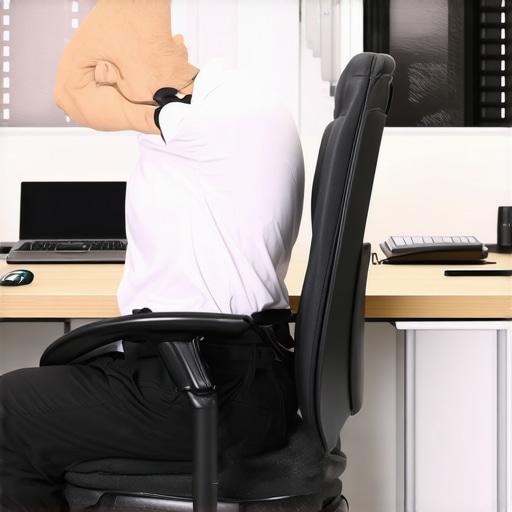
Stop Letting Your Shoulders Drift Toward Your Ears
When we get stressed or focused, our upper trapezius muscles tend to hike up. This shortens the distance between your shoulders and your ears, putting the suboccipital nerves under a constant squeeze. You need a physical ‘reset’ button. Using the scapular reset that stops shoulder clicking during bench press is surprisingly effective for office workers too. By pulling your shoulder blades down and back—think of tucking them into your back pockets—you create the slack your neck needs to breathe. If you don’t do this, your upper back will eventually seize, and you’ll find why your mid-back burns when you wash the dishes or perform other simple tasks.
Why Your Hips Are Secretly Pulling on Your Skull
It sounds counterintuitive, but your pelvic position dictates where your head lands. If you are tucked into a posterior pelvic tilt, your entire spine rounds like a C-shape, thrusting your chin forward. You cannot fix your head position if your pelvis is out of alignment. Learning how to sit without compressing your l5-s1 disc is the first step toward a headache-free afternoon. You want to sit on your ‘sit bones’ with a slight anterior tilt. This creates a natural stack that allows the weight of your head to be supported by your vertebrae rather than your soft tissue. For those of us who have spent years in a bad chair, incorporating the 5-minute decompression routine after a 10-hour shift can help reverse the day’s damage. I used to think my car seat was the enemy, but once I understood why your lumbar spine hates your car seat, I applied those same ergonomic principles to my desk, and the results were almost instant. To truly stabilize this, you must apply the pelvic tilt fix to your seated posture to keep the kinetic chain from collapsing under the weight of your own focus.Most people think that when a muscle feels tight, the solution is to pull on it until it gives way. I used to be the king of the ‘doorway stretch,’ trying to wrench my chest open every time my shoulders rounded. But here is the contrarian truth: most of the time, your ‘tight’ muscles are actually overstretched and weak, not short and tight. When you stretch a muscle that is already at its end-range because of poor posture, you are just destabilizing the joint further. This is why your morning stretching routine is making you stiffer by noon. Your body is creating tension as a protective ‘brake’ to keep your joints from sliding out of place. If you keep pulling on that brake, the nervous system will eventually just lock the whole area down in a painful spasm. I see this constantly with people who use foam rollers or lacrosse balls incorrectly; why you should stop rolling your lower back on a tennis ball becomes obvious once you realize you’re just bruising your spinal stabilizers. 
Stop Chasing the ‘Pop’ Like a Junkie
We’ve all done it—twisting our necks or shoving our backs against a chair until we hear that satisfying ‘crack.’ You think you’ve fixed the problem because the pressure disappears for twenty minutes. In reality, you are likely just hyper-mobilizing the joints above or below the actual restriction. This creates a cycle of instability where the ‘stuck’ segment stays stuck, and the healthy segments become loose and noisy. True relief comes from the science behind chiropractic adjustments for back pain relief, which targets the specific restricted level rather than just making noise. A study published in the Journal of Bodywork and Movement Therapies suggests that non-specific ‘self-manipulation’ can lead to ligamentous laxity over time, making it even harder for your muscles to hold your spine in place.
Does more force always equal a better adjustment?
This is the most common question I get from people who are used to ‘aggressive’ therapists. The answer is a hard no. In the world of sports rehab and spinal health, speed (high velocity) is far more important than brute force (high amplitude). A heavy-handed approach often triggers a guarding reflex, where your muscles fight the adjustment. If you discover how chiropractic adjustments can alleviate chronic back pain properly, you’ll find that the best moves are often the most subtle. This is especially true when you learn what to expect during your first thoracic adjustment; it’s about precision, not power. Another trap is the over-reliance on external supports. While they seem helpful, the truth about back braces and muscle atrophy is that they eventually tell your core muscles to retire early, leaving you more vulnerable than when you started. Have you ever fallen into this trap of stretching a pain point only to have it come back twice as hard the next day? Let me know in the comments, because understanding that ‘tightness’ isn’t always the enemy is the first step toward permanent relief.Once you’ve stopped the immediate throbbing, the real work begins. I spent years in a cycle of getting adjusted, feeling great for three days, and then slowly sliding back into a crumpled heap at my desk. The missing link for me wasn’t more visits to the clinic; it was the specific tools and ‘spine hygiene’ I maintained between those sessions. If you want strategic chiropractic solutions for long-term back health, you have to treat your workspace like a high-performance laboratory. I personally switched to a dual-monitor arm setup that I adjust twice a day—once in the morning for peak focus and once in the afternoon to encourage a slightly different gaze angle. This prevents the static muscle loading that leads to ‘creeping’ fatigue. I also rely heavily on a high-density foam lumbar roll, not a fancy built-in chair support, because it allows for micro-adjustments as my energy levels shift.
Build a Workspace That Forces You to Move
Many people think a $1,500 chair is a magic bullet, but even the best chair becomes a cage if you stay in it for six hours straight. I use a mechanical interval timer—the old-school clicking kind—to force a physical reset every 50 minutes. During these breaks, I don’t just stand up; I perform the 5-minute decompression routine after a 10-hour shift to reset my neural tension. This isn’t just about ‘resting’; it’s about actively reversing the compression of your discs. If you’re a gamer or a deep-focus coder, you might find the nerve glide for people who game 6 hours a day to be the single most important tool in your kit for preventing carpal tunnel and neck radiating pain. 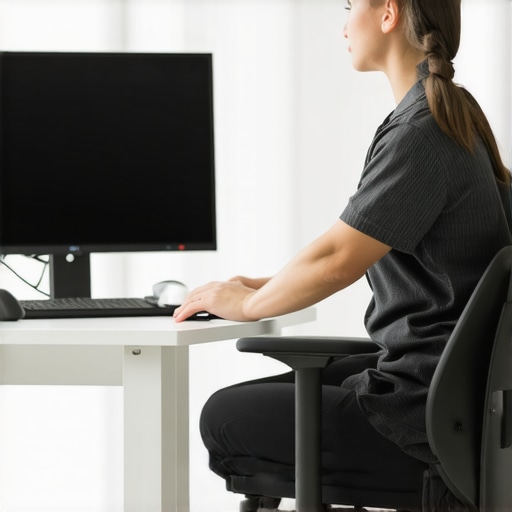
How do I keep my spine in check without seeing a pro every week?
The secret is what Dr. Stuart McGill, a world-renowned expert in spine biomechanics and author of Back Mechanic, calls ‘spine hygiene.’ It’s the small, non-exercise movements—how you brush your teeth, how you pick up a laundry basket, and how you get out of a car. I stopped bending at the waist and started hinging at the hips for every mundane task. When I coupled this with the role of chiropractic care in effective sports injury recovery, my ‘chronic’ issues virtually vanished. You have to realize that essential tips for managing back pain through healthy lifestyle choices aren’t just suggestions; they are the manual for your body’s longevity.
The Future of Your Spine is Probably Digital
Looking ahead, I predict we are going to see a massive shift toward AI-integrated wearable haptics that vibrate when your cervical sensors detect a 15-degree forward tilt. We’re already seeing the beginnings of this with ‘smart’ standing desks that track your weight distribution. This technology will revolutionize your rehab with chiropractic techniques for faster recovery by providing real-time data to your therapist. However, no sensor can replace the foundational strength you build yourself. I want you to try one specific thing today: move your monitor three inches higher than you think it needs to be. It will feel weird for ten minutes, but watch how your headaches dissipate by 4:00 PM. Let’s stop reacting to pain and start engineering it out of our lives.
The Hard Truths About Spine Health I Learned the Hard Way
Looking back, the biggest mistake I made was treating my chiropractor like a mechanic instead of a coach. Here are the lightbulb moments that finally stuck after years of trial and error:
- Consistency beats intensity: A five-minute movement break every hour is worth more than a two-hour gym session once a week. If you aren’t integrating essential tips for managing back pain through healthy lifestyle choices into your daily flow, you’re essentially just treading water.
- Relief is a dynamic process: Your spine thrives on variety, not static perfection. Sitting perfectly straight is just as taxing as slouching if you maintain that position for six hours. Movement is the only real antidote.
- Equipment is only a support: You cannot buy your way out of a movement problem. Real progress comes from unlocking back pain relief through a combination of professional guidance and changing how you interact with your desk.
My Personal Arsenal for Beating the 3 PM Slump
I’m frequently asked what I actually keep at my workstation to stay pain-free. These are the non-negotiables I personally trust:
- Back Mechanic by Dr. Stuart McGill: This book was a game-changer for me. It provides the biomechanical foundation every office worker needs to understand their own injury triggers.
- A High-Density Lumbar Roll: I prefer a portable roll over built-in chair supports because it allows for micro-adjustments as my energy levels shift throughout the day.
- Mechanical Pomodoro Timer: I use a physical clicking timer to remind me to perform strategic chiropractic solutions for long-term back health like chin tucks and scapular resets.
- Preventative Maintenance: I now view my sessions for the science behind chiropractic adjustments for back pain relief as a tune-up for my nervous system rather than an emergency fix for a crisis.
Your New Relationship with Your Spine Starts Tomorrow
The transition from feeling like a crumpled heap to someone who moves with ease doesn’t happen in a single afternoon, but the path is clearer than you think. You don’t have to accept a throbbing skull as the inevitable price of a digital career. By combining ergonomic awareness with expert chiropractic adjustments and a commitment to spine hygiene, you can reclaim your focus and your health. Your body is a high-performance machine that simply needs a more informed operator. Have you ever noticed your headaches vanish after you finally adjust your monitor height, or have you found a specific desk hack that changed everything for you? Let me know in the comments below!