
I still vividly remember the sound—a sharp, sickening crack that echoed through the gym during the final minute of a high school playoff game. I wasn’t even touched by another player. I just came down from a routine rebound and my ankle folded like a piece of wet cardboard. I spent the next six weeks on my couch, icing a balloon-sized foot and watching my teammates play without me. It was devastating. I had the strength and the latest high-tops, but I had absolutely zero stability in my actual feet. If you’ve ever sat on the sidelines because of a fluke sprain and felt that mix of frustration and helplessness, you know exactly what I’m talking about. We are going to change that today by building a foundation that actually keeps you on the hardwood.
Why Your Expensive Sneakers Won’t Save You
Look, I love a fresh pair of kicks as much as the next guy, but even the most advanced basketball shoes can’t fix a foot that’s functionally “asleep.” I made the massive mistake early on of thinking that heavy squats and calf raises were enough to bulletproof my lower body. I was wrong. By ignoring the intricate mechanics of the 26 bones in my feet, I was basically building a mansion on a foundation of sand. Research in the Journal of Athletic Training actually points out that ankle sprains account for nearly 25% of all time-loss injuries in basketball. That is a staggering number. We need to stop just bracing the problem and start training the source. You might think why your arch support might be weakening your ankle stability is only for long-distance runners, but for us hoopers, it’s the difference between a clean crossover and a season-ending injury. If your foot can’t move naturally, your ankle has to take the hit.
Is Spending Time on Foot Drills Actually Worth the Hype?
You’re probably thinking that you only have a few hours of gym time and you’d rather spend them working on your three-point shot. I get it. I used to skip the “boring stuff” too because I thought it was just for people in rehab. But here is the reality: you can’t shoot if you’re in a walking boot. When I finally swallowed my pride and started implementing specific mobility work, I realized that the ankle mobility fix for deep pain-free squats translated directly into my defensive sliding and explosive first step. Have you ever felt that weird “clicky” sensation in your ankles during warm-ups? That’s your body telling you it’s not ready for the impact. We’re going to dive into the exact drills that saved my career and kept me from ever hearing that “pop” again. Understanding why your ankle sprain from high school still affects your gait is the first step toward reclaiming your explosiveness. It’s time to move past the old-school “just wrap it” mentality and realize why icing your sprained ankle might be a huge mistake compared to the drills we’re about to cover.
Fix Your Foot Tripod First
To stop the cycle of sprains, you have to look at your foot as a tripod, not a flat slab. You have three main points of contact: the center of your heel, the base of your big toe, and the base of your pinky toe. Most hoopers fail because they lose contact with one of these points during a lateral cut. I learned this the hard way when I realized I was ‘rolling’ onto the outside of my foot even during simple warm-ups. By consciously pressing into those three points, you create a stable arch that prevents the ankle from caving. This is why learning how to tell if your orthotics are actually doing anything is so important; if your insoles are doing all the work, your ‘tripod’ muscles go on vacation. Check your stance. If your big toe is lifting off the floor when you load your weight, you are a prime candidate for a turnover or a tweak.
Why Your Big Toe Controls the Game
The big toe is the anchor of the entire lower kinetic chain. If it can’t extend properly, your foot collapses, your ankle wobbles, and your knee takes the brunt of the force. I spent months doing heavy squats while my big toes were essentially frozen. It wasn’t until I started using the 30-second big toe stretch for better squat depth that I felt my ankles finally lock into place. This isn’t just about flexibility; it’s about neural drive. If you can’t push off your big toe, you lose your explosive first step. Most players don’t realize why your squat depth is limited by your toes and not your hips, but it all comes back to that first joint. If that joint is stuck, your ankle mobility is capped, and your vertical jump will never hit its peak.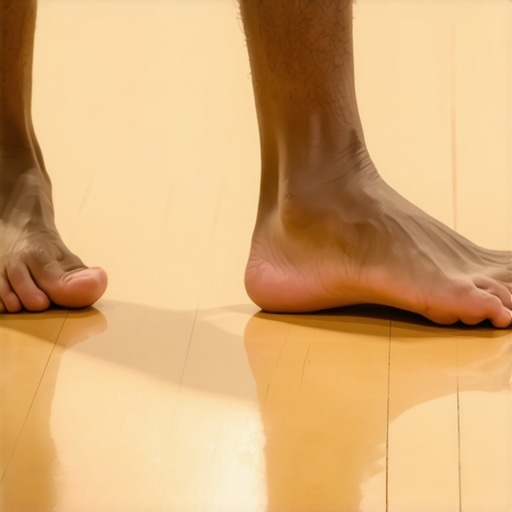
Slow Down the Descent to Speed Up the Game
Training for stability requires moving slower than you want to. I used to rush through my rehab, bouncing through calf raises and thinking I was getting stronger. My physical therapist eventually made me do five-second descents on a single leg. I was shaking like a leaf. That ‘shake’ is your nervous system trying to find its way. Incorporating the eccentric calf fix for chronic achilles tension teaches your muscles to control force as you land, which is exactly when most injuries happen. You need to own the downward phase of every movement. This is a core part of enhancing athletic performance with targeted chiropractic care because it aligns your mechanical structure with your neurological output.
Stop Training on Fluffy Surfaces
Ditch the BOSU balls for a minute. If you want to play on a hardwood court, you need to train on a solid surface. I once spent an entire summer doing balance drills on foam pads, thinking I was a ‘stability king,’ only to roll my ankle the first week of training camp. The foam taught my foot to be reactive to a surface that didn’t exist in a real game. Instead, stand on the flat gym floor and do ‘clock reaches’—balance on one leg and reach your other foot to 12, 3, 6, and 9 o’clock. This forces your ankle to stabilize against a hard, unforgiving surface. If you feel a sharp pinch, you need to address 3 signs your ankle stiffness is the real cause of your knee pain. Using a structured approach to boost your sports rehab journey with proven chiropractic strategies will ensure that your joints are actually moving correctly before you start adding the high-intensity jumps and cuts that basketball demands.
Let’s dig deeper. Most players I work with are obsessed with stretching. If a muscle feels tight, they yank on it for 30 seconds and wonder why the tension returns the moment they step back onto the court. This is the biggest myth in sports rehab: that tightness is a length problem. Usually, it’s a stability problem. Your brain makes a muscle feel tight because it doesn’t trust your joint’s stability. If you force a stretch, you’re just overriding a safety mechanism. This is why stretching your hamstrings won’t fix your chronic tightness—and the same logic applies to your ankles. Research in the Journal of Manipulative and Physiological Therapeutics (2019) suggests that while manual adjustments can restore joint play, the real gains come when you integrate those changes with specific neuromuscular training. If you just stretch the ‘tightness’ away, you’re actually making your ankle more vulnerable to rolling during a crossover.
Stop Stretching for ‘Loose’ Muscles
Here is a contrarian take that most trainers won’t tell you: pre-game static stretching can actually decrease your explosive power and make your joints feel ‘sloppy.’ When we talk about the role of chiropractic care in effective sports injury recovery, we aren’t just talking about clicking bones. We are talking about recalibrating the nervous system. If your ankle joint is slightly restricted, your calf muscle will stay ‘on’ to protect it. Yanking on that calf muscle without addressing the joint restriction is like trying to drive with the parking brake engaged. You might force the car to move, but you’re going to burn something out. Understanding the science behind chiropractic adjustments for back pain relief helps us see that the same neurological principles apply to the foot. We need to clear the joint path first, then load it with stability work.

The Trap of the ‘Quick Fix’ Adjustment
The biggest ‘oops’ factor I see with high-level athletes is treating a chiropractic adjustment like a car wash. You don’t just ‘get adjusted’ and walk away fixed. The adjustment creates a window of opportunity where your brain is more receptive to new movement patterns. If you don’t use that window to perform the drills we discussed earlier, your body will revert to its old, guarded posture within hours. This is what your chiropractor wishes you knew about heavy lifting: the adjustment gets you to the starting line, but the stability work wins the race. I once saw a D1 point guard get a superb ankle adjustment, only to go immediately into a heavy squat session without any foot-tripod activation. He tweaked his back because his brain didn’t know how to handle the new range of motion in his ankle. Don’t be that guy. Use revolutionize your rehab chiropractic techniques for faster recovery by pairing every session with 10 minutes of active stability work.
Does Your Brain Actually Trust Your Ankle to Land?
This is the question that separates the benchwarmers from the starters. You can have the strongest ligaments in the world, but if your proprioception—your brain’s sense of where your foot is in space—is lagging, you will get hurt. Most people think they have ‘bad ankles,’ but they actually have a ‘bad connection.’ By combining essential tips for managing back pain through healthy lifestyle choices with specific athletic foot-loading, you build a body that doesn’t need to ‘guard’ itself. You’ll move faster because your brain finally trusts that you aren’t going to snap something when you plant. Have you ever fallen into this trap of stretching a muscle that was actually trying to protect you? Let me know in the comments. We’re moving into the final phase of this series where we put all these pieces into a 5-minute pre-game routine that actually works.
If you want to move from ‘recovering’ to ‘invincible,’ you need to invest in a Tibialis Bar. I started using one three years ago, and it’s the only tool that truly ended my cycle of shin splints and ankle instability. Most players focus exclusively on the calf, but the tibialis anterior is the brake system for your foot. If you can’t decelerate, you will crash. I pair this with a 20-degree slant board for loaded stretches, which is a massive part of the ankle mobility fix for deep pain-free squats. According to Mike Reinold, a renowned sports physical therapist and former Head Athletic Trainer for the Boston Red Sox, the key to longevity isn’t just range of motion; it’s ‘strength at the end-range’—essentially, can you control the position you’re trying to reach? If your muscles are only strong in the middle of their movement, they will fail you when you’re fully stretched out during a crossover.
How do I keep my ankles bulletproof for the long haul?
Maintenance isn’t a twenty-minute ordeal; it’s a lifestyle of micro-habits. I treat my feet like a high-performance engine. This means a 30-second foot massage for instant lower back relief every night to desensitize the fascia after a long day of training. You also have to be critical of your gear; I constantly look for 3 signs your custom insoles are weakening your feet because if I rely on plastic inserts, my natural arch muscles will atrophy. Long-term success comes from strategic chiropractic solutions for long-term back health that ensure your hips and spine aren’t compensating for your ankles. #IMAGE_PLACE_HOLDER_D#
Your Brain Needs a Map Not Just a Massage
We are heading toward an era where ‘feeling’ your movement won’t be enough. I predict that within the next decade, integrated haptic feedback in our sneakers will provide real-time data on foot strike and arch collapse. Until that tech is standard, you have to be your own biofeedback machine. This involves essential tips for managing back pain through healthy lifestyle choices, such as staying hydrated to keep your connective tissues supple and ensuring you discover how chiropractic adjustments can alleviate chronic back pain by keeping the entire kinetic chain aligned. If your L5-S1 nerve root is even slightly irritated, the signal to your big toe will be ‘fuzzy,’ making all those balance drills half as effective. Real stability is a top-down and bottom-up approach. By unlocking back pain relief expert chiropractic adjustments that work, you clear the path for your brain to actually ‘see’ your feet. Try this today: stand on one leg while you brush your teeth tonight. If you can’t hold it for sixty seconds without your ankle shaking like a leaf, your ‘map’ is blurry and needs work.
3 Brutal Truths About Ankle Stability I Learned the Hard Way
After years of rehab and research, I’ve realized that mobility without stability is a recipe for disaster. If you gain new range of motion through adjustments but don’t strengthen that range, you’re just giving your ankle more room to roll. Secondly, your hips are usually the silent saboteurs. If your glutes are “off,” your foot has to work twice as hard to stabilize your landing; that’s why the glute medius drill for faster lateral cuts is just as important as any balance board. Lastly, pain is a data point, not a stop sign. When you boost your sports rehab journey with proven chiropractic strategies, you aren’t just killing pain; you’re restoring communication between your brain and your joints.
The Gear That Actually Saved My Career
I don’t believe in gadgets for the sake of gadgets, but three things changed the game for me. A heavy-duty Tibialis Bar taught my lower leg how to “brake” during hard cuts. I also swear by a standard lacrosse ball to release the fascia in the arch—because the real reason your feet ache after running is often stuck tissue, not “bad shoes.” Finally, I recommend the book Becoming a Supple Leopard by Dr. Kelly Starrett. It’s the bible for anyone trying to understand movement mechanics. Pairing these tools with strategic chiropractic solutions for long-term back health ensures my entire kinetic chain is firing correctly from the ground up.
Take Your First Step Toward an Injury-Free Season
The journey to indestructible ankles isn’t about one magic stretch; it’s about the daily commitment to the “boring” work. You’ve spent enough time on the sidelines watching everyone else play. It’s time to stop fearing the floor and start trusting your foundation. Whether you’re recovering from a fresh sprain or just trying to gain an edge, investing in your sports rehab today will pay dividends in every crossover and jump shot tomorrow. You have the tools, the science, and the plan—now get to work.
Have you ever struggled with a recurring sprain that just won’t go away even after months of rest? Let me know below.