
The feeling of loose gravel shifting under your heel while your full body weight is mid-descent is a very specific kind of terror. I remember a humid Saturday morning in the Catskills when my right ankle decided to take a vacation just as I stepped over a wet log. I didn’t fall, but that sickening *pop* followed by an immediate heat bloom told me my weekend was over. I spent the next three miles hobbling back to the trailhead, clutching a makeshift walking stick and cursing my ‘weak’ joints. For years, I assumed I was just cursed with bad luck or poor genetics. I bought the tallest, stiffest boots I could find, thinking that locking my joints in a leather cage was the answer. I even started leaning on heavy arch supports that actually made my stability worse over time. It wasn’t until I dove deep into sports rehab and chiropractic neurology that I realized the problem wasn’t my strength—it was my brain. My ankles weren’t weak; they were just ‘offline.’ [IMAGE_PLACEHOLDER]
Your Hiking Boots Are Lying to Your Brain
Most of us treat our hiking boots like a permanent cast. We lace them tight and expect the gear to do the stabilizing for us. But here is the reality: when you over-support the joint, your proprioceptors—the tiny sensors in your ligaments that tell your brain where your foot is in space—go to sleep. This is why that ankle sprain from high school still affects your gait decades later. Your brain stopped trusting the signals from that ankle, so it stopped reacting quickly to uneven ground. Today, I am going to show you a 30-second neurological ‘wake-up call’ that I now do before every single trek. It is the exact move I use to flip the switch and get my nervous system ready for the trail. Have you ever felt like your ankles were ‘giving out’ even on relatively flat ground? Tell me your story in the comments—I’m willing to bet you’ve been relying on your boots more than your body.
Is this just another social media gimmick?
It sounds too good to be true, right? How can 30 seconds of work prevent a multi-day injury? The science is actually quite simple. According to the Journal of Athletic Training, balance-focused neuromuscular training can reduce the risk of recurrent ankle injuries by roughly 35%. That is a massive margin for such a small time investment. When we perform this drill, we aren’t just stretching muscles; we are recalibrating the communication line between your feet and your cerebellum. If you skip this, you’re basically hiking with a laggy internet connection.
The Real Cost of Stiff Ankles on the Trail
When your ankles lack the ability to adapt to the terrain, your body finds that movement elsewhere. Usually, it’s your knees or your lower back that pays the price. I see so many hikers who think they have ‘bad knees,’ but in reality, their ankle stiffness is the actual cause of the knee pain. If the basement of the house is tilted, the roof is going to leak. By waking up the stabilizers in your feet before you hit the dirt, you take the pressure off your larger joints. This is the same principle we use in proven chiropractic strategies for sports rehab. We don’t just look at where it hurts; we look at where the movement stopped working. Before we get into the literal steps of the drill, you need to understand that this isn’t about power—it’s about precision. If you’ve been told to ‘just do more calf raises,’ you’ve been given the wrong map. We need to focus on the small, intrinsic muscles that keep you upright when the ground gets shifty.
Waking Up the Tripod Before You Hit the Trail
To stop the cycle of sprains, you have to reclaim the ‘Tripod Foot.’ Think of your foot as a three-legged stool. The legs are your heel, the base of your big toe, and the base of your pinky toe. When you lose contact with any of these points, the stool tips, and your ankle rolls. Most hikers suffer because they’ve spent years in stiff boots, causing their feet to become rigid blocks rather than adaptable sensors. This transition is a core part of the role of chiropractic care in effective sports injury recovery; we have to re-teach the body how to sense the ground.
Mastering the Three-Point Pivot Drill
This is the 30-second move I mentioned. Stand barefoot or in thin socks. Lift your toes off the ground and spread them as wide as possible. Now, press the base of your big toe, the base of your little toe, and your heel into the floor simultaneously. While maintaining this ‘tripod’ grip, slowly shift your weight forward, backward, and side-to-side without letting any of those three points lift. It feels like you are trying to suction your foot to the floor. I remember a freezing morning at the White Mountains trailhead where I rushed out of the car, skipped this drill, and immediately felt ‘clunky’ on the first half-mile of granite. I actually stopped, took my boots off on a flat rock, and did thirty seconds of these pivots. The difference was night and day—my brain suddenly knew exactly where the rock ended and my foot began. 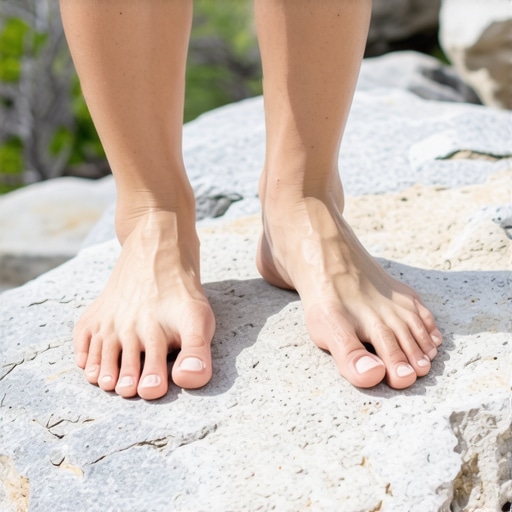
Why Your Big Toe Controls the Whole Show
Your big toe is effectively the steering wheel of your lower body. If it’s stiff or jammed from narrow toe boxes, your ankle loses its primary stabilizer. Performing a 30-second big toe stretch for better squat depth doesn’t just help in the gym; it prevents your arch from collapsing when you step on an uneven root. When that big toe is engaged, it sends a high-speed signal to your glutes to fire and stabilize your hip. It’s a chain reaction that keeps you upright. This is why many athletes find that the best foot drills for basketball players to prevent sprains are almost identical to what a hiker needs on a technical descent.
Ditch the Cast Mentality for Better Balance
If you’ve been relying on heavy inserts, you might actually be doing more harm than good. I’ve seen countless cases where custom insoles are weakening your feet by doing the work your intrinsic muscles should be doing. It’s like wearing a neck brace to fix a weak neck—eventually, the muscles just give up. To fix this, you need to challenge the foot. Once you master the Three-Point Pivot on flat ground, try doing it while standing on a rolled-up towel or a soft foam pad. This mimics the unpredictability of a trail. You aren’t building ‘bulk’ muscle here; you are sharpening the resolution of your nervous system. By the time you lace up your boots, your brain is already ‘online’ and ready to catch you before that micro-slip becomes a season-ending injury.
But even with the right foot drills, I see hikers fall into the same ‘recovery trap’ every season: the obsession with static stretching. We’ve been conditioned to believe that if a joint feels tight or ‘off,’ we should pull on it until it yields. However, this is where most people get sports rehab completely wrong. If you are preparing for a technical climb or a long descent, long-duration static stretching can actually temporarily decrease your muscle’s power output and its ability to react to sudden shifts in terrain. In my experience, focusing on strategic chiropractic solutions for long-term back health and limb stability requires dynamic activation, not passive lengthening.
Stop Chasing the ‘Pop’ and Start Focusing on the Signal
A common myth in the hiking community is that a chiropractic adjustment is just about ‘cracking’ a joint back into place like a puzzle piece. This couldn’t be further from the truth. When we perform an adjustment, we are actually delivering a high-velocity, low-amplitude input to the nervous system. The goal isn’t just mechanical; it’s neurological. We are hitting the ‘reset button’ on the mechanoreceptors around the joint. This is why the science behind chiropractic adjustments for back pain relief is so effective—it clears the ‘noise’ in your nervous system so your brain can actually hear what your body is saying. If you’ve ever felt like your balance was ‘off’ despite having strong legs, your neural communication lines are likely jammed.
Why does my injury feel worse after I rest it for a week?
This is the ‘Oops Factor’ that catches even seasoned trail veterans. We assume rest is a passive process, but true recovery is active. When you stop moving entirely, your brain begins to ‘map out’ the injured area, effectively blurring its representation in the primary motor cortex. A study published in the British Journal of Sports Medicine introduced the ‘PEACE & LOVE’ protocol, which emphasizes that after the initial 48 hours, movement and ‘load’ are actually what signal the body to repair tissue correctly. If you just sit on the couch, you aren’t healing; you’re just getting rusty. This is also why why icing your sprained ankle might be a huge mistake—it can actually shut down the inflammatory signaling required for actual tissue remodeling. #IMAGE_PLACE_HOLDER_C#
The Secret Link Between Your Glutes and Your Toes
If you really want to boost your sports rehab journey with proven chiropractic strategies, you have to look at the ‘sling’ of muscles that connect your foot to your hip. Most hikers treat an ankle issue as an isolated event. But if your glute medius—the muscle on the side of your hip—isn’t firing, your knee will collapse inward, and your ankle will be forced to over-compensate. I’ve seen hikers spend months on calf stretches only to realize that their why your morning stretching routine is making you stiffer by noon was actually because their hips were completely offline. To truly stabilize the ankle, you must stabilize the hip. Have you ever fallen into the ‘rest and ice’ trap only to find your injury lingering for months? Let me know in the comments—I want to hear how you broke the cycle.
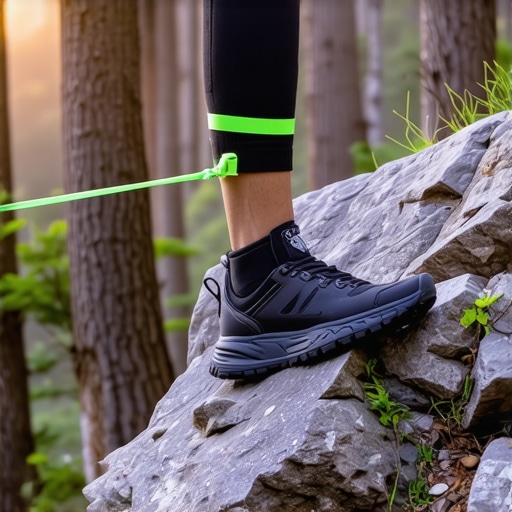
But how do we move beyond just fixing a current injury and actually build a body that can handle 20-mile days on technical terrain without breaking down? It comes down to the gear you choose and the habits you maintain. I’ve stopped carrying bulky foam rollers in my hiking kit. Instead, I carry a single heavy-duty latex mini-band. Why? Because most ‘ankle’ problems are actually ‘lazy hip’ problems. If my glute medius isn’t firing during a steep ascent, my leg rotates inward, and my ankle is forced into a vulnerable, unstable position. By using a band for lateral walks at the trailhead, I am enhancing athletic performance with targeted chiropractic care by ensuring my entire kinetic chain—from the hip to the big toe—is fully online before I take my first step.
The Transition to Barefoot-Style Footwear Needs a Map
A few years ago, I finally traded my heavy, stiff leather boots for zero-drop, wide-toe-box shoes. This was a game-changer, but I didn’t do it overnight. If you make the switch too fast, you will quickly discover the real reason your feet ache after running or hiking: your connective tissues and intrinsic muscles simply aren’t conditioned for the new load. I recommend a strict ‘10% transition rule.’ Start by wearing minimalist shoes for only 10% of your total distance. This slow adaptation allows your nervous system to revolutionize your rehab chiropractic techniques for faster recovery because you aren’t constantly fighting the acute inflammation that comes from over-stressing a dormant arch. When your foot can finally feel the ground, your brain doesn’t have to guess where your center of gravity is.
How do I maintain my trail stability over the long haul?
Consistency is significantly more important than intensity when it comes to neurological maintenance. I spend five minutes every single morning performing the ankle mobility fix for deep pain-free squats, even on days when I am stuck at a desk. This habit keeps the joint capsule hydrated and ensures the proprioceptors are firing. Beyond daily drills, I schedule a biomechanical check-in once a month. High-mileage weeks can cause subtle shifts in pelvic alignment that you might not feel until they manifest as knee or ankle pain. Adhering to these essential tips for managing back pain through healthy lifestyle choices ensures that a minor imbalance doesn’t snowball into a season-ending injury. I also use a small cork massage ball to release the plantar fascia after every long trek, preventing the ‘stiff-foot’ syndrome that often leads to morning heel pain.
The Future of Your Gait Is Digital
I predict that in the next few years, we will see a massive shift toward wearable gait-analysis technology. Imagine pressure-sensitive insoles that provide real-time biofeedback directly to your smartwatch. We won’t have to guess if our arch is collapsing or if our weight distribution is off; the tech will alert us to engage our big toe before a sprain even occurs. This aligns with the groundbreaking research on the ‘Foot Core System’ by Dr. Patrick McKeon, which emphasizes that the intrinsic muscles of the foot are just as critical for spinal stability as your abdominal core. We are moving away from external supports and toward internal neurological mastery. Try this today: Attempt to lift only your big toe while keeping your other four toes pinned to the floor. If you can’t do it, your ‘foot core’ is offline. Practice this for two minutes a day and watch how much more stable you feel on your next rocky descent.
What Most Hikers Get Wrong About Ankle Resilience
After years of hobbling and “resting,” I realized that the hardest lesson wasn’t about strength, it was about trust. Your brain is a protective parent; if it doesn’t trust your ankle, it will lock it down. Here are three things I wish I’d understood sooner:
- Rest is rarely the solution. Total inactivity actually causes your brain to “forget” how to control the joint. You need to revolutionize your rehab with chiropractic techniques that emphasize movement over stasis.
- Stability starts at the hip. If your glutes are sleeping, your ankles are overworking. I used to blame my shoes when I should have been blaming my lazy hips.
- The big toe is your anchor. If you can’t move your big toe independently, your balance is essentially compromised before you even step on a rock.
My Go-To Toolkit for Trail Longevity
I don’t leave for a trailhead without a few specific items that keep my nervous system sharp. First, a heavy-duty latex mini-band is essential for waking up the glutes—I use it for lateral walks in the parking lot. Second, I recommend a cork massage ball. It is firmer than a tennis ball and perfect for a 30-second foot massage for instant lower back relief and foot sensitivity. Finally, I suggest looking into clinical research on the “Foot Core System,” which emphasizes the role of chiropractic care in effective sports injury recovery by focusing on intrinsic muscle activation.
[IMAGE_PLACEHOLDER_E]
Take Your First Step Toward a Fearless Trek
The trail shouldn’t be a place of fear. When you stop treating your feet like problems to be solved with gear and start treating them like sensors to be sharpened, the entire experience changes. By incorporating these neurological wake-up calls and essential tips for managing back pain through healthy lifestyle choices, you aren’t just protecting your ankles—you’re reclaiming your freedom to explore. The road to recovery isn’t paved with stiffer boots; it is paved with better signals. Have you ever felt like your balance completely vanished halfway through a long hike? Let me know in the comments how you handled it!