
I was three hours into a cross-country trek when that familiar, dull throb started radiating from my L5-S1 disc right down into my glutes. You know the feeling—the one where you start shifting your weight every thirty seconds, desperately trying to find a sweet spot that simply doesn’t exist. I used to think my car seat was just poorly designed, a victim of cheap manufacturing. I even went out and bought one of those bulky, orthopedic lumbar rolls from a gas station, thinking it would be my savior. Spoiler alert: it wasn’t. In fact, that generic pillow pushed my pelvis into such a weird anterior tilt that I couldn’t walk straight for two days after arriving. My biggest mistake was assuming more padding equaled better support, but I was just masking the problem while making my alignment worse. Have you ever felt like your car seat was actually winning a fight against your spine?
Stop Blaming the Car Seat for Your Aching Back
Most of us treat our car seats like a lounge chair, but the physics of a moving vehicle are brutal on the human frame. When you’re driving, your spine is subjected to constant micro-vibrations and forces from braking and turning. It turns out that why your lumbar spine hates your car seat has more to do with your specific pelvic positioning than the foam quality of the upholstery. I spent years over-extending my back because I thought I needed to sit perfectly upright. Research published in the Journal of Biomechanics notes that prolonged sitting can increase intradiscal pressure by up to 40% compared to standing, and the vibration of a car only compounds this stress. I finally realized that learning how to fix your posture while driving long distances without a pillow was the real key to longevity on the road.
Will a cheaper fix really work as well as those fancy cushions?
It sounds too good to be true, but the most effective solutions are often about biomechanical adjustments rather than expensive gadgets. Today, I am going to show you exactly how to set up your cockpit for a pain-free journey, so you can stop dreading the road and start enjoying the destination. We will look at why essential tips for managing back pain often start with the small habits we ignore behind the wheel. We are going to fix your seat angle, support your natural curves, and ensure your glutes don’t fall asleep before you reach the state line.
Fix the Bucket Seat Dip for Instant Relief
Most modern car seats are designed with a ‘bucket’ shape that causes your hips to sink lower than your knees. This isn’t just uncomfortable; it forces your pelvis into a posterior tilt, flattening the natural curve of your lower back and turning your spine into a C-shape rather than its healthy S-shape. Think of your pelvis like a bowl of water. When you sit in a bucket seat, that bowl tips backward, spilling water out the back. To fix this, you need to adjust your seat pan angle. If your seat allows it, raise the rear of the seat base or lower the front. You want your hips to be slightly higher than your knees. If you can’t adjust the angle, you might need a firm wedge, but knowing how to sit without compressing your l5-s1 disc often starts with just leveling that seat pan as much as the electronic controls allow. I remember a trip to Colorado where I forgot this rule. By the time I hit the mountains, my left leg felt like it belonged to someone else because my sciatic nerve was being pinched by that very ‘bucket’ design. It was a messy realization, but simply leveling the seat changed the entire pressure profile of my spine.
The 100 Degree Rule for Backrest Angle
Many people think sitting at a perfect 90-degree angle is ‘good posture,’ but for a driver, this is a recipe for disaster. At 90 degrees, your hip flexors are fully shortened, which pulls on your lumbar spine. Instead, you want a slight recline—roughly 100 to 110 degrees. This angle allows the seat back to actually take some of the weight of your torso, reducing the load on your spinal discs. When you are too upright, your spinal muscles have to work overtime to keep you balanced against the car’s movement. By reclining slightly, you move the center of gravity back, which is one of the most strategic chiropractic solutions for long-term back health while traveling. It stops your back from ‘fighting’ the seat. 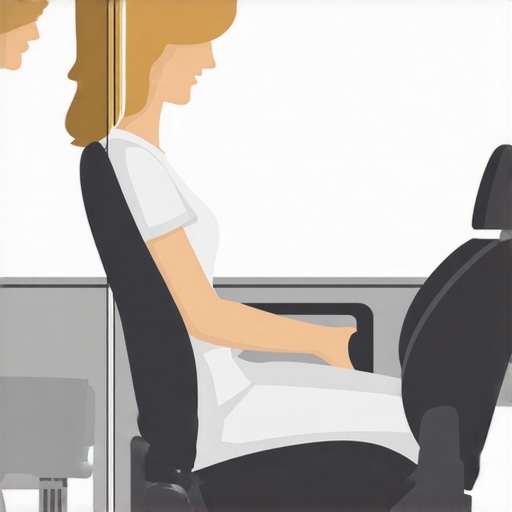
Position Your Steering Wheel to Save Your Shoulders
The distance you sit from the wheel determines the tension in your mid-back and neck. If you have to reach forward, your shoulder blades ‘wing’ out, stretching the muscles between your spine and your scapula until they burn. This is exactly why your mid-back burns during long tasks—you are overextending your reach. To find the sweet spot, rest your wrists on the top of the steering wheel. Your shoulders should remain in contact with the seat back. If your arms are fully straight or your shoulders peel off the seat, you are too far away. This reach adjustment is vital because it prevents the ‘forward head’ posture that leads to tension headaches.
Stop Your Glutes from Falling Asleep
We’ve all experienced ‘dead butt syndrome’ during a long haul. This happens because the pressure of the seat cuts off blood flow and compresses the nerves in your glutes. I once spent six hours in a rental car and realized why your glutes turn off when you sit too long—it’s because we don’t change our foot position. If you use cruise control, don’t just tuck your feet back near the seat. Keep them flat on the floor or the dead pedal to maintain a stable pelvic base. This subtle shift keeps the hip stabilizers active and prevents the deep gluteal muscles from becoming ischemic, which is often the real culprit behind that nagging ‘sciatica’ feeling on the road.
Stop Stretching Your Lower Back into Oblivion
Many well-meaning drivers try to relieve car-seat stiffness by performing aggressive stretches at gas stations, but this often does more harm than good. A common contrarian truth in sports rehab is that ‘tightness’ is not always an invitation to stretch. In many cases, your muscles are tight because they are protecting an unstable joint. For example, why stretching your hamstrings won’t fix your chronic tightness is often because your brain is using those muscles to stabilize a wandering pelvis. If you force them to relax, you remove your back’s only line of defense, leading to a massive flare-up once you get back behind the wheel. We also need to address the ‘oops’ factor of DIY massage. I often see people use tools far too aggressively on their lumbar spine. Understanding why you should stop rolling your lower back on a tennis ball is crucial; you are essentially grinding your sensitive spinal processes against a hard surface, which can lead to inflammation and nerve irritation rather than the relief you crave. The trap of ‘perfect posture’ is another hurdle to clear during your trip. Most people think they need to sit like a statue, but why your back hurts more when you try to sit perfectly straight is due to the static loading of the spinal muscles. Static muscles fatigue quickly and lose their ability to support the discs.
Does your core routine actually stabilize your spine?
We have been told for decades that a ‘strong core’ is the secret to a healthy back, but for an advanced driver or athlete, it is not about the sheer strength of the six-pack—it is about intra-abdominal pressure. Professor Stuart McGill, a world-renowned expert in spine biomechanics from the University of Waterloo, explains that the spine requires ‘stiffness’ to bear loads safely. If you are ‘sucking in’ your gut while driving, you are actually destabilizing your spine. Instead, you need to learn how to create a 360-degree ‘canister’ of pressure. This is why the lung drill that instantly lowers your stress and back tension is so transformative. It teaches you to use your diaphragm as a stabilizer rather than just a breathing muscle. #IMAGE_PLACE_HOLDER_C#
Break the Cycle of Chronic Muscle Tightness
The hidden nuance that most people miss is that your nervous system is the ultimate boss of your muscle tone. If you are constantly feeling like your back needs to ‘pop,’ you might be falling for the cycle of temporary relief. Using boost your sports rehab journey with proven chiropractic strategies involves moving beyond the adjustment and into motor control. When a chiropractor performs a maneuver, they aren’t just ‘clicking’ a joint; they are providing a high-velocity, low-amplitude input to the brain to say, ‘It is safe to let go of this muscle spasm.’ However, if you do not follow up with the right movement, like the real reason your si joint keeps shifting out of place suggests, your brain will simply default back to its old, painful patterns within a few miles. True recovery requires marrying the science behind chiropractic adjustments for back pain relief with active stabilization and proper ergonomics. This integrated approach keeps the ‘check engine’ light from coming back on every time you hit a pothole or sit for a long commute. Have you ever fallen into this trap where stretching more actually made you feel worse? Let me know in the comments.
I’ve realized that the real secret to staying pain-free isn’t just what you do during the drive; it’s how you reset once you step out of the car. If you want to keep your results, you have to treat your spine like a high-performance engine that needs regular tuning. For me, the most indispensable tool in my kit isn’t a fancy electronic massager, but a simple, firm EVA foam wedge. Unlike those soft pillows that compress and lose shape, a firm wedge maintains your pelvic angle throughout the entire journey. This is the car seat hack for people with chronic tailbone pain that actually works because it prevents the ‘sacral sitting’ that grinds your vertebrae together. When I use a wedge, I’m essentially forcing my hip sockets to sit higher than my knees, which naturally preserves the lumbar curve without me having to think about it.
How can I keep my back healthy without a weekly appointment?
Maintenance is about consistency, not intensity. I’ve found that the most effective way to protect your adjustments is through a ‘movement snack’ approach. Dr. Kelly Starrett, a renowned physical therapist and author of Becoming a Supple Leopard, argues that the human body is simply not designed to remain in a static position for hours on end, regardless of how ‘perfect’ your seat is. He recommends a 2-minute mobilization for every 45 minutes of sitting to prevent the tissues from becoming ‘gluey.’ This matches what I’ve seen in my own recovery; using strategic chiropractic solutions for long-term back health means you are actively teaching your body to stay mobile. Once you reach your destination, don’t just collapse onto a sofa. I swear by the 5-minute decompression routine after a 10-hour shift to allow the discs to rehydrate and the spinal muscles to turn off. It’s about signaling to your nervous system that the ‘survival mode’ of driving is over.
Ditch the Guesswork with Real-Time Feedback
Looking ahead, the future of back health is moving toward biofeedback. We are seeing a massive shift toward wearable sensors that provide haptic alerts—a tiny vibration on your skin—whenever your pelvis tilts too far or your head drifts forward. This is going to revolutionize enhancing athletic performance with targeted chiropractic care because it bridges the gap between the clinic and real life. Instead of guessing if your posture is slipping, you’ll have data. Until that tech becomes mainstream, my advice is to use your mirrors as a low-tech feedback loop. Set your rearview mirror while sitting in perfect alignment; if you find you can no longer see clearly through it, you’ve likely slumped, and it’s time to reset. This simple habit is one of the most essential tips for managing back pain because it builds immediate self-awareness. If you’re serious about ending the cycle of road-trip stiffness, I challenge you to try the 100-degree recline rule on your next drive. You’ll be shocked at how much ‘fresher’ your legs feel when you finally step out of the cabin.
The Hardest Lessons I Learned on the Open Road
Looking back at my years of struggling with driving-induced sciatica, I’ve realized that my biggest hurdle wasn’t the seat at all—it was my own misunderstanding of what my body was trying to tell me. Here are a few lightbulb moments that changed everything for me:
- Stiffness is often a bodyguard, not a bug. I used to think my back was ‘tight’ because the muscles were short. In reality, my brain was creating tension to stabilize my spine because I was sitting in a way that left my discs vulnerable. When you discover how chiropractic adjustments can alleviate chronic back pain, you realize that mobility only sticks when your nervous system feels safe.
- Small resets beat big stretches. I stopped waiting for gas stations to do a massive stretching routine. Instead, I started doing pelvic tilts and shoulder rolls every 15 minutes while driving. Constant micro-movement prevents the ‘gluing’ of tissues.
- The mirror is your best coach. I learned to set my rearview mirror only when I was in perfect posture. The second that mirror view looked ‘off,’ I knew I had slumped. It’s the ultimate low-tech biofeedback loop for long-distance durability.
My No-Nonsense Toolkit for Long Hauls
If you were to look in my trunk or on my bookshelf, you’d see the same few items that have kept me out of the ‘pain cave’ for years. First, I never travel without a high-density EVA foam wedge; it’s the only thing that consistently fixes the bucket-seat dip without compressing. Second, I highly recommend the book Becoming a Supple Leopard by Dr. Kelly Starrett. It’s the Bible of human movement and will help you understand the role of chiropractic care in effective sports injury recovery and daily maintenance. Lastly, I always schedule a ‘tune-up’ session after a major trip. Relying on strategic chiropractic solutions for long-term back health ensures that any minor misalignments from those 500-mile days don’t turn into permanent patterns of compensation.
The Road Ahead Looks Better Without the Pain
You don’t have to accept a throbbing lower back as the price of admission for a road trip. By reclaiming your posture and treating your body with the same respect you give your car’s engine, you can arrive at your destination ready to explore rather than ready to collapse. Use these essential tips for managing back pain as your roadmap, and remember that the goal isn’t just to get there—it’s to get there feeling as good as when you left. I’m rooting for you and your spine on your next adventure. What’s the one thing that always starts hurting first on your long hauls? Let me know in the comments below!