
I remember the first time I unboxed my massage gun. I’d just finished a brutal squat session—the kind where you’re already planning how to fall into bed because walking isn’t an option. I cranked that device up to its highest setting and jammed it right into the middle of my thigh. I expected instant relief. Instead, I nearly jumped through the ceiling as my leg spasmed and a nasty bruise started blooming by the next morning. I was treating my body like a piece of tough leather rather than living tissue. It was a classic mistake that actually stalled my progress, much like why your foam roller is useless for it band syndrome if you’re just smashing the wrong spots. If you’ve been using your percussive therapist as a blunt-force weapon, we need to talk. Today, I’m going to show you how to actually flush out soreness without ending up with a collection of multicolored bruises.
Why Your Thighs Hate Your Current Technique
My biggest blunder early on was thinking that pain equaled progress. I would hammer away at my quads until my skin was beet red, thinking I was “breaking up” knots. The reality is far more subtle. When you use a massage gun correctly, you’re not trying to tenderize steak; you’re communicating with your nervous system. I see so many people make the same errors I did, often neglecting how the pelvic tilt fix that instantly boosts your squat depth can actually take the pressure off your quads in the first place. Research published in the Journal of Clinical and Diagnostic Research suggests that percussive therapy can be just as effective as manual massage in preventing DOMS, but only when applied with the right frequency and pressure—not just brute force. If you don’t respect the tissue, the tissue won’t respect you back.
Does a $400 Vibration Machine Actually Do Anything?
I get it. You see these sleek devices all over social media and wonder if it’s just a glorified power tool with a fancy logo. I was a skeptic too, especially when my first few attempts left me feeling more beat up than before. But once I learned that the goal is blood flow and desensitization rather than “smashing” tissue, everything changed. It’s a lot like essential tips for managing back pain through healthy lifestyle choices—it’s the small, consistent, correct actions that yield the biggest results. Have you ever picked up a massage gun, used it for two minutes, and felt like you’d just been in a minor car accident? Tell me I’m not the only one who started out this way! We are about to change that approach so you can finally get the recovery you paid for.
Grab the Round Attachment First
Most people rip the box open and go straight for the pointed ‘bullet’ attachment because it looks like it means business. I did exactly that during a heavy training block for a half-marathon. I had a nagging tightness in my calf and thought I could just ‘drill’ it out. Big mistake. I hit a nerve branch so hard my foot went numb for an hour. If you want to actually improve your the role of chiropractic care in effective sports injury recovery, start with the large foam ball or the flat dampener. These attachments distribute the force over a larger surface area, allowing the vibration to penetrate the muscle without your nervous system going into a defensive spasm. Think of it like using fine-grit sandpaper instead of a wood rasp; you want to smooth the tissue, not gouge it.
Stop Pushing the Device Into Your Bone
The most common error I see—and one I spent months making—is applying too much manual pressure. I used to lean my entire body weight into the gun, thinking more force meant deeper relief. All I got was a collection of bone bruises and a device that kept stalling out. The real secret is to ‘float’ the gun. Turn it on, let it reach full speed, and then gently rest it on the skin. Let the weight of the machine do the work. If the gun starts chattering or bouncing like a jackhammer, you’ve hit a bone or your muscle is too guarded to accept the vibration. This is often where strategic chiropractic solutions for long-term back health come into play, as they address the underlying alignment that causes that guarding in the first place. 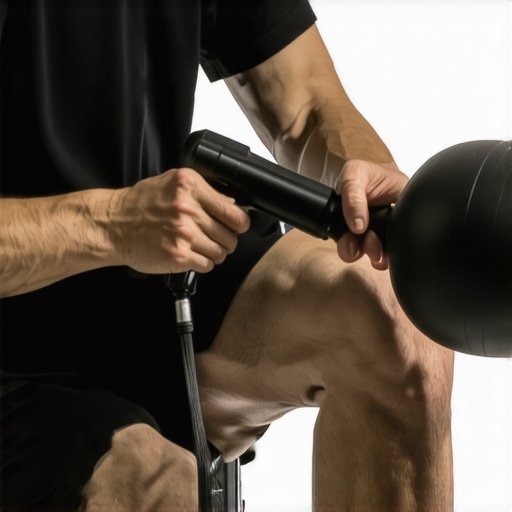
The Pin and Stretch Secret for Rapid Recovery
If you just sit there and vibrate a relaxed muscle, you’re only getting half the benefit. To really unlock the tissue, you need to incorporate movement. I call this the ‘Active Glide.’ Place the gun on a tight spot—let’s say your quadriceps—and then slowly go through a range of motion, like a seated leg extension. This pulls the muscle fibers under the point of percussion. It creates a sliding effect between the muscle layers and the fascia, much like how discover how chiropractic adjustments can alleviate chronic back pain by restoring functional movement to ‘stuck’ segments. I remember the first time I tried this on my hip flexors; the release was so intense I actually felt my stride open up during my run the next morning. It’s significantly more effective than static ‘smashing.’
Mapping Your Muscles Without Hitting the Spine
You have to be surgical with your placement. One area where people consistently fail is the lower back. I can’t stress this enough: why you should stop rolling your lower back on a tennis ball applies to massage guns too. Never, ever run the device directly over your vertebrae or your ribs. You aren’t ‘adjusting’ anything; you’re just vibrating your bones, which can lead to inflammation. Instead, focus on the ‘meaty’ anchors. Spend time on the gluteus medius (the side of your hip) and the erector muscles that run parallel to the spine, but stay at least two inches away from the bone. If you’re dealing with limited mobility that makes reaching these spots difficult, you might need to address the the ankle mobility fix for deep pain free squats first to ensure your overall mechanics aren’t overloading your back. By targeting the soft tissue and avoiding the ‘no-go’ zones, you boost your sports rehab journey with proven chiropractic strategies that actually last beyond the 10 minutes you spend with the machine.I often hear people say that if a spot hurts, you should stay on it until the pain vanishes. That is probably the biggest myth in the recovery world. In my experience, if you sit on a single trigger point for more than two minutes, you aren’t ‘releasing’ it; you’re likely just numbing the local nerves. This creates a false sense of security. You might feel ‘loose’ for twenty minutes, then find yourself wondering why stretching your hamstrings won’t fix your chronic tightness later that evening when the rebound effect kicks in. The ‘Oops’ factor here is over-stimulation. Your nervous system has a threshold, and if you exceed it, the muscle actually tightens up as a protective mechanism. According to a study in the Journal of Sports Science and Medicine, short bursts of high-frequency vibration are far more effective for increasing range of motion than long, sustained ‘grinding’ sessions. If you overdo it, you’re just creating micro-trauma. This is similar to how why your foam roller is useless for it band syndrome if you’re just irritating the bursa rather than the muscle.
Can Too Much Vibration Actually Damage Your Nerves?
Yes, and this is where the expertise comes in. Using these machines on high settings for prolonged periods can lead to temporary nerve desensitization. I’ve seen athletes lose the ‘pop’ in their vertical jump because they over-massaged their calves right before a game, effectively turning off their muscle spindles. If you want to be enhancing athletic performance with targeted chiropractic care, you have to treat the massage gun as a primer, not a replacement for neurological work. One hidden nuance is recognizing that localized pain is often a ‘liar.’ You might be hammering your lower back when the issue is actually the pelvic tilt fix that instantly boosts your squat depth or perhaps the hip mobility drill every golfer needs to stop lower back tweaks. If the gun isn’t working after two days, stop using it and look upstream or downstream. Have you ever fallen into this trap of ‘chasing the pain’ instead of the cause? Let me know in the comments. By shifting your focus from ‘smashing’ to ‘integrating,’ you boost your sports rehab journey with proven chiropractic strategies that stick.Moving beyond the initial excitement of a new gadget requires a transition from ‘fixing a problem’ to ‘maintaining a system.’ I’ve found that the real ‘secret sauce’ isn’t just one device, but how you layer them into a daily ritual. For example, while I swear by my Theragun for large muscle groups like the quads or glutes, I always reach for a high-density lacrosse ball when I need to pin down those stubborn knots under my shoulder blade. If you haven’t integrated this yet, you absolutely must learn how to use a lacrosse ball to melt away mid-back knots because that static, pinpoint pressure offers a level of precision that a vibrating motor simply cannot replicate. I personally keep a ball in my car and one at my desk; it’s about having the right tool within arm’s reach before a minor tightness turns into a full-blown spasm.
Stop Buying Every New Tool and Master the Essentials
I’ve spent thousands on fancy recovery tech over the years, but I’ve realized that 90% of the results come from just three things: a percussive device, a firm ball, and a professional who understands your unique biomechanics. You can vibrate your muscles all day, but if your structural alignment is off, you’re just putting a band-aid on a bullet wound. This is why I schedule regular sessions for unlocking back pain relief expert chiropractic adjustments that work to ensure my foundation is solid. Without that professional check-in, you might be accidentally reinforcing bad habits or masking a deeper issue. It’s the difference between a DIY oil change and having a master mechanic look under the hood.
How can I maintain these mobility gains over time?
The key to long-term success is what I call ‘The 1% Rule.’ You don’t need a grueling hour-long recovery session every night. Instead, spend five minutes focused on your biggest restriction. If you are a desk worker, that might mean hitting your psoas or thoracic spine. Consistency is what allows for revolutionize your rehab chiropractic techniques for faster recovery to actually stick. As noted in the International Journal of Sports Physical Therapy, local vibration therapy is most effective when integrated into a comprehensive strength and conditioning program, rather than as a standalone fix. This means your ‘maintenance’ must include moving through your full range of motion under load. I personally use my massage gun as a ‘neurological primer’—I hit the target area for 30 seconds to wake it up, then immediately go into a mobility drill to ‘own’ that new range. Looking ahead, I predict we are going to see a massive shift toward biofeedback-integrated recovery tools. Imagine a massage gun that syncs with your wearable tech to detect exactly which muscles are overworked and adjusts its frequency automatically. We are moving away from the ‘shotgun approach’ and toward surgical precision in home recovery. For now, the best way to stay ahead is to combine your at-home tools with strategic chiropractic solutions for long-term back health. Don’t wait for the pain to return to start your maintenance routine; that’s like waiting until you’re dehydrated to start drinking water. Your body is a high-performance machine, and it deserves more than just an occasional ‘smashing’ with a foam ball. Focus on essential tips for managing back pain through healthy lifestyle choices, such as sleep and hydration, to support the work you’re doing with your tools. My challenge to you: try the ‘Active Glide’ technique I mentioned earlier for just two minutes before your next workout. You’ll be amazed at how much faster you find your flow.
Hard Truths from My Percussion Addiction
Reflecting on years of training, my biggest ‘lightbulb moment’ was realizing that the massage gun is a communicator, not a carpenter’s tool. I used to think that if I wasn’t wincing, I wasn’t winning, but the reality is that your nervous system needs a gentle nudge rather than a total knockdown. Another major lesson was that percussion cannot fix a fundamentally poor setup in the gym; if you are consistently tightening up, it is worth checking what your chiropractor wishes you knew about heavy lifting to prevent the need for rescue therapy in the first place.
I also learned that timing is everything. Using a high-frequency setting right before bed can actually over-stimulate your system and ruin your sleep quality. Recovery happens most efficiently when you are in a parasympathetic state, so I have shifted to using lower, slower rhythms in the evening to help my body wind down rather than revving it up like a race car.
The Recovery Kit I Actually Pack in My Gym Bag
You do not need a suitcase full of expensive gadgets to stay mobile and pain-free. My daily carry is refined and focused on what actually moves the needle. First, a reliable percussive device for the big movers like quads and glutes. Second, a standard lacrosse ball for the high-precision work around the shoulder blades. Third, I always keep a mental note to stop icing new injuries and try this instead, focusing on movement and active blood flow over simply freezing the tissue into a temporary numb state. Finally, nothing replaces the structural precision you get by unlocking back pain relief expert chiropractic adjustments that work. Your tools are great for maintenance, but a professional eye ensures your foundation is actually level.
Stop Hammering and Start Healing
The journey from ‘smashing’ your muscles to intelligently integrating recovery tools changes your entire relationship with your physical performance. You stop being a victim of your daily soreness and start becoming the active architect of your own longevity. By pairing your at-home routine with enhancing athletic performance with targeted chiropractic care, you create a sustainable feedback loop that keeps you moving fluidly through every squat, sprint, and workday. Your body isn’t an enemy to be conquered with vibration; it is a high-performance partner to be tuned with care. Have you ever felt that ‘rebound’ tightness a few hours after using a massage gun too hard on a single spot? Let me know in the comments below!