
I remember one Tuesday morning vividly. I swung my legs over the edge of the mattress, went to stand up, and froze halfway. It felt like someone had driven a cold chisel into my lumbar spine. The weirdest part? By the time I had finished my second cup of coffee and walked the dog, the pain was gone. I spent months convinced I was just ‘getting old’ or that my gym sessions were too intense. I even doubled down on my morning mobility, which turned out to be one of those morning stretching mistakes that actually made the stiffness worse. Today, I am going to show you exactly why your back is throwing a tantrum at 7:00 AM and how to fix it without buying a five-thousand-dollar smart bed. We are going to tackle the real culprits: nocturnal inflammation, disc hydration, and the subtle ways you are unknowingly sabotaging your spine while you dream.
Your Spine Is Actually Taller and Grumpier in the Morning
It is a strange biological fact that you are actually slightly taller when you first wake up. Overnight, your spinal discs soak up fluid like sponges in a process called imbition. While this is vital for disc health, it also means your spine is under significantly more tension the moment you stand up. Research suggests that the internal pressure in your lumbar discs is significantly higher first thing in the morning compared to when you go to sleep, often increasing by as much as 200 percent as the discs rehydrate. This extra ‘puffiness’ makes your back far more sensitive to bending and twisting. I learned the hard way that jumping straight into a high-intensity workout or aggressive toe-touches was a recipe for disaster. Instead of forcing mobility, I had to learn how to breathe through my belly to create internal stability before I even left the bedroom. Have you ever felt that sharp ‘catch’ in your back the second you tried to reach for your slippers?
Can a better pillow or mattress really solve a chronic ache?
Many of my neighbors ask if they just need to go shopping to solve the problem. While gear matters, it is usually about alignment. I used to sleep on my stomach with one leg hiked up, effectively twisting my lower back into a pretzel for eight hours straight. It was not until I looked for the signs my mattress was failing me and mastered the art of side-sleeping alignment that the morning ‘rust’ finally started to flake off. You do not always need a new bed; sometimes you just need to stop fighting your anatomy while you are unconscious. If you have been struggling with this, you might also want to check out how to sleep without a stiff neck, as spinal health is a top-to-bottom game. Let’s look at the specific mechanics of why this happens and how you can reset your body in under five minutes.The first thing you have to stop doing is treating your body like a light switch that you can just flip on the moment the alarm sounds. Your spine is more like an old steam engine; it needs a gradual warm-up and pressure regulation before it can handle a full load. When you sit up abruptly, you are asking those fluid-filled discs—which are currently at their most pressurized state—to bear your entire body weight while they are biologically vulnerable. I remember one morning I tried a ‘power stretch’ right after waking up, thinking I could just force the stiffness out. It felt like my lower back was made of dry, brittle wood, and I spent the next three days walking like I had a broomstick taped to my spine. That was the day I realized that ‘forcing’ the morning rust away is a direct path to a clinic visit.
Stop Jumping Out of Bed Like a Startled Cat
To avoid that sharp, jarring sensation, you need to manage your internal spinal pressure before gravity takes over. Think of your spine as a pressurized canister in the morning. If you just pop the lid without caution, things go flying. Instead, start with a few gentle movements while you are still horizontal. This allows the fluid in your discs to redistribute without the crushing force of your upper body weight. This is where essential tips for managing back pain through healthy lifestyle choices begin—with the first sixty seconds of your day.
Adopt the Log Roll Method
This is a non-negotiable for anyone with chronic lumbar issues. Instead of crunching forward to sit up—which puts massive pressure on your L5-S1 disc—roll onto your side as one solid unit. Keep your shoulders and hips moving together, avoiding any twisting of the torso. Once on your side, use your arms to push yourself sideways into a seated position while simultaneously swinging your legs off the bed. This ‘log roll’ protects the delicate ligaments that have been resting all night.  If you have trouble keeping your hips from twisting during this move, you might need to look into the pelvic tilt fix for chronic tight hamstrings to ensure your pelvis moves freely.
Fix Your Internal Pressure Before You Stand
Once you are sitting on the edge of the bed, do not just stand up and start walking. Take thirty seconds to reset your diaphragm and engage your deep core. Most people are ‘chest breathers,’ which leaves the lower back unsupported by the abdominal wall. By learning how to breathe through your belly for instant lower back relief, you create a natural weightlifting belt of internal pressure that stabilizes your spine from the inside out. This simple act can be the difference between a productive morning and a day spent searching for a heating pad. If you are still feeling a sharp zing or a radiating sensation, it might be time to learn how to identify if your back pain is muscular or nerve related.
Why a Professional Realignment Fixes What Stretching Can’t
Sometimes, despite your best efforts at home, that ‘stuck’ feeling persists because a joint is literally out of its optimal tracks. This is where the science behind chiropractic adjustments for back pain relief comes into play. While your morning log roll protects you, a targeted adjustment can reset the joint’s mechanoreceptors—the little sensors that tell your brain your back is ‘safe’ to move. I’ve seen patients who did everything right at home but could not get over the hump until they sought out unlocking back pain relief expert chiropractic adjustments that work. It is about clearing the neurological static so your body can actually use the mobility you are working so hard to gain. Think of it like greasing a rusty hinge; once the alignment is restored, your morning routine becomes a lot less of a chore and more of a launchpad.
One of the biggest mistakes I see in my clinic—and one I admittedly made myself for years—is the assumption that ‘tightness’ always requires stretching. We have been conditioned to believe that if a muscle feels stiff, we should pull on it until it gives up. However, in the world of advanced sports rehab, we often find that what feels like a tight muscle is actually a protective neurological guard. Your brain is essentially ‘parking’ your muscles in a state of high tension to act as a secondary splint for a spine it perceives as unstable. When you aggressively stretch these areas, you aren’t releasing tension; you are actually ripping away your body’s only defense mechanism. This is exactly why stretching your hamstrings won’t fix your chronic tightness if the root cause is a lack of spinal stability.
Stop Stretching a Nerve That Just Wants to Rest
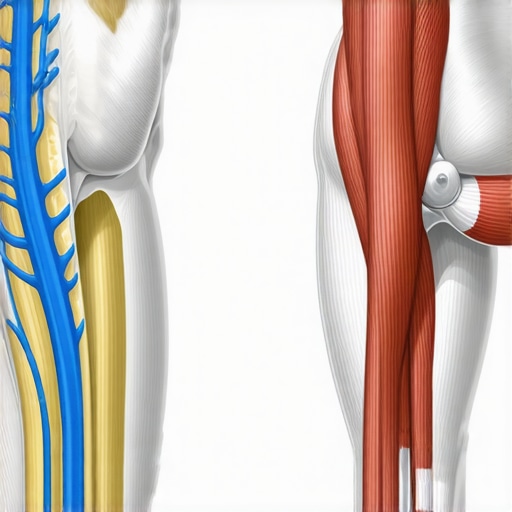
Here is a nuanced truth: many people who think they have ‘tight glutes’ or ‘stiff legs’ are actually dealing with neural tension. If you have a disc that is slightly sensitized, your sciatic nerve can become less tolerant to being stretched. When you do those classic toe-touches or hurdler stretches, you aren’t lengthening a muscle; you are literally tugging on a sensitized nerve like a guitar string. This can lead to the ‘oops’ factor—a massive flare-up that leaves you worse off than before. I call this the ‘Neural Tug-of-War,’ and it is one of the primary stretching mistakes that make sciatica worse. Instead of pulling, we need to create space and mobility through gentle gliding and proper alignment.
Does your back need more raw power or just better neurological timing?
Most advanced athletes assume that a stronger core is the shield against back pain. But here is the contrarian view: many of the people I treat with the most debilitating back issues have incredibly strong abdominal muscles. Their problem isn’t a lack of ‘power’; it is a lack of coordination. If your deep stabilizers (like the multifidus) don’t fire milliseconds before you lift a grocery bag or a 400-pound barbell, your big ‘show’ muscles will overcompensate, leading to that dreaded ‘catch.’ As Dr. Stuart McGill, a world-renowned spine biomechanist, often notes, excessive ‘crunching’ and traditional abdominal work can actually increase spinal shear forces. This is a common trap where why most core exercises actually make lower back pain worse because they emphasize movement over stability.
The Stability Trap That Keeps You Stiff
If you find that you feel great after an adjustment but the pain returns within forty-eight hours, you are likely missing the ‘re-education’ phase of rehab. A chiropractic adjustment is like hitting the reset button on a glitched computer, but if you go right back to the same movement patterns that caused the glitch, the system will crash again. You must combine those manual interventions with proven chiropractic strategies that teach your nervous system how to hold that new position. This is the truth about why your adjustments don’t seem to last—it is rarely a failure of the technique and usually a failure of the follow-through. Have you ever fallen into this trap where you feel stuck in a cycle of temporary relief? Let me know in the comments.
I have been in that loop more times than I care to admit. You leave the clinic feeling like a new person, only to have that familiar ‘twinge’ return the second you sit in traffic or hunch over your laptop for three hours. The reality is that the work done on the table is only half the battle. To truly scale your results, you need strategic chiropractic solutions for long term back health that bridge the gap between your visits. We aren’t just looking for a temporary patch; we are building a resilient system that can handle the stressors of your actual life. This transition from ‘fixing a problem’ to ‘optimizing a machine’ is what I call the Maintenance Phase, and it is where the real magic happens.
Why You Need a Plan Beyond the Adjustment Table
If you only think about your spine when it hurts, you are playing a losing game of catch-up. I always tell my clients that maintenance isn’t about preventing pain—it is about preserving function. According to a landmark study in the Journal of Manipulative and Physiological Therapeutics (JMPT), patients who utilized maintenance spinal manipulative therapy reported significantly fewer days with bothersome back pain over a 12-month period compared to those who only sought care when symptoms flared up. This suggests that regular ‘check-ins’ help the nervous system stay calibrated. To support this, you should focus on how to revolutionize your rehab chiropractic techniques for faster recovery by integrating movement into your daily routine rather than treating it as a chore.
The Two-Dollar Tool That Changes Everything
People often ask me what expensive massage chair or electronic gadget they should buy. My answer is always the same: a lacrosse ball. I use one every single day. It is the most effective tool for targeted self-myofascial release because it doesn’t compress like a tennis ball. I specifically use it to tackle the ‘knots’ that form in the rhomboids and levator scapulae, which often pull the neck out of alignment. Learning how to use a lacrosse ball to melt away mid back knots is a foundational skill for anyone with a desk job. By pin-pointing these trigger points, you are essentially performing a soft-tissue ‘reset’ that allows your skeletal adjustments to hold much longer.

How do I keep my back happy during long drives?
For many of us, the car is where our progress goes to die. The standard bucket seat is a nightmare for lumbar health, often forcing the spine into a ‘C’ curve that puts immense pressure on the discs. I personally use a small, rolled-up towel or a dedicated lumbar roll positioned just above the belt line. You need to know how to optimize your car seat for lumbar support to ensure that a forty-minute commute doesn’t undo a week of rehab. Beyond just the seat, you must understand the best way to support your lumbar spine while driving long distances, which includes regular stops to reset your pelvic tilt and prevent the glutes from ‘falling asleep’ during the journey.
Predicting the Next Era of Movement Health
I believe we are moving toward a future where biofeedback becomes a standard part of our daily attire. We are already seeing the rise of wearable sensors that vibrate when your posture slumps or your pelvic alignment shifts. This real-time data will eventually allow us to how to safely adjust your own posture throughout the day with surgical precision. Instead of guessing if you are standing correctly, your phone will simply tell you. Until that tech is perfected, the best thing you can do is stay consistent with the basics. Try this today: Tonight, spend exactly two minutes with a lacrosse ball on those stubborn knots between your shoulder blades. Your spine will thank you in the morning.
The Hardest Lesson My Lower Back Ever Taught Me
Reflecting on years of rehab and clinical practice, I have realized that the most common mistake isn’t doing the wrong exercise—it is doing the right exercise at the wrong time. For the longest time, I thought I could out-stretch a structural problem. I eventually learned that my back didn’t need more range of motion; it needed the safety of stability. One of my biggest lightbulb moments was realizing that how chiropractic adjustments can alleviate chronic back pain is actually by quieting the nervous system, not just ‘popping’ a bone. If your brain thinks your spine is in danger, it will keep those muscles tight forever. Another lesson? Pain is a lagging indicator. By the time your back ‘goes out,’ the dysfunction has usually been brewing for weeks. This is why I shifted my focus toward strategic chiropractic solutions for long term back health rather than just looking for a quick fix when things hurt.
Tools That Keep Me Moving Without the Constant Aches
I am often asked what I keep in my gym bag or my car to stay ahead of the curve. First and foremost, I never leave for a long trip without a dedicated lumbar support. Understanding why your lumbar spine hates your car seat and how to fix it saved my back during cross-country moves. Second, I highly recommend the book ‘Back Mechanic’ by Dr. Stuart McGill; it is the gold standard for understanding spinal hygiene. Third, I rely on the lung drill that instantly lowers your stress and back tension to reset my nervous system after a high-stress day. Finally, keep that lacrosse ball handy—it is the cheapest, most effective way to manage soft tissue at home.
You Don’t Have to Settle for a Stiff Spine
Morning stiffness shouldn’t be your ‘new normal’ just because you have hit a certain age. Your body has an incredible capacity for recovery if you stop fighting its natural mechanics and start supporting them. Whether it is changing how you sit up in bed or seeking expert chiropractic adjustments that work, every small choice adds up to a much more resilient you. You deserve to wake up feeling ready for the day, not like you are recovering from a wrestling match. Have you found a specific morning habit that actually makes your back feel better, or are you still searching for the right routine? Let me know in the comments below!