
I was three miles into a trail run when my left foot hit a hidden root. That sickening pop wasn’t just a sound; it was the feeling of my weekend plans evaporating. I hobbled back, reached for the athletic tape, and did what we all do: wrapped it round and round until it looked like a mummy’s foot. Within twenty minutes, my toes were purple, but my ankle still felt like a bowl of Jello. It’s a frustrating reality many of us face—we think we’re providing support, but we’re actually just cutting off circulation while leaving the joint vulnerable. Today, I’m going to show you exactly how to lock that joint down so you can actually move without fear.
Stop Wrapping Your Foot Like a Mummy
I’ve been there. You’re in pain, you’re desperate to get back to your life, and you think “more is better.” My early attempts at taping were a disaster because I focused on the swelling rather than the structural instability. If you’re dealing with the immediate aftermath, you should first check out the best way to ice a sprained ankle before you even think about the tape. Taping a “hot,” swollen joint too early can actually trap fluid and increase your pain. I learned this the hard way during a summer hiking trip where I taped so tightly I ended up with a secondary nerve pinch. Trust me, it’s not a fun trade-off. Proper stabilization is about creating “baskets” of support for your ligaments, not just mummifying your skin. This is a crucial part of the role of chiropractic care in effective sports injury recovery because if the bones are out of alignment, the tape is just a band-aid on a broken bridge.
Does some sticky tape actually make a difference?
You might be wondering if a few strips of adhesive can really replace the strength of a torn ligament. It’s a fair question. Skepticism is healthy! But here’s the thing: taping isn’t just about physical bracing; it’s about “proprioception”—telling your brain where your foot is in space. A study in the Journal of Athletic Training found that while tape loses some of its mechanical stiffness after 20 minutes of play, the neurological benefit—the “reminder” to your muscles to stay tight—persists much longer. This is how you boost your sports rehab journey with proven chiropractic strategies. Have you ever felt that terrifying “giving way” sensation when you step on uneven grass? That’s what we are fixing today. By the way, have you ever tried to tape yourself and ended up with a sticky mess that didn’t even stop the wobbling? It’s a common hurdle, but once you master the anchor points, everything changes. Before you head back out, especially if you’re a hiker, you might want to try the 30-second drill to stabilize your ankles before a hike to prime the nervous system. Now, let’s get into the stirrups and heel locks that actually work.
Build a Foundation That Actually Holds
Before we lay down a single inch of tape, your foot needs to be at a strict 90-degree angle. If you tape with your toes pointed down, you’re basically setting yourself up for failure. Think of this like trying to paint a door while it’s half-open—you’re never going to get a clean, functional finish. Keeping that 90-degree flex ensures the ligaments are at their neutral length, which is vital if you want to the best foot drills for basketball players to prevent sprains to actually work.
Lay Your Anchors Without Over-Compressing
Place your first two ‘anchor’ strips about three inches above the ankle bone. These aren’t meant to be tight; they are simply the docking station for the structural tape to come. I learned this the hard way during a rainy regional basketball tournament. I was so rushed I didn’t dry my skin or use pre-wrap, and by halftime, the ‘anchors’ had slid down to my mid-calf, leaving my joint totally exposed and feeling like it was made of wet cardboard. Lay them flat and smooth. If you feel a pinch, you’ve gone too tight. This is a foundational step to revolutionize your rehab chiropractic techniques for faster recovery because if the anchors fail, the whole structure collapses.
Use Stirrups to Mimic Natural Ligaments
This is where we build the actual ‘suspension bridge’ for your ankle. Start on the inside (medial) side of your anchor, run the tape under your heel like a stirrup on a horse’s saddle, and pull it up to the outside (lateral) anchor. You want to pull with tension on the outside—this is what prevents the ankle from rolling inward. Repeat this three times, overlapping by half an inch each time. 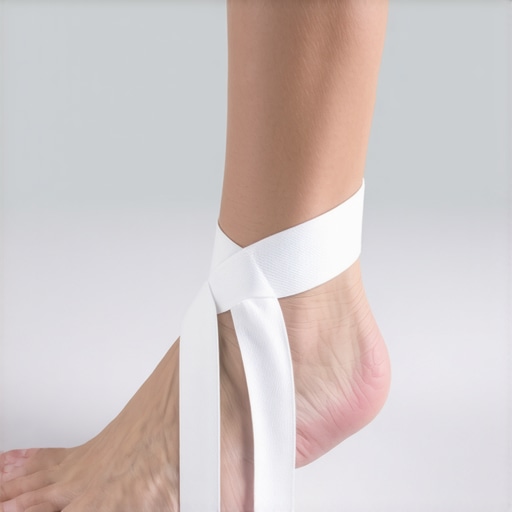 Creating this ‘basket’ of support is exactly how we enhancing athletic performance with targeted chiropractic care. By physically mimicking the job of your lateral ligaments, you give the brain the green light to move with confidence.
Lock Your Heel to Stop the Sudden Giving-Way
The ‘Heel Lock’ is the part everyone skips because it looks complicated, but it’s the secret to total stability. Start at the front of the ankle, wrap around the heel, under the arch, and back up to where you started. Imagine you are drawing a figure-eight that hugs the back of your heel bone. This move prevents the ‘drawer effect’ where the foot slides forward and backward within the joint. If you find your mobility feels restricted afterward, you might need to try the 45-second drill to improve your ankle dorsiflexion to ensure you haven’t traded stability for a complete loss of motion. Each pass of the tape should feel like a firm handshake—supportive but not crushing. When I finally mastered this, I noticed my trail runs felt different; I wasn’t constantly scanning the ground for every tiny pebble because I knew my heel was physically locked into the shoe.But here’s the advanced nuance that separates the pros from the amateurs: the tape isn’t a permanent replacement for your ligaments. Many athletes fall into the trap of ‘mechanical over-reliance,’ thinking if they just pull the tape tighter, they’ll be safer. In reality, over-tightening can actually inhibit the very muscles you need to wake up. This is a common pitfall when trying to boost your sports rehab journey with proven chiropractic strategies. If you rely on the tape as a crutch rather than a trainer, you’re just delaying the inevitable.
Why Your Brain Matters More Than the Tape Tension
Most people believe the tape is physically holding the bones together like a steel brace. In my experience, that’s a dangerous misconception. If the tape were actually providing 100% of the mechanical support, you wouldn’t be able to run—the tension would either snap the tape or tear your skin. Research published in the British Journal of Sports Medicine highlights that external support primarily functions by enhancing proprioceptive feedback to the peroneal muscles. Basically, the tape acts as a sensory ‘alarm’ that tells your brain to fire your muscles faster when the ankle starts to tilt. This is why we focus on enhancing athletic performance with targeted chiropractic care; it’s about the communication between the joint and the brain, not just the sticky stuff on your skin. 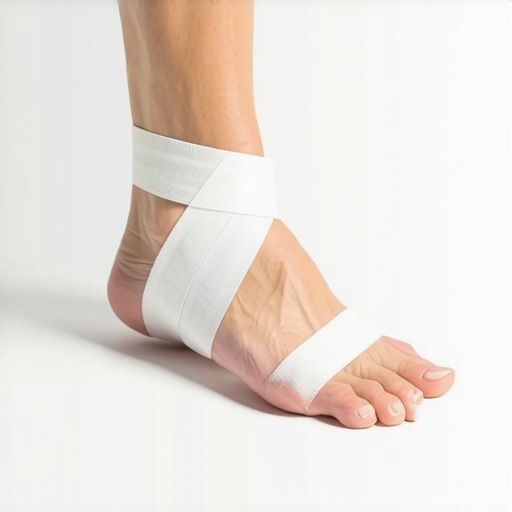
Why Does Your Ankle Still Give Way Despite the Tape?
Have you ever felt a ‘micro-collapse’ even when you’re fully wrapped? This usually happens because athletes neglect the ‘window of inflammation.’ If you wrap an ankle that hasn’t been properly drained of fluid, the tape will loosen the second your swelling goes down during activity. It creates a false sense of security that disappears after the first ten minutes of a game. This is why I often tell people to stop icing new injuries and try this instead to manage blood flow more effectively. If the internal pressure is high, the tape can’t do its job.
Stop Treating Your Ankle Like a Piece of Furniture
The ‘Oops’ factor I see most often is the ‘Cast Effect.’ When you tape your ankle the exact same way for every workout, your body stops trying to stabilize itself. You end up with ‘lazy’ stabilizers. This is often the truth about why your adjustments don’t seem to last—your nervous system has become dependent on external input. To avoid this, you must gradually reduce the tension of your tape as your strength returns. Transitioning from heavy stirrups to lighter ‘reminder’ strips is key to long-term health. Have you ever fallen into the trap of taping for months just because you were afraid to go without it? Let me know in the comments below, and let’s figure out how to get your confidence back.Ditching the ‘lazy stabilizer’ trap means transitioning from passive support to active resilience. I personally swear by a specific kit that goes beyond just a roll of tape. For rigid support, I only use Mueller MTape because its zinc-oxide adhesive handles the high-friction environment of a trail shoe far better than generic store brands. However, when I am in the final stages of rehab, I switch to RockTape for its elasticity, which allows for better proprioceptive feedback without the ‘cast-like’ restriction. This gradual shift is crucial to ensure you do not suffer from the same issues found with external supports, as discussed in the truth about posture braces and muscle atrophy. If you keep the joint too restricted for too long, the muscles simply forget how to work.
Ditch the High-Tech Braces for These Simple Tools
You do not need a thousand-dollar recovery suite to keep your joints healthy. My daily driver is a standard six-ounce lacrosse ball. I use it to break up adhesions in the plantar fascia and the peroneal longus—the muscle on the outside of your calf that acts as the primary stabilizer for your ankle. Using how to use a lacrosse ball to melt away mid-back knots as a guide, you can apply those same myofascial release principles to your lower leg. By keeping the soft tissue supple, the tape you apply actually sits on a more responsive foundation. 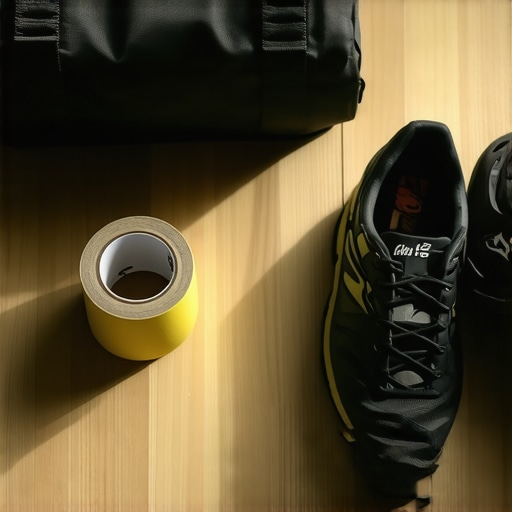
How do I keep my ankles resilient for the long haul?
Maintenance is about consistency, not intensity. The goal is to move from ‘fixing a problem’ to ‘building a system.’ This involves strategic chiropractic solutions for long-term back health because the kinetic chain starts at the ground. If your ankle is stiff, your knee overcompensates, and eventually, your SI joint takes the hit. I recommend integrating the foot exercise that prevents plantar fasciitis in runners into your morning routine even when you are pain-free. According to the technical guidelines from the American Orthopaedic Foot & Ankle Society (AOFAS), progressive loading is the only way to permanently increase ligamentous strength. This is why the science behind chiropractic adjustments for back pain relief is so relevant here; we are clearing the neurological path so your body can actually handle that load.
The Future of Taping Is Getting Smarter
I predict that within the next five years, we will see the mainstream adoption of ‘smart tape’—adhesives embedded with micro-sensors that sync to your watch to tell you exactly when your peroneal muscles are fatiguing. Until then, you have to be your own sensor. My challenge for you this week is to perform your next walk or light jog with 20% less tape tension than usual. See if you can feel your muscles ‘waking up’ to fill the gap. If you feel a wobble, it is a sign that your neuromuscular connection needs more work, not more tape.
Hard Truths I Learned from a Decade of Taped Ankles
After years of trail running and court sports, I’ve realized that the biggest mistake is treating the tape like a permanent fix. Tape is a feedback loop, not a replacement for muscle. One of the biggest lightbulb moments for me was realizing that if I needed to tape every single day for months, I wasn’t actually recovering; I was just masking a functional deficit. This is where the role of chiropractic care in effective sports injury recovery becomes essential, as it addresses the underlying joint mechanics that the tape simply cannot reach. I also learned that the ‘Pre-Wrap’ layer is a double-edged sword; while it saves your leg hair, it significantly reduces the mechanical grip of the tape on your skin, often leading to slippage during intense lateral movements. For high-stakes activity, I now choose skin adherent over pre-wrap every time. Finally, never forget the ‘Upstream Domino’ effect. A stiff, heavily taped ankle often forces the knee or hip to work harder to compensate for the lost range of motion. Always check your total kinetic chain to ensure you aren’t fixing your foot while inadvertently stressing your lower back.
The Essential Toolkit for Long-Term Resilience
You do not need an entire warehouse of supplies to see professional results, but the quality of your gear dictates the success of your wrap. For my own boost your sports rehab journey with proven chiropractic strategies, I rely on a few specific, high-value items. First, Zinc Oxide Athletic Tape is non-negotiable for rigid support because it maintains its structural integrity even when you start to sweat. Second, a simple lacrosse ball is the most effective tool I own for maintaining tissue quality in the lower leg; you can use the principles found in how to use a lacrosse ball to melt away mid-back knots and apply those same pressure techniques to your tight calves and arches to keep your foundation supple. Lastly, a foam balance pad is my go-to for retraining proprioception once the tape comes off, bridging the gap between passive support and active strength.
Take Control of Your Path Back to the Field
Recovery is rarely a straight line, and sometimes it feels like you are taking two steps back for every leap forward. However, by mastering these taping techniques, you aren’t just protecting a joint—you are giving your brain the sensory confidence it needs to let your body perform at its peak. Whether you are seeking strategic chiropractic solutions for long-term back health or simply trying to finish a weekend hike without a flare-up, remember that stability starts with intentional movement and the right support system. You now have the knowledge to revolutionize your rehab chiropractic techniques for faster recovery and get back to your sport without the constant fear of another roll. Have you ever struggled with that annoying tape residue or felt like a wrap was actually making your foot feel ‘lazy’ over time? Let me know in the comments below!