
I’ll never forget that crisp October morning when I stood at the top of my basement stairs, staring down at twelve wooden steps like they were Mount Everest. My right knee was throbbing with a dull, nagging heat. Every time I tried to descend, it felt like a sharp needle was being driven right under my kneecap. I actually ended up gripping the handrail and shuffling down backward like a toddler. It was embarrassing, painful, and honestly, a little scary. If you’ve ever felt that “give-way” sensation or a sharp pinch while heading down to the kitchen, you aren’t alone. Today, I’m going to pull back the curtain on why this happens and help you reclaim your mobility without the guesswork.
The Day I Had to Walk Downstairs Backward
I used to tell myself it was just “wear and tear.” I even made the classic plyometric mistake destroying my patellar tendon by trying to power through the pain with more jumping exercises. I thought I could out-train a mechanical issue. But here is the truth: your knee isn’t failing because you’re “old”; it’s struggling because descending a staircase requires your quads and hips to control a massive amount of force while lengthening. According to a study published in the Journal of Orthopaedic & Sports Physical Therapy, the load on the patellofemoral joint during stair descent can be up to 3.5 times your body weight. That’s a lot of pressure for a joint that might be slightly out of alignment. If you’ve noticed why your knee clicks every time you squat, you’re already seeing the warning signs of this tracking issue.
Is this just part of getting older?
Why Downward Steps Are the Ultimate Knee Stress Test
When we walk on flat ground, our muscles work in a relatively balanced way. But the second you step down, your knee has to act like a brake. If your hips are weak or your ankles are stiff, that braking force goes straight into the soft tissue of the knee. I spent months ignoring the hidden link between my ankles and lower back health, not realizing that my stiff calves were forcing my knees to take the brunt of every step. Have you ever felt like your knee might just collapse out from under you while walking down a flight of stairs? I’d love to know if your pain is a sharp pinch or a dull ache. We need to stop believing the truth about no pain no gain in sports rehab and start listening to what these signals are actually telling us about our mechanics.
Free Up Your Ankles to Save Your Knees
If your ankle cannot bend forward properly, your knee is forced to move in ways it was never designed for. Think of your ankle like a door hinge; if the hinge is rusted shut, you have to force the door or kick it down just to get through. I spent weeks aggressively foam rolling my quads, but the pain only vanished when I started using the 45-second drill to improve your ankle dorsiflexion. When you step down, your shin needs to track forward over your toes smoothly. If it hits a “physical wall” because of tight calves or a jammed joint, your knee joint ends up absorbing the entire shock of the descent. 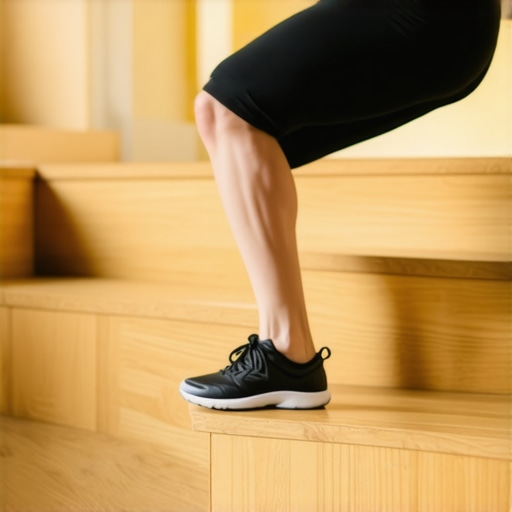
Get Your Glutes in the Game
Most people think knee pain is strictly a knee problem, but in the rehab world, it is often a “lazy hip” problem. If your gluteus medius—the muscle on the side of your hip—is not firing correctly, your leg will rotate inward every time you take a step. This is the hidden reason your knees cave during heavy squats, and it is the exact same mechanical failure that causes that sharp pinch on the stairs. I remember trying to perform a simple single-leg balance test and nearly toppling over sideways. My hip was so unstable it could not even keep my pelvis level. By focusing on proven chiropractic strategies to ensure my pelvis was properly aligned, I finally gave my glutes the neurological “green light” to wake up.
The Proper Way to Train the Descent
To fix the pain, you actually have to practice the specific movement that hurts—but at a significantly lower intensity. I call this “eccentric loading,” and it is the secret to rebuilding resilient tendons. Start by standing on a small 2-inch block or just the bottom step of your stairs. Slowly lower your “good” leg toward the floor while keeping 100% of the weight on your painful leg. The goal is to tap your heel to the floor so softly it’s like you are stepping on an eggshell you do not want to break. If your knee wobbles or dives inward, it is a sign of poor motor control. This is where effective sports injury recovery bridges the gap between just resting and actually rebuilding functional strength.
Check Your Foundation and Your Spine
We often forget that the nerves controlling your leg muscles originate in your lower back. If your lumbar spine is misaligned, the signals sent to your quads and glutes can be “muted,” much like a bad cell phone connection. This is how spinal alignment directly impacts your athletic performance and even your simple daily walk. If you find that your hip flexors are still tight after a year of stretching, it might not be a muscle length issue at all, but rather a protective tension created by your nervous system. Addressing the spine ensures that when you tell your knee to stabilize, it actually has the power to do so without the stabbing pain.The biggest mistake I see in sports rehab isn’t a lack of effort; it’s a fundamental misunderstanding of how the body handles threat. Most people believe that if something hurts, you should rest it and ice it until the cows come home. But the ‘RICE’ protocol is becoming increasingly outdated. A study published in the British Journal of Sports Medicine suggests that active recovery—often called the ‘PEACE & LOVE’ approach—is far superior for soft tissue healing because movement promotes mechanotransduction. This is the process where your cells turn mechanical loads into actual healing signals that rebuild tissue. If you’ve been wondering why icing your lower back might be slowing down recovery, this is exactly why. You aren’t just numbing pain; you’re often shutting down the very metabolic pathways needed to repair the injury site.
Ditch the ice and start moving for better results
Many athletes are obsessed with ‘opening up’ their hips or ‘fixing’ their posture with aggressive stretching. However, your nervous system often creates ‘protective tension’ as a survival mechanism. If your brain perceives that your spine is unstable or misaligned, it will lock down your hamstrings or psoas to act as secondary stabilizers. This is the core of the 3 stretching mistakes that make sciatica worse—you’re trying to stretch out a ‘safety brake’ that the brain has set for your own protection. Pushing through this type of tension doesn’t make you more flexible; it just makes your nervous system more defensive.
Why does that ‘tight’ feeling return ten minutes after you stretch?
It returns because the underlying instability or joint restriction hasn’t been addressed. Without strategic chiropractic solutions for long term back health, your brain will simply re-engage those tight muscles to protect your spinal cord. It is a software problem, not just a hardware problem. Another massive ‘trap’ is the over-reliance on passive treatments alone. I’ve seen patients who get an adjustment, feel like a million bucks, and then go right back to the same desk posture or poor lifting mechanics that caused the issue in the first place. This is the truth about why your adjustments don’t seem to last. 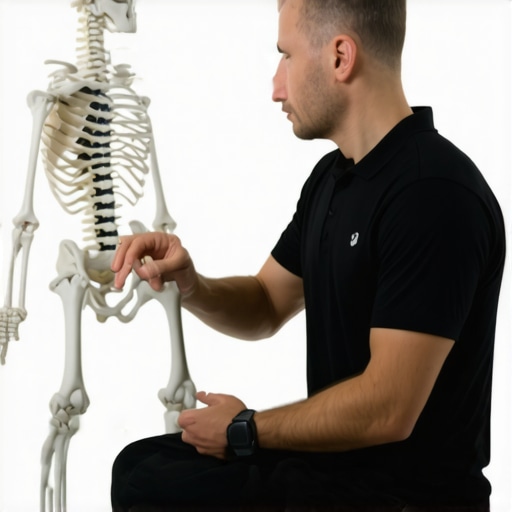 To truly revolutionize your rehab with chiropractic techniques, you have to pair the adjustment with specific neuromuscular re-education. You need to ‘save’ the new range of motion by moving through it immediately after the joint is cleared. Have you ever fallen into this ‘stretch-and-repeat’ trap where you feel better for an hour and then stiffen right back up? Let me know in the comments, because identifying that cycle of protective tension is the first step toward a real, permanent recovery.
The Slant Board Strategy That Changed Everything
I stopped looking for magic pills and started looking for mechanical leverage. One tool I swear by is the slant board. If you’ve struggled with that stair-descent pain, the slant board allows you to isolate the knee joint while maintaining an upright torso, which is a game-changer for patellar tracking. I use it for ‘Poliquin Step-ups’—a move popularized by the late strength coach Charles Poliquin—to build the VMO (vastus medialis oblique) muscle that stabilizes the kneecap. This isn’t just about ‘leg day’; it’s about strategic chiropractic solutions for long term back health and lower limb stability. If your foundation is shaky, your spine is going to pay the price eventually. By strengthening the connective tissue at these deep angles, you’re essentially bulletproofing the joint against the forces of gravity. 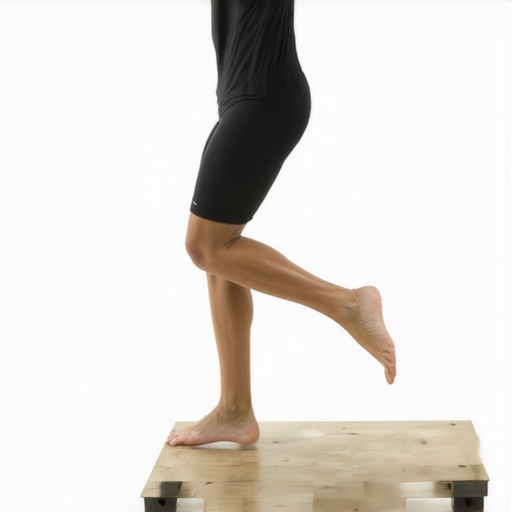
How do I maintain these results for the long haul?
Maintenance isn’t about doing a grueling two-hour workout every day; it’s about micro-habits and environmental changes. For me, that meant finally admitting that your running shoes might be the cause of your shin splints and switching to a wider toe box to let my feet actually function. I also use a simple lacrosse ball to roll out the bottom of my feet every night while brushing my teeth to keep the fascia supple. Every morning, I do a quick check of my pelvic levelness in the mirror. If I feel ‘off’ or notice one hip sitting higher than the other, I don’t just push through it; I look for expert chiropractic adjustments that work to reset my neurological baseline. This proactive approach is the difference between a minor tweak and a three-month setback. I’ve also integrated essential tips for managing back pain through healthy lifestyle choices, like prioritized hydration and anti-inflammatory nutrition to keep spinal discs resilient.
Stop Chasing Symptoms and Start Managing Signals
Looking ahead, I see a massive shift toward bio-feedback and predictive analytics in sports rehab. We are moving away from the ‘wait until it breaks’ model. I’ve personally started experimenting with wearable gait sensors—similar to the technology used in elite gait labs—that beep when my stride becomes asymmetrical. This is an early warning system for the knee pain I used to dread. This is the future of targeted chiropractic care: using real-time data to know exactly when your alignment is slipping before you even feel a pinch. It changes the conversation from ‘I’m hurt’ to ‘I’m out of sync.’ My challenge to you today: don’t just read this and move on. Go find a 2-inch book or a small step and try five slow, controlled heel taps. If you feel that familiar pinch, it’s not a sign to stop—it’s a signal that your mechanics need a tune-up. Take that first step toward alleviating chronic pain by addressing the root cause, not just the ache.
The Hardest Mechanical Lesson I Learned
After years of trial and error, the biggest ‘aha’ moment was realizing that the site of the pain is rarely the actual source of the problem. My knee was often just the messenger for poor hip and ankle mechanics. Second, I learned that consistency beats intensity every single time; doing five minutes of eccentric heel taps daily is infinitely more effective than a grueling two-hour leg session once a week. Finally, I stopped fearing the ‘pinch’ and started treating it as a valuable data point. When you understand the science behind chiropractic adjustments for back pain relief and joint function, you stop feeling like a victim of your biology and start feeling like the architect of your own recovery.
My Personal Resilience Toolkit
If you are serious about rebuilding your movement, I highly recommend investing in a sturdy slant board; it is quite simply the best way to isolate the VMO and protect the patellar tendon. I also rely on high-quality foam rollers to manage tissue quality between professional sessions. For managing the systemic side of health, I follow essential tips for managing back pain through healthy lifestyle choices like keeping my hydration levels high to support joint lubrication. Lastly, I keep a trusted chiropractor on speed dial. Understanding the role of chiropractic care in effective sports injury recovery has saved me months of unnecessary downtime by catching alignment issues before they turned into full-blown injuries.
It Is Time to Reclaim Your Mobility
You do not have to live in a world where you dread the basement stairs or the hike back down to the car. Your body is incredibly resilient and capable of remodeling itself at any age, provided you give it the right environment and neurological signals. Whether you are a high-level athlete or just someone who wants to walk the dog without a limp, the journey to discover how chiropractic adjustments can alleviate chronic back pain and lower extremity issues is one of the best investments you will ever make. Do not wait for the ‘perfect’ time to start; start with one better step today. Have you ever noticed that one knee feels significantly weaker than the other when walking downhill? Let me know in the comments below!