
It always seems to happen around 3:00 AM. I would wake up from a deep sleep, groggy and disoriented, with a strange, cold emptiness in the outer edge of my left hand. I’d shake my wrist, tap my hand against the mattress, and wait for that agonizing, prickly ‘pins and needles’ sensation to rush back into my pinky and ring finger. Early on, I made the classic mistake of thinking this was just a simple circulation issue. I bought softer pillows and tried to force myself to sleep like a statue. But the numbness kept coming back, disrupting my sleep and leaving me with a weak, clumsy grip during my morning workouts. If you are experiencing this, you might also find that adjusting your setup, like adjusting your bicycle handlebars to stop hand numbness during the day, isn’t quite solving the nighttime mystery.
The Midnight Pinch in Your Arm
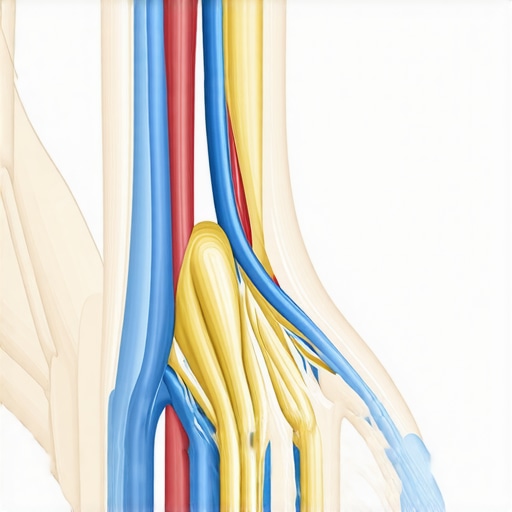
When your pinky finger goes numb at night, it is rarely a problem with blood flow. Instead, it is almost always a nerve issue, specifically involving the ulnar nerve. This nerve travels all the way from your neck, down your arm, and through a narrow tunnel in your elbow called the cubital tunnel before ending in your ring and pinky fingers. When you sleep, you likely bend your elbows deeply or tuck your hands up near your chin. This prolonged bending stretches and compresses the ulnar nerve. According to the American Academy of Orthopaedic Surgeons, keeping your elbow bent for long periods puts significant physical tension on this nerve, which directly triggers that late-night numbness. It is a mechanical issue, much like how why your thumb pain is actually coming from your neck due to nerve compression further up the spine.
Is this actually a sign of permanent nerve damage?
It is incredibly easy to spiral into panic when you wake up and cannot feel part of your hand. You start wondering if you are developing a permanent neurological condition or if you will need invasive surgery just to hold a coffee cup again. Fortunately, for the vast majority of us, this nighttime numbness is temporary and highly treatable. The real danger is ignoring the warning signs for so long that the nerve remains constantly irritated, leading to muscle weakness in your hand. Have you ever woken up in the middle of the night shaking your hand desperately to get the feeling back? Drop a comment below and let me know how often this is happening to you. By understanding how spinal alignment and joint mechanics protect your nervous system—much like how we look at unlocking back pain relief expert chiropractic adjustments that work—we can easily take pressure off that stubborn ulnar nerve and finally get a peaceful night of sleep.
How to Stop Stretching the Nerve While You Sleep
To fix the midnight pinch, you have to stop treating your arm like a folded pocketknife. Think of your ulnar nerve as a garden hose. When you bend your elbow past ninety degrees, you put a kink in that hose, stopping the natural flow of nerve signals. When I first started struggling with this, I tried to resolve it by sheer willpower, telling myself I would sleep with straight arms. Of course, the moment I fell asleep, my subconscious took over, and I woke up face-down with my elbows clamped tightly to my chest and my pinky fingers completely dead. The solution isn’t mental discipline; it is physical boundary-setting.
The Towel Wrap Method
Before you spend money on expensive medical splints, try this simple home hack that saved my sleep. Take a thick bath towel and fold it in half lengthwise. Wrap it snugly around your extended elbow, then secure it with a couple of loose strips of medical tape or even some athletic wrap. The bulk of the towel physically prevents your arm from bending past a gentle, safe angle while you sleep, keeping the ulnar nerve free from tension. It feels incredibly goofy the first night, and you will probably feel like a robot, but waking up with fully functioning fingers is worth the temporary awkwardness.

Ditch the Head-on-Hand Pillow Prop
Another common mistake is sleeping on your side with your hand tucked directly under your pillow or cheek. This position combines extreme elbow flexion with direct wrist compression. If you must sleep on your side, hug a medium-sized body pillow. This keeps your top arm resting at a much wider, neutral angle and prevents you from curling your wrists inward. Protecting your upper body joints during rest is just as critical as learning the best sleeping position for lower back pain relief to keep your spine neutral.
Releasing Tension Above the Elbow
Sometimes, the restriction isn’t just at the elbow joint itself. The ulnar nerve can get snagged by tight muscles in your neck, shoulder, and forearm. If you are active, these tight spots can accumulate quickly, which is why athletes often integrate targeted bodywork to keep their nerves moving freely. For example, knowing how to boost your sports rehab journey with proven chiropractic strategies can make a massive difference in how your upper extremity nerves glide through tight muscular pathways.
Nerve Gliding Exercises for Instant Relief
Nerves do not like to be stretched, but they love to slide. You can perform a simple nerve glide right at your desk. Hold your hand out in front of you, palm up, as if you are holding a tray. Slowly bend your elbow and bring your hand toward your ear, turning your fingers downward toward your shoulder. At the same time, gently tilt your head away from that shoulder. Return to the starting position. Do this slowly for ten repetitions. It should never feel like a deep stretch; rather, it is a gentle flossing motion that coaxes the nerve through the cubital tunnel, releasing minor tissue adhesions without causing further irritation.
When we struggle with that nagging nighttime numbness, we tend to look for direct, mechanical quick fixes. We wrap our elbows, we buy ergonomic pillows, and we try to control our sleeping posture like military drills. But there is a deeper level to this puzzle that most traditional advice completely ignores. We treat our bodies like a collection of isolated pipes and joints, forgetting that the nervous system is a continuous, highly sensitive web stretching from the brain all the way to the fingertips.
The Double Crush Theory Most Doctors Miss
Everyone tells you to look directly at the elbow when your pinky finger goes numb. In my experience, focusing solely on the site of the symptom is a recipe for chronic frustration. If you only cushion your elbow but ignore your neck and shoulder, you are missing the concept of ‘double crush syndrome.’ This medical term describes how a minor compression of a nerve in your neck makes the same nerve significantly more vulnerable to compression further down at your elbow or wrist. A study published in the Journal of Hand Surgery confirms that patients with mild, asymptomatic cervical nerve pressure are far more likely to develop symptomatic cubital tunnel syndrome at the elbow.
Why does my finger still go numb even when I sleep with completely straight arms?
If you have spent weeks sleeping with your arms straight out like a mummy and still wake up with that cold, empty sensation in your pinky, you are likely dealing with proximal entrapment. The ulnar nerve passes beneath the collarbone and through the pectoral muscles before it ever reaches your arm. When you sleep on your side, your shoulders naturally collapse forward, pinching the nerve at the chest level. To fix this, you need to look at your entire kinetic chain. Incorporating broad athletic recovery principles, such as learning how to boost your sports rehab journey with proven chiropractic strategies, helps address these systemic restrictions rather than just babying your elbow joint.
The Static Stretching Trap
The most common ‘oops’ factor I see with people trying to self-treat hand numbness is aggressive static stretching. When you feel stiffness or tingling, the instinct is to pull your fingers back or stretch your neck to the side and hold it. Do not do this. Holding a deep stretch on an already irritated, inflamed nerve actually cuts off its internal blood supply, micro-scarring the nerve tissue over time. If a stretch makes your pinky tingle or throb, you are actively worsening the injury. You should instead focus on gentle mobilization and systemic alignment.
When the Real Issue Sits in Your Spine
Ultimately, your peripheral nerves are only as healthy as the spine they originate from. When your neck alignment is off, the protective spacing between your vertebrae shrinks, putting quiet pressure on the nerve roots. This is why targeted manual therapy is so effective; by restoring proper joint mechanics at the source, you take the baseline tension off the entire nerve pathway. If you want to dive deeper into how joint corrections relieve this deep systemic pressure, explore the science behind chiropractic adjustments for back pain relief to see how physical realignment directly calms irritated nerves. Have you ever fallen into this trap of stretching a nerve until it hurt? Let me know in the comments below.
When you have spent weeks adjusting your sleep positions and still find yourself waking up with that familiar, frustrating pinky numbness, it is time to shift from temporary fixes to long-term physical maintenance. The human body adapts to the repetitive patterns of our daily routines. If your job involves staring at a monitor for eight hours or your training routine lacks proper recovery, your nervous system remains in a heightened, tense state before you even lay your head down on the pillow. Protecting your nerves over the long haul requires integrating real, physical maintenance into your daily schedule.
How do I maintain my nerve and joint health over time?
Consistency beats intensity every single day. To keep your ulnar nerve gliding freely through the cubital tunnel, you must build a routine that addresses the entire kinetic chain. This is why incorporating broad physical recovery methods, such as learning essential tips for managing back pain through healthy lifestyle choices, is so critical. Daily mobility work, proper hydration, and scheduled professional tune-ups keep your joints aligned and prevent the micro-compressions that lead to middle-of-the-night wake-up calls. I personally use a simple, firm lacrosse ball against a wall for two minutes every afternoon to roll out my pectoral and shoulder muscles, preventing that forward shoulder collapse that pinches the nerve path.

The Tech and Tools That Actually Work
Many recovery tools on the market are pure gimmick, but a few specific items have transformed my personal maintenance routine. First, I highly recommend using a firm, dedicated night splint if the towel wrap method proves too bulky. Specifically, look for a splint with a rigid internal stay set at precisely 120 degrees; this keeps the elbow in a relaxed, neutral position without completely immobilizing you like a straight board. Additionally, when looking at your daytime desk setup, a vertical mouse is an absolute game-changer. Standard computer mice force your forearm into constant pronation, which twists the muscles surrounding the ulnar and median nerves. By using a vertical mouse, your forearm remains in a relaxed, neutral ‘handshake’ position, reducing the baseline muscular tension that contributes to nighttime nerve irritation.
The Future of Nerve Recovery and Tracking
Looking ahead, the way we manage nerve health and physical recovery is rapidly evolving. We are moving away from reactive treatments and heading toward predictive biometric tracking. In the near future, wearable technology will likely monitor peripheral nerve conduction and muscle tension in real-time, alerting you via your smartwatch when your ulnar nerve is under sustained tension long before your fingers actually go numb. Furthermore, advanced clinical therapies are increasingly focusing on the relationship between spinal alignment and distal nerve pain. Clinicians are recognizing that local hand and arm issues are best resolved by ensuring the spine is moving perfectly. Incorporating strategies like enhancing athletic performance with targeted chiropractic care is becoming the gold standard for active individuals who want to stay ahead of chronic nerve entrapment.
My challenge to you tonight is simple: do not wait for another 3:00 AM wake-up call to take action. Try the simple towel wrap tonight or commit to doing ten slow, gentle nerve glides before bed. If your symptoms have persisted for months, it is time to stop guessing. Take a proactive step toward systemic alignment and book an evaluation to see how target manual therapies can finally release the pressure at the source.
What Sleeping Like a Mummy Taught Me About Nerve Compression
When I first started trying to fix my own nighttime hand numbness, I made several mistakes that actually delayed my recovery. Here are the most important lessons I learned along the way:
- The elbow is rarely the sole culprit: Just wrapping your elbow won’t fix the problem if you are still collapsing your shoulders or compressing your neck. You must treat the entire nerve pathway from your spine down to your fingertips.
- Aggressive stretching is your enemy: Pulling your fingers back to stretch out a tingly hand actually irritates the nerve sheath. Gentle gliding is always superior to a static hold.
- Ergonomics is a 24-hour job: How you hold your mouse or keyboard during the day directly dictates how easily your ulnar nerve gets compressed when you finally lie down to sleep.
My Essential Recovery Toolkit for Hand and Spine Health
If you want to speed up your recovery and protect your joints, these are the tools and resources I personally rely on to keep my nervous system happy:
- A Rigged Night Splint (120 Degrees): Instead of immobilizing your arm completely straight, a dedicated splint kept at a gentle 120-degree angle prevents tension without making you feel like a robot.
- A Firm Lacrosse Ball: This is my favorite tool for releasing tension in the chest and shoulders. Using it for two minutes daily prevents the forward shoulder collapse that pinches nerves at the collarbone. To learn how to use this tool effectively, check out how to use a lacrosse ball for better thoracic mobility.
- A Vertical Ergonomic Mouse: It places your forearm in a neutral ‘handshake’ position, which drastically reduces the daytime muscular strain that makes your ulnar nerve so vulnerable at night. To see how to optimize your desk layout further, read about the best way to position your mouse to avoid wrist pain.
Your Path to Pain-Free Sleep Starts Tonight
You do not have to live with the anxiety of waking up to lifeless fingers every single night. By making small, consistent adjustments to your sleep posture, mobilizing your nerves gently, and supporting your overall spinal alignment, you can finally reclaim uninterrupted rest. Taking care of your nervous system is a daily practice, but the reward is waking up feeling strong, rested, and ready to take on the day. If you are tired of dealing with nagging physical limitations, consider looking into discover how chiropractic adjustments can alleviate chronic back pain and body-wide nerve tension to get your health back on track.
Have you tried wrapping your elbow or changing your pillows to stop nighttime numbness? Let me know what worked or what failed for you in the comments below!