
I remember sitting at a wedding three years ago, wearing a suit that felt three sizes too small by the time the appetizers were finished. It wasn’t the crab cakes. It was the familiar, painful expansion of my midsection that made me want to curl up in a ball under the table. For months, I’d been living on a diet of steamed kale and hope, convinced my digestive system was just permanently broken. I’d tried every gut-health hack on the internet, but nothing stuck. It wasn’t until a particularly rough week of back stiffness that I finally sought help. I thought I was going in to fix a nagging ache between my shoulder blades, but I didn’t expect my chiropractor to start asking about my digestion. I was skeptical. I spent way too much time treating the symptoms in my stomach while ignoring the signals coming from my spine. I was popping antacids like candy while my nervous system was essentially screaming for a reset. Today, we’re going to look at how realigning your spine can actually calm your digestive tract and finally kick that balloon-belly feeling for good.
Your Spine Might Be Sending Bad Signals to Your Stomach
I’ll be honest: I made the mistake of thinking my body was a collection of separate parts that never talked to each other. I thought my back was for lifting and my stomach was for eating. But the reality is that your spinal cord is the primary highway for every message your brain sends to your organs. When your mid-back—specifically the thoracic spine—is out of alignment, it can put pressure on the nerves that control your digestive enzymes and the rhythm of your gut. I’ve found that the science behind chiropractic adjustments for back pain relief also explains how we can influence the autonomic nervous system. Have you ever felt like you were doing everything right for your diet but your body still refused to cooperate? Drop a comment below; I’d love to hear your story. It’s worth noting that according to research in the Journal of Chiropractic Medicine, the relationship between the spine and visceral health is real, as spinal manipulation can influence the nerve pathways that govern GI motility.
Is this back-gut link actually worth the hype?
It sounds like a stretch, right? How does a crack in the back fix a gassy stomach? I used to think it was just a placebo effect until I saw the results myself. When your thoracic vertebrae are stuck, your body stays in a state of high alert, often referred to as ‘fight or flight’ mode. In this state, your body shuts down non-essential functions like digestion. By clearing those blockages, you’re basically telling your nervous system it’s safe to relax and process food again. If you’re nervous about the process, knowing what to expect during your first thoracic adjustment can take the edge off. Beyond just getting adjusted, I’ve found that using a simple drill that instantly lowers your stress can help maintain that calm state between visits. This isn’t a magic pill, but it is a fundamental shift in how your body operates from the inside out.
Stop treating your body like a collection of Lego blocks
I used to view my body as a set of isolated systems. If my stomach hurt, I talked to a nutritionist; if my back ached, I saw a trainer. But your body functions more like a complex electrical grid than a pile of bricks. Think of your spine as the main fuse box. If a fuse is tripped in your mid-back, the lights might go out in your digestive tract. When I finally realized that my constant bloating was tied to my stiff thoracic spine, I stopped searching for ‘magic’ probiotics and started looking at [strategic chiropractic solutions for long-term back health](https://motiontherapypro.com/strategic-chiropractic-solutions-for-long-term-back-health). I remember one Tuesday afternoon after a heavy lifting session; I felt a sharp, stabbing sensation in my chest that I was sure was a heart attack or severe acid reflux. It was actually just a rib that had shifted slightly. Learning [how a single rib out of place can mimic heart pain](https://motiontherapypro.com/how-a-single-rib-out-of-place-can-mimic-heart-pain) was a total lightbulb moment for me. If a rib can make you think you’re having a cardiac event, it can certainly mess with your stomach’s ability to process a sandwich. 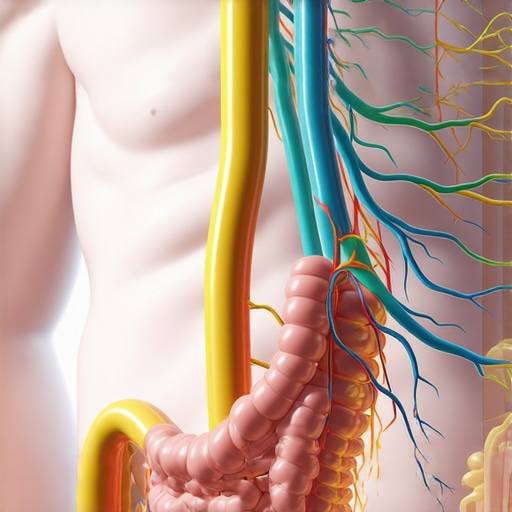
Why your mid-back acts like a kinked garden hose
The nerves exiting your thoracic spine (T5 through T9) are the direct communication lines to your stomach, liver, and gallbladder. If your vertebrae are misaligned—a condition we call subluxation—it’s like stepping on a garden hose. The signal still tries to get through, but it’s weak and erratic. This neural interference can slow down peristalsis, the wave-like muscle contractions that move food through your gut. When food sits too long, it ferments, and that’s where the ‘balloon-belly’ comes from. To get things moving again, you need to [discover how chiropractic adjustments can alleviate chronic back pain](https://motiontherapypro.com/discover-how-chiropractic-adjustments-can-alleviate-chronic-back-pain) and restore that neural flow. I’ve seen clients who struggled with IBS for years find relief not through a new diet, but by releasing the tension in their mid-back.
The 2-minute test for rib cage stiffness
You can check this connection yourself right now. Sit tall and try to rotate your upper body to the left and right without moving your hips. Do you feel a ‘catch’ or a sharp burn? If you do, you’re likely dealing with restricted thoracic mobility that is squeezing your internal organs. To fix this, I started using [the thoracic extension move that saves your shoulders](https://motiontherapypro.com/the-thoracic-extension-move-that-saves-your-shoulders) as a daily reset for my digestive health too. If you’re stuck at a computer all day, you probably feel that mid-back fire. Using [the simple desk stretch to stop mid-back burning](https://motiontherapypro.com/the-simple-desk-stretch-to-stop-mid-back-burning) can prevent the slouching that physically compresses your abdominal cavity.
Master the art of the active reset
Actionable recovery isn’t just about what happens in the clinic; it’s about what you do at home. I started using a mobility tool to break up the ‘fuzz’ or fascia around my spine. Knowing [how to use a lacrosse ball to melt away mid-back knots](https://motiontherapypro.com/how-to-use-a-lacrosse-ball-to-melt-away-mid-back-knots) became my secret weapon against post-lunch fatigue. Furthermore, pay attention to your posture during the mundane moments. If you spend hours commuting, you need to learn [how to sit without compressing your l5-s1 disc](https://motiontherapypro.com/how-to-sit-without-compressing-your-l5-s1-disc), because even lower back compression can create a ripple effect of tension that travels up to the diaphragm, further complicating your breathing and digestion.
Stop stretching your way into more pain
Most people assume that if something feels tight, it needs to be stretched. This is what I call the ‘rubber band’ fallacy. If you have a knot in a rubber band and you pull both ends, the knot only gets tighter. I see athletes and office workers alike trying to force mobility into their hamstrings when the issue is actually neural tension. For instance, understanding how to tell if your sciatica is actually a muscle knot in your glute is a vital distinction because aggressively stretching a sensitized nerve is a recipe for a multi-week flare-up. In my experience, why your morning stretching routine is making you stiffer by noon often comes down to the fact that you’re tugging on joints that are already hyper-mobile. Your brain isn’t tight because it forgot how to relax; it’s tight because it’s trying to protect you from an unstable spine.
The foam roller trap you need to avoid
Let’s talk about a major ‘Oops’ factor that I see daily. While I’m a huge fan of soft tissue work, why you should never roll your lower back on a foam roller is a point I cannot emphasize enough. Your lumbar spine doesn’t have the protective cage of the ribs that your thoracic spine does. When you lay your full body weight on a roller in the small of your back, you’re essentially jamming the vertebrae together and forcing the surrounding muscles into a protective spasm. It might feel like ‘good pain’ in the moment, but you’re actually destabilizing the very area that needs structural support. 
Is your chronic tightness actually a nerve screaming for space?
Advanced recovery isn’t about getting ‘loose’; it’s about creating ‘stiffness’ in the right places to protect the joints. Dr. Stuart McGill, a world-renowned expert in spine biomechanics and author of Back Mechanic, highlights that ‘clinical stability’ is often the missing link in recovery. If you’re constantly feeling the need to crack your own back or you feel like the truth about back braces and muscle atrophy is a topic you’ve researched because you’re desperate for support, your brain might be creating that sensation of tightness as a protective splint. Instead of fighting your body’s natural defense mechanisms, you should focus on essential tips for managing back pain through healthy lifestyle choices that emphasize core stability over mindless flexibility. This shift in perspective—from ‘loosening’ to ‘stabilizing’—is usually the moment my clients finally see permanent progress. Have you ever fallen into this trap? Let me know in the comments.I’ve spent thousands of dollars on gadgets that promised to ‘fix’ my posture, and most of them ended up as expensive paperweights. But after years of trial and error, I’ve narrowed it down to a few non-negotiables that actually move the needle for my recovery. Since I stopped trying to stretch my way out of pain, I shifted my focus to high-leverage tools that reinforce stability. For one, I never travel without my lacrosse ball. I’ve found that knowing how to use a lacrosse ball to melt away mid-back knots is the difference between enjoying a weekend trip and spending it in a hotel bed with a heating pad. If you’re a high-performance athlete or just someone who hits the gym hard, you probably already own a massage gun. The mistake I see most often, however, is people pounding their joints directly with it. I learned the proper way to use a massage gun on your quads from a sports therapist who explained that soft tissue work is about down-regulating the nervous system, not tenderizing meat.
How can I keep my spine feeling this good forever?
Maintenance isn’t a destination; it’s a series of micro-decisions you make every single day. I look at essential tips for managing back pain through healthy lifestyle choices as the foundation. You can get the best expert chiropractic adjustments that work every single week, but if you go home and sit like a pretzel for eight hours, you’re essentially undoing all that progress. This is where I think the future of spinal health is headed: real-time biofeedback. We are moving toward wearable sensors that don’t just track your steps but analyze the shear force on your lumbar spine in real-time. Imagine an app that vibrates gently when you start compressing your l5-s1 disc while driving or working at your desk. That’s the level of precision we’re approaching, and it will eventually make ‘chronic’ back pain a thing of the past for those who use it. 
Your movement blueprint matters more than your equipment
Dr. Kelly Starrett, a world-renowned physical therapist and author of Becoming a Supple Leopard, often talks about ‘movement archetypes.’ He posits that humans have a limited number of ways we should move to remain functional. If you deviate from those archetypes, you pay a ‘movement tax’ in the form of pain and inflammation. This is why I’ve shifted my focus toward enhancing athletic performance with targeted chiropractic care. It’s not just about feeling better; it’s about auditing your movement patterns so you stop creating the problem in the first place. This long-term approach is what we call strategic chiropractic solutions for long-term back health.
Try this one-minute reset before your next meal
My challenge to you is simple and requires zero equipment. Before you sit down for your next meal today, perform one thoracic extension move that saves your shoulders. It takes less than a minute and resets that ‘fuse box’ in your mid-back that we discussed earlier. It is the single most effective way to signal to your body that it’s time to relax and digest rather than fight and flight. Give it a try right now and see if your next meal feels a little less like a lead weight in your stomach.
The Hard Truth About My Failed Fight Against Bloating
For years, I thought I was just “sensitive” to every food under the sun. The biggest lightbulb moment for me was realizing that no amount of ginger tea or expensive probiotics could override a pinched nerve in my mid-back. If the “fuse” is blown at the spinal level, the digestive organs simply won’t function at 100%, no matter how “clean” your diet is. I eventually learned that my body’s constant tightness wasn’t a lack of flexibility, but a protective response to an unstable spine. This led me to explore the science behind chiropractic adjustments for back pain relief as a way to regulate my entire system, not just my muscles.
My Personal Recovery Arsenal for a Happy Gut
I don’t leave my health to chance anymore; I use a specific set of tools to keep the communication lines open between my brain and my belly. I’ve found that knowing how to use a lacrosse ball to melt away mid-back knots is the most effective way to self-manage tension before it impacts my digestion. I also prioritize essential tips for managing back pain through healthy lifestyle choices, like staying hydrated and avoiding prolonged sitting. #IMAGE_PLACEHOLDER_E# For anyone looking for a permanent shift, I highly recommend looking into strategic chiropractic solutions for long-term back health rather than relying on over-the-counter fixes that only mask the symptoms.
You Aren’t Destined to Feel Like a Balloon
Your journey toward a calm stomach and a pain-free spine starts with listening to the subtle signals your nervous system is sending. It is entirely possible to break the cycle of “balloon-belly” by focusing on the structural health of your thoracic spine. When you align your body, you align your life. Take that first step toward expert chiropractic adjustments that work and see how much lighter you feel—both in your back and your gut. Have you ever noticed your digestion getting worse during a week when your back feels particularly stiff? Let me know your experience in the comments below!