
I remember the day I finally cracked—not my back, but my spirit. I was sitting at my desk, squinting at a spreadsheet for the fourth hour straight, when a sharp, white-hot pull radiated from the base of my skull down to my shoulder blades. I’d spent thousands on ergonomic gadgets, yet here I was, feeling like a human question mark. I used to think the solution was just another thoracic adjustment or a more expensive chair. But then, I noticed something: every time I struggled to read a line of text, I wasn’t just squinting; I was jutting my chin forward like a turtle. That lightbulb moment changed everything. My neck pain wasn’t a desk problem—it was a vision problem.
Stop Blaming Your Desk Chair for Your Aching Neck
Today, we are going to dive into the literal sight-to-spine connection. I’m going to show you how your eyes are secretly hijacking your posture and, more importantly, how to stop the cycle before you end up in a permanent slump. I spent way too long trying to fix my forward head posture without addressing the root cause, and I don’t want you to make that same mistake. When your eyes fatigue, your body compensates by moving closer to the stimulus. This is one of the biggest signs your neck pain is actually coming from your eyes.
Is vision correction actually worth the hype for pain relief?
You might be thinking, ‘I have 20/20 vision, this can’t be me.’ I thought the same thing. But there’s a huge difference between seeing clearly and your eyes working efficiently together. According to the American Optometric Association, computer vision syndrome often leads to compensatory postures that wreak havoc on your musculoskeletal system. I spent months cracking my own neck at my desk only to realize my eyes were pulling my head forward to compensate for slight astigmatism I didn’t even know I had. It’s a vicious cycle where your head feels heavy because your brain is prioritizing sight over spinal health. Have you ever caught yourself leaning inches away from your monitor just to read an email? It’s time to stop the turtle neck for good. Let’s look at how to retrain your focus so you can finally set up your laptop for better neck alignment.
Give your eyes a break before your neck breaks first
To stop the ‘turtle neck’ effect, you have to address the stimulus. Your brain will always prioritize visual clarity over spinal comfort. If you can’t see the text, your brain tells your neck to move your head closer, regardless of how much your discs protest. This is often why your headaches start at the computer. I once worked with a software engineer who came in three times a week for a thoracic adjustment. He felt great for an hour, then the ‘weight’ would return. It wasn’t until I visited his office and saw his dual-monitor setup—one screen was significantly dimmer than the other—that we found the culprit. He was squinting and leaning into the dim screen for eight hours a day. We matched the brightness, raised his monitors, and his chronic ‘knots’ vanished within a week.
The 20-20-20-20 rule for spinal relief
You’ve probably heard of the 20-20-20 rule (every 20 minutes, look 20 feet away for 20 seconds). I add a fourth ’20’ to that: perform 20 reps of a chin tuck or a thoracic extension move that saves your shoulders. This resets the neurological loop. By looking far away, you relax the ciliary muscles in your eyes that are stuck in ‘near-focus’ mode. By adding the physical movement, you remind your deep neck flexors that they have a job to do. When you neglect this, you end up with that burning sensation between your shoulder blades that no amount of rubbing seems to reach.
Place your screen where your eyes actually want to look
Most people set their monitors way too low. When the screen is low, your eye line drops, and your chin follows. This puts an incredible amount of leverage on the upper cervical spine. If you are working from a kitchen table or a coffee shop, you are likely failing the ‘horizon test.’ Sit up straight and look straight ahead. Your eyes should naturally hit the top third of your screen. If you are looking down at the middle or bottom, you are begging for a flare-up. 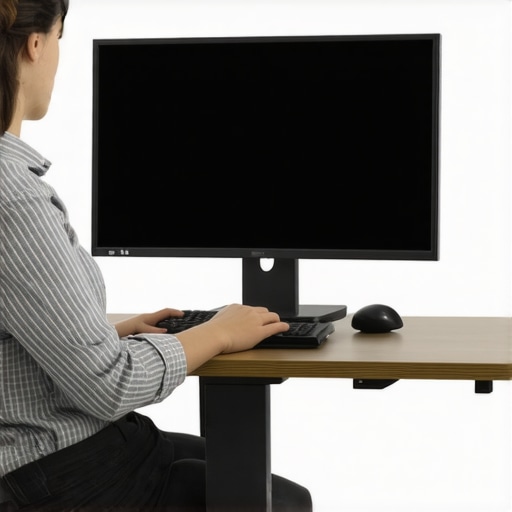 This is why learning how to set up your laptop for better neck alignment is non-negotiable. I use a simple collapsible laptop stand and a separate keyboard. It looks a bit dorky in a Starbucks, but my neck feels twenty years younger than it did when I was ‘hunching’ over a MacBook on my lap.
Retrain your gaze with pencil pushups
If you find your eyes drifting or blurring, your eye muscles might be weak, forcing your neck to compensate for the lack of focus. Try ‘pencil pushups.’ Hold a pencil at arm’s length, focus on the tip, and slowly bring it toward your nose until it doubles, then move it back. This strengthens the muscles that converge your eyes. Strengthening these can be just as effective as the 3 exercises that fix a forward head posture because it removes the need for the head to jut forward in the first place. If your eyes are stable, your head stays back. If your eyes struggle to focus, your head goes hunting for the image, and that is the truth about why you keep cracking your own neck for temporary relief that never actually lasts.
The reason that temporary relief doesn’t last is that most of us are treating symptoms while ignoring the neurological ‘protective tension’ our bodies create. I see this every day: people coming in for the science behind chiropractic adjustments for back pain relief, hoping for a quick fix, but then they go right back to the habits that caused the misalignment. We need to talk about why your body is fighting the adjustment in the first place.
Stop chasing the tight feeling with endless stretching
Here is a contrarian take that usually surprises my patients: you cannot stretch your way out of chronic tightness. In fact, for many of you, your morning stretching routine is actually making you stiffer by noon. When a muscle feels ‘tight,’ it is often because your brain is using that tension to stabilize a joint that it perceives as vulnerable. If you force that muscle to relax through aggressive stretching, your brain panics and sends a signal to tighten up even more. This is exactly why stretching your hamstrings wont fix your chronic tightness if the real issue is an unstable pelvis or a misaligned lumbar spine. Instead of pulling on the muscle, we need to address the stability of the joint it’s trying to protect.
Why do my adjustments seem to disappear after forty-eight hours?
This is the most common question I get from people who are serious about their recovery. If you find the truth about why your adjustments dont seem to last, it usually boils down to ‘proprioceptive memory.’ Your nervous system has ‘learned’ to be in a slumped position. A study published in the Journal of Clinical Medicine (2019) notes that chronic pain involves maladaptive neuroplasticity, where the brain remains in a state of high-alert even after tissue healing. To break this, you have to pair your proven chiropractic strategies with active movement. You aren’t just getting ‘cracked’; you are retraining a communication line between your brain and your spine.
The one foam rolling mistake that ruins your progress
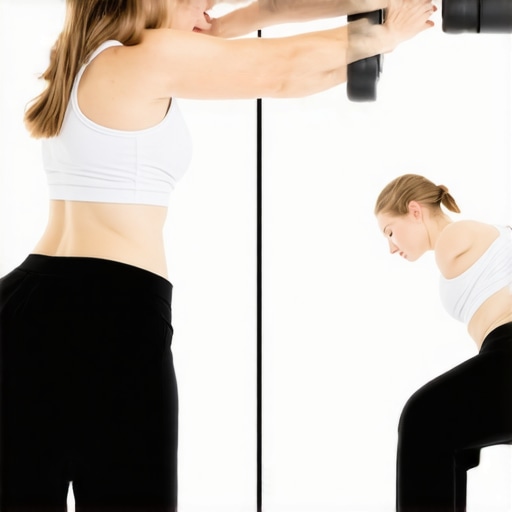
If you take nothing else away from this, please hear this ‘oops’ factor: stop rolling your lower back. I see athletes all the time trying to ‘massage’ their lumbar spine with a hard foam roller. Your lower back is designed for stability, not the extreme mobility of your upper back. When you put a roller directly on those lumbar vertebrae, you are essentially jamming the joints together and irritating the very nerves you’re trying to soothe. You should never roll your lower back on a foam roller because it can lead to increased inflammation and even disc aggravation. Stick to the glutes, the upper back, and the lats instead.
Ultimately, long-term health is about essential tips for managing back pain through healthy lifestyle choices that support your structure. It is the combination of the right visual environment, the right stabilization exercises, and the right professional care. Have you ever fallen into this trap of over-stretching or rolling the wrong spot? Let me know in the comments. Let’s start looking at the body as a connected system rather than a collection of parts that need to be stretched into submission.
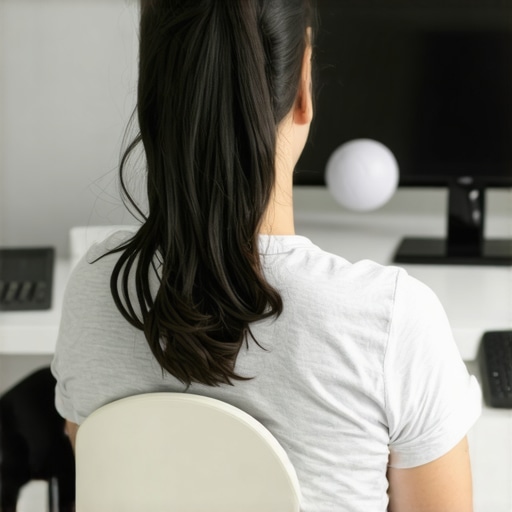
After years of trial and error, I’ve realized that maintenance isn’t about doing more work; it’s about having better data. If you aren’t tracking your movement, you’re just guessing. I personally rely on a high-density lacrosse ball for trigger point release—specifically for the infraspinatus and rhomboids—because it’s denser and more targeted than any foam roller on the market. If you want to know how to use a lacrosse ball to melt away mid-back knots, the secret is all about the cross-friction, not just rolling over the bone like a rolling pin. I use this tool because it allows me to find the ‘eye’ of the muscle knot with surgical precision.
Your wearable device should do more than count steps
I’m a huge advocate for biofeedback sensors. I use a small device that sticks to my upper back and vibrates every time I begin to slump into a ‘turtle’ position. According to a study published in the journal Sensors (2020), immediate haptic feedback significantly improves postural awareness and reduces musculoskeletal strain more effectively than periodic manual reminders. This is exactly how to safely adjust your own posture throughout the day without having to constantly look in a mirror or ask a coworker if you’re slouching. It turns spinal health from a chore into a subconscious habit.
How can I keep my spine healthy for the next decade?
Maintenance is a lifestyle choice, not a checklist you finish once a week. You need strategic chiropractic solutions for long-term back health that account for your specific activity level, whether you’re a marathoner or a software developer. I predict that in the next five years, we will see a massive shift toward ‘active’ footwear with AI-integrated insoles. These will analyze your gait in real-time to prevent issues like ankle stiffness causing knee pain before the first symptoms even appear. This shift from reactive to predictive care is the ultimate way to enhance athletic performance with targeted chiropractic care.
Even the nervous system gets a boost from this consistency. Did you know that keeping your spine aligned actually helps your heart? It sounds wild, but it’s true that regular adjustments can lower your resting heart rate by reducing the overall sympathetic load on your body. When your structure is sound, your ‘fight or flight’ response can finally take a back seat. If you’re serious about your recovery, I want you to try this one advanced tip tonight: set a ‘posture alarm’ for every 45 minutes. When it goes off, perform three slow diaphragmatic breaths and a 10-second chin tuck. It’s a simple recalibration that saves you hours of pain later.
Hard-Won Truths from My Years in the Clinic
I spent years thinking my spine was a mechanical failure, but I finally realized it is a living, breathing communication network that responds to how you see the world. First, remember that your body prioritizes sensory input—like vision—over structural integrity. If your eyes are struggling, your neck will pay the price every single time. Second, a 10-second posture reset you can do at your desk is more valuable than a sixty-minute stretch that simply irritates your nerves further. Finally, do not ignore your breath. If you are chest-breathing throughout the day, you are keeping your neck muscles in a constant state of tension, which sabotages proven chiropractic strategies you may be using elsewhere. Your body isn’t working against you; it is just trying to find the path of least resistance for your eyes.
Tools and Methods That Actually Moved the Needle for Me
To truly sustain your progress, you need a physical toolkit that addresses both the muscle knots and the neurological habits. I personally swear by a high-density lacrosse ball; learning how to use a lacrosse ball to melt away mid-back knots saved me more time and discomfort than any expensive massage chair. I also recommend auditing your workspace to ensure you have strategic chiropractic solutions for long-term back health, including a dedicated laptop stand and an external monitor at eye level. Lastly, mastering how your breathing mechanics are sabotaging your core strength will provide the internal stability that no external gadget can ever replace. These aren’t just accessories; they are the infrastructure of a pain-free life.
Start Reclaiming Your Comfort Today
You aren’t stuck in an endless cycle of ‘turtle necking’ and stiffness; you are simply in a period of recalibration. By shifting your focus from ‘fixing’ symptoms to ‘supporting’ your visual and structural systems, you will find that chiropractic adjustments can alleviate chronic back pain more effectively and permanently than you ever thought possible. Trust the process, listen to your body’s subtle cues, and take that first small step toward a more aligned, energized version of yourself. Your spine and your eyes will thank you for the relief. Which of these vision or posture habits was the biggest ‘aha’ moment for you today? Let me know in the comments below!