
Three years ago, I thought I was being incredibly efficient by working from my kitchen stool. Within two weeks, I felt like a rusty gate hinge. I would finish my shift and feel a literal burning sensation between my shoulder blades that no amount of hot showers could fix. I was living in a studio apartment where a ‘dedicated office’ was just a pipe dream, so I hunched over whatever surface was available. It was a disaster for my spine. I made the classic mistake of thinking that because I was in a small space, I was destined for discomfort. I bought a fancy ergonomic chair but used it at a dining table that was four inches too high, completely nullifying the benefit. I’m here to tell you that you don’t need a corporate corner office to save your discs. I’m going to show you exactly how to pivot from a cramped, painful setup to a streamlined, ergonomic station that actually supports your body. Have you ever found yourself hunched over a coffee table by 3 PM, wondering why your neck feels like it is made of lead?
Stop Sacrificing Your Spine for Your Side-Hustle
Working from home shouldn’t be a physical endurance test. When you are tight on square footage, the temptation is to just ‘make do’ with the couch, but that is the fastest way to trigger a flare-up. According to the Mayo Clinic, prolonged sitting in poor postural positions can lead to significant musculoskeletal strain, particularly in the neck and lower back. I learned the hard way that the couch position is secretly ruining your lumbar spine by forcing it into a constant, rounded C-shape. My first major breakthrough happened when I stopped trying to fit a massive desk into my living room and started focusing on height-adjustable solutions that fit my specific frame. You have to realize that a laptop, by design, is an ergonomic nightmare because it forces you to choose between proper hand height and proper eye level. If you are struggling with a tiny setup, you need to learn how to set up your laptop for better neck alignment immediately by using an external keyboard and a stack of books to raise that screen.
Is a tiny workspace actually worth the effort?
Many people tell me they don’t bother with ergonomics because they ‘only work a few hours’ or their space is too small to change. This is a trap. Even an hour of poor mechanics can set you back. Early in my journey, I neglected the importance of micro-breaks, thinking I could just power through the stiffness. Now, I swear by a 10-second posture reset every hour to keep my joints lubricated. It is not about the size of the desk; it is about the angles of your joints. We are going to dive into the specific equipment hacks that let you turn any closet or corner into a recovery-friendly workspace without spending a fortune.
Fix Your Eyes and Your Spine Will Follow
The first thing I did in my tiny apartment was stop looking down. Think of your head as a 12-pound bowling ball balanced on a golf tee. If that ball tilts forward even an inch, the muscles in your neck and upper back have to work ten times harder to keep it from falling off. This is why you need to how to adjust your monitor to stop mid-back burning by bringing the top third of your screen to eye level. I didn’t have a monitor stand, so I used a stack of heavy coffee table books and a sturdy shoebox. It looked absolutely ridiculous in my living room, but that five-inch lift stopped a three-day migraine in its tracks. When you elevate the screen, you force your cervical spine back into its natural curve, which is the cornerstone of strategic chiropractic solutions for long-term back health.
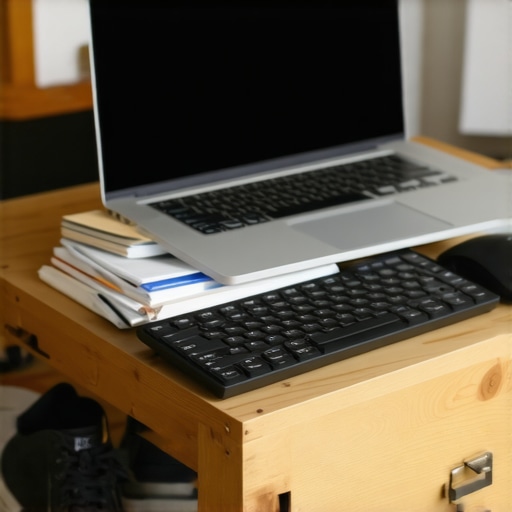
Separate Your Hands from Your Screen
Your laptop is a liar; it tries to convince you that your hands and eyes belong on the same plane. If you are serious about comfort, you must buy a cheap external keyboard and mouse. This allows you to keep your elbows tucked at a 90-degree angle while your screen stays high. I remember a week where I ignored this and typed for eight hours straight on my lap. By Friday, I couldn’t even turn my head to check my blind spot while driving. I learned that how a weak core actually causes chronic neck tension when you’re forced to lean forward to reach keys. By separating the two, you can find the exact height your armrests should be for neck health, which keeps your shoulders from creeping up toward your ears like a turtle retreating into its shell.
Stop the C-Curve in Your Lower Back
In a small space, you’re likely sitting on a chair that wasn’t meant for 40 hours of labor. Most dining chairs force your pelvis to tilt backward, turning your spine into a giant ‘C’. You need to create a ‘neutral’ pelvis. I used a rolled-up yoga mat as a makeshift lumbar roll, tucked right into the small of my back. This simple hack supports the natural arch and prevents the disc compression that leads to sciatica. If you are already feeling that familiar twinge, you should look into the hip hinge secret for people with chronic lumbar issues to help you get in and out of your chair without a flare-up. Using these essential tips for managing back pain through healthy lifestyle choices doesn’t require a thousand-dollar setup, just a commitment to keeping your joints at right angles. I once spent an entire afternoon rearranging my kitchen table height with blocks of wood just to ensure my feet were flat on the floor, because dangling feet are the silent killers of lower back stability.
Learn to Adjust on the Fly
Ergonomics isn’t a ‘set it and forget it’ situation. Your body fatigues, and you’ll start to slump after lunch. You need to know how to safely adjust your own posture throughout the day to counteract the gravity pulling you down. When I felt my shoulders rounding, I would perform a simple scapular squeeze, pulling my shoulder blades down and back as if I were trying to put them into my back pockets. It’s like hitting a reset button for your nervous system, preventing that heavy, leaden feeling in your traps from becoming a permanent fixture of your workday.
Now that you’ve elevated your monitor and fixed your seat height, we need to talk about the nuance that most ‘office health’ gurus miss. You can have a five-thousand-dollar setup, but if your nervous system is stuck in a state of high-alert, you’re still going to hurt. I see so many people obsessing over a 90-degree elbow angle while ignoring the fact that they haven’t taken a deep breath in four hours. This is where we move past basic ergonomics and into the real science behind chiropractic adjustments for back pain relief. It’s not just about bone-on-bone alignment; it’s about signaling your brain that it is safe to relax those overactive stabilizers.
Stop Chasing a Static Perfect Posture
Here is the contrarian truth: there is no such thing as ‘perfect posture.’ In the clinical world, we often say that ‘the best posture is your next posture.’ I used to think I had to sit like a statue for eight hours to be healthy, but the reality is that your body thrives on variability. Research published in the British Journal of Sports Medicine highlights that sedentary behavior is a far more significant risk factor for chronic pain than the specific shape of your spine while sitting. If you try to force a rigid ‘perfect’ position, you end up creating new patterns of compensation. This is often the truth about why your adjustments dont seem to last—you’re treating your body like a piece of furniture rather than a living, moving system. You need to focus on movement quality within your space, not just fixed angles.
Why does your back feel tighter after a long weekend of rest?
This is a common frustration for many of my readers. They spend the week working, then ‘rest’ all weekend, only to wake up on Monday feeling like they’ve been in a car wreck. The trap here is thinking that inactivity equals recovery. I’ve learned that why bed rest is the worst thing for acute back spasms is because controlled movement is what actually flushes out inflammatory markers and keeps the discs hydrated. If you’re dealing with a flare-up, gentle, active movement is your best friend. Have you ever fallen into the ‘rest’ trap? Let me know in the comments if you’ve noticed that the more you sit still, the more everything aches.
Don’t Stretch a Nerve That Needs Space
One of the biggest ‘oops’ factors I see is the urge to aggressively stretch out a ‘tight’ muscle. If you feel a pulling sensation in your glute or down your leg, your instinct is to go for a deep pigeon stretch. But if that tension is actually coming from a compressed nerve, you are just pulling on a sensitive wire. This is why why your morning stretches might be making your back more sensitive; you’re irritating the neural tissue rather than lengthening a muscle. Before you go into a yoga flow, you must learn how to identify if your back pain is muscular or nerve related. Stretching a nerve is like pulling on a thread in a sweater—eventually, the whole thing starts to unravel. Another trap to avoid is the ‘self-adjustment.’ I know it feels good in the moment, but the truth about cracking your own neck at your desk is that you’re usually just moving the joints that are already too loose, while the stuck ones remain jammed. You’re creating joint instability for a five-minute endorphin rush that eventually leads to more chronic tightness.
I used to think that once I raised my monitor and swapped my chair, my work was done. I treated my spine like a fixed renovation project—set it and forget it. But the reality is that your body is a biological machine that requires constant recalibration, especially as your career demands grow. To truly stay out of the ‘pain cycle,’ I started incorporating specific biofeedback tools that moved beyond the physical desk. One of my favorite unconventional tools is a simple interval timer set to 20-minute windows. Why? Because research from Dr. Stuart McGill, a world-leading expert in spine biomechanics, suggests that ’tissue creep’—the gradual stretching of ligaments during static loading—starts much sooner than we think. By using these micro-breaks to perform the 60-second move to open up your tight chest muscles, I stop the cumulative damage before it even begins. This isn’t just about comfort; it is about strategic chiropractic solutions for long-term back health that treat your body as a high-performance asset.
Stop guessing and start measuring with biofeedback
If you want to scale your productivity without scaling your pain, you have to get honest about your internal mechanics. I’ve started using wearable posture sensors—small devices that vibrate when you begin to slump. It sounds annoying, but it is the most effective way to retrain your proprioception. Most of us have lost the ‘feel’ for where our spine is in space. When the sensor goes off, I don’t just sit up straighter; I take it as a cue to check my breathing. I learned that how to use diaphragmatic breathing to calm your nervous system is the secret sauce for maintaining a relaxed posture under pressure. If your breath is shallow and restricted to your upper chest, your neck muscles will stay on high alert no matter how expensive your chair is. Integrating these essential tips for managing back pain through healthy lifestyle choices into your daily tech stack turns your workspace into a recovery zone.
How do I maintain these ergonomic gains as my career scales?
Maintenance is a discipline, not a one-time event. As your workload increases, your ‘maintenance budget’ needs to increase too. For me, this meant shifting from reactive care to a proactive mindset. I don’t wait for a flare-up to visit my chiropractor; I go for regular tune-ups to ensure my joints are moving through their full range of motion. This approach is central to how you can boost your sports rehab journey with proven chiropractic strategies, even if your ‘sport’ is sitting at a computer. I also keep a set of mobility tools—like a lacrosse ball and a specific resistance band—right next to my mouse. When I’m on a long conference call, I’m often working through a trigger point in my mid-back. This kind of ‘active maintenance’ ensures that I’m never stuck in one position for long, which is the foundational science behind chiropractic adjustments for back pain relief and long-term mobility.
The future of your workspace is smarter than you think
Looking ahead, I predict we are moving away from ‘dumb’ furniture toward fully integrated bio-responsive environments. We are already seeing the rise of desks that track your standing-to-sitting ratio and AI-driven cameras that analyze your head tilt in real-time. But until those become mainstream, the best tool you have is your own awareness. If you are serious about your longevity, I challenge you to try one thing this week: download a haptic feedback app for your phone or computer. Use it to remind yourself to reset your shoulders every 30 minutes. You’ll be shocked at how much tension you’ve been carrying without realizing it. Moving from a passive observer of your pain to an active manager of your alignment is how you unlock back pain relief with expert chiropractic adjustments that work over the long haul. Don’t wait for the ‘perfect’ setup; use the tools you have to start the maintenance process today.
What Your Desk Setup Can’t Fix on Its Own
Reflecting on my years spent in a cramped apartment, I realized that equipment only accounts for half the equation. You can have the perfect monitor height, but if your nervous system is stuck in a ‘fight or flight’ state from work stress, your muscles will stay guarded. I’ve learned that breathing is the foundation of stability. If you aren’t careful, you might find how your breathing mechanics are sabotaging your core strength, making even the best chair feel like a torture device. Another hard-earned lesson is that ‘maintenance’ is cheaper than ‘repair.’ Waiting for a crisis to seek help is a recipe for chronic issues. Understanding the science behind chiropractic adjustments for back pain relief helped me see these visits not as an emergency stop, but as a performance tune-up for my daily grind.
#IMAGE_PLACEHOLDER_E#
The Minimalist Kit for a Pain-Free Home Office
I don’t believe in cluttering a small space with gadgets you won’t use. Instead, I rely on a few high-leverage tools that offer the most relief for the least amount of space. First, a firm foam roller is non-negotiable; however, you have to know the correct way to use a foam roller on your IT band to avoid unnecessary bruising. Second, keep a set of light loops nearby to counteract the ‘desk slump.’ Knowing how to choose the right resistance band for shoulder rehab can help you build the endurance needed to sit tall without fatigue. Finally, I always recommend a simple haptic timer to remind you to move every 25 minutes. These small investments, combined with strategic chiropractic solutions for long-term back health, create a resilient body that can handle any workload.
Take the First Step Toward a Pain-Free Career
Your health is your most valuable business asset. It is easy to get caught up in the hustle and ignore the subtle signals your body is sending, but those whispers eventually become screams. By making small, incremental changes today—raising your screen, breathing into your belly, and scheduling regular maintenance—you are ensuring that your career isn’t cut short by preventable pain. Don’t be afraid to contact us if you need a professional eye to evaluate your progress. You have the power to transform your tiny corner into a sanctuary of productivity and health. If you are ready to stop the cycle of stiffness, remember that movement is medicine. Have you ever noticed a specific time of day when your posture starts to completely collapse? Let me know in the comments below!