
I still remember the exact pull-up rep that did it. I was hanging from the bar, determined to squeeze out one more clean lift, when a sharp, searing heat flared right along the inside of my elbow. It felt like a hot needle sinking into the bone. Over the next month, that dull ache became my constant shadow. Brushing my teeth hurt. Picking up my morning coffee mug felt like lifting a heavy dumbbell. I was terrified I would have to give up my favorite back exercise forever, and like many lifters, I just kept trying to work through it, hoping it would magically disappear. Spoiler alert: it didn’t.
The Real Reason Your Pull-Ups Hurt Your Elbows
Many people blame weak tendons or assume they just have bad genetics. But the actual culprit is almost always how your wrists and elbows rotate while you grip the bar. When we use a standard, rigid overhead grip, our forearms are forced into a position of extreme pronation. If you have any restriction in your shoulder mobility, your elbows end up taking the brunt of that twisting force. It is the exact recipe for chronic elbow tendonitis, a nagging overuse injury that can sideline you for months.
Is This Quick Tweak Really Worth the Hype?
You might be wondering if changing how you hold a bar can actually make a difference for a deep, painful joint issue. It sounds too simple to be true. However, shifting the torque away from your medial epicondyle is highly effective. In fact, sports medicine studies published by the National Institutes of Health confirm that altering grip angles significantly reduces shear stress on the elbow joint by redistributing load to the larger muscles of the upper back. When I made this adjustment, the relief was almost instantaneous.
Early in my lifting journey, I made the classic mistake of gripping the bar as hard as possible and flaring my elbows outward to force my chin over the bar. This terrible habit combined with poor wrist alignment is what triggered my injury. If you want to speed up your recovery and get back to training pain-free, integrating targeted sports injury recovery strategies is essential. Have you ever felt that sharp, nagging pinch in your inner elbow during a heavy back workout? Drop a comment and let me know—I want to hear about your experience so we can fix it together.
How to Re-Align Your Grip for Elbow Longevity
To stop tearing up your inner elbow tendons, you have to change how your body interacts with the bar. Think of your arm as a complex system of gears and pulleys. When you lock your wrist into a completely flat, pronated position on a straight bar, you are essentially throwing a wrench directly into those gears. The joint force has nowhere to go but straight into your medial epicondyle. By adjusting your alignment, you immediately redirect that destructive torque back into your largest, most capable back muscles.
Switch to a Neutral Grip
The easiest way to save your joints is to abandon the straight overhead bar entirely. Switch to a neutral grip where your palms face each other. This simple change allows your wrist, elbow, and shoulder joints to stack naturally. I remember when my elbow pain was at its peak, I tried forcing myself through a set of wide-grip pull-ups. I barely managed three agonizing reps. The very next day, I switched to a neutral grip on a set of parallel gym rings. I was shocked to find I could easily perform eight reps completely pain-free. If you are struggling with persistent joint issues, exploring chiropractic techniques for faster recovery can help restore that vital mobility and speed up your healing process.
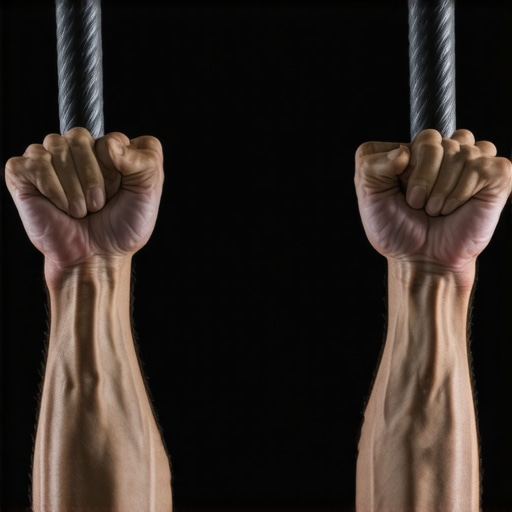
Incorporate Gym Rings for Fluid Movement
If you only have access to a straight pull-up bar, buy a cheap set of gymnastic rings and hang them over the bar. Rings do not lock your hands into a rigid plane. Instead, they allow your wrists to naturally rotate as you pull your body upward. You will start the movement with your palms facing away from you, and as you pull yourself up, your hands will naturally rotate to face your body. This fluid rotation takes all of the twisting stress off your elbow tendons. It acts like a pressure release valve for your forearms. Learning how to manage these mechanical stresses is just as important as understanding how to design the best way to warm up before any demanding physical activity.
Drive with Your Elbows, Not Your Hands
Most lifters make the mistake of trying to pull themselves up by squeezing the bar as hard as possible and flexing their biceps. This intense forearm activation triggers immediate tension in the elbow. Instead, imagine your hands are simply hooks hanging onto the bar. Initiate the pull by driving your elbows down toward your hips. This shifts the focus of the lift to your lats and middle back, keeping the tension away from your sensitive elbow joints. If your movement patterns have been compromised by years of improper lifting, seeking targeted chiropractic care can help correct those deep-seated biomechanical compensations and get you back to lifting heavy without pain.
When most lifters feel that familiar burning sensation in their inner elbow, their immediate reaction is to buy a forearm strap, do a few wrist curls, or simply rest. But let’s dig deeper. Standard sports medicine advice often tells you to focus entirely on local treatments like ice and friction massages. In my experience, focusing solely on the elbow is a massive trap. Your elbow is a simple hinge joint caught in a turf war between your wrist and your shoulder. If you only treat the elbow, you are merely silencing the alarm system without putting out the fire.
Why Does Stretching Your Forearms Make the Tendonitis Worse?
It sounds completely counterintuitive. Your forearms feel tight, so you stretch them. However, when you have medial epicondylitis, those tendons are already overstretched, micro-torn, and structurally compromised under tension. Aggressive static stretching actually creates more micro-tearing. Clinical studies from institutions like the National Institutes of Health show that eccentric loading—strengthening the tendon while it is lengthening—is vastly superior to stretching for remodeling collagen fibers. Instead of stretching, you should focus on restoring proper joint mechanics above and below the injury site. Often, restricted shoulder mobility forces the elbow to overcompensate. Improving your upper body mechanics through targeted chiropractic care or learning the scapular drill for overhead mobility is what actually unloads the elbow joint long-term.

The biggest nuance that coaches miss is the lat-to-elbow connection. When your latissimus dorsi muscles are locked up and tight, they limit your ability to externally rotate your shoulder. To get your hands into a flat, pronated position on a straight pull-up bar, your body must find that missing rotation somewhere else. It steals it from your elbow and wrist joints. This mechanical compensation places an immense shear force on your medial tendons. To truly fix your elbows, you have to release your shoulders. Using the lat stretch that stops your shoulder from clicking is often the missing puzzle piece that instantly relieves elbow tension during overhead pulling movements.
Another common mistake is over-bracing. Many athletes wear tight elbow sleeves or wrist wraps during every single workout. While this might offer temporary pain relief, it alters your brain’s perception of stability. Your nervous system stops firing the stabilizer muscles of your forearm and shoulder because the external wrap is doing the work. Once you take the wrap off, the joint is even more vulnerable to injury. If you are rehabbing, you want to build active, functional stability. Integrating proactive treatments like chiropractic techniques for faster recovery helps restore natural joint tracking without making you dependent on external braces. Have you ever fallen into this trap of relying on sleeves and stretches only to have the pain flare up again? Let me know in the comments below so we can discuss a better way forward.
How do I maintain elbow and shoulder mechanics over time?
If you want to keep training hard without constantly fighting off nagging tendon issues, you need to treat your joint health as an ongoing maintenance project. You cannot simply fix a mechanical flaw once and expect it to stay resolved forever, especially as you increase your training volume. Over time, your body will naturally seek the path of least resistance, which usually means slipping back into those old, destructive movement patterns. Maintaining joint health requires a deliberate combination of self-treatment tools, structured recovery routines, and professional oversight.
My absolute favorite tool for self-maintenance is a simple, high-density lacrosse ball. I do not use it to roll over the painful elbow tendon itself. Instead, I lay on the floor and place the lacrosse ball directly under my infraspinatus and teres minor—the small rotators on the back of the shoulder blade. By pinning those tight tissues and slowly moving my arm through an overhead range of motion, I can instantly release the shoulder restriction that forces my elbow to twist during pull-ups. Learning how to use a lacrosse ball for better thoracic mobility is one of the most effective, low-cost habits you can develop to protect your upper body joints from wear and tear.

As sports science evolves, we are seeing a massive shift away from passive recovery treatments. The future of athletic longevity belongs to active, movement-based therapy. Simply sitting on a training table with an ice pack is no longer the standard for dedicated athletes. The trend is moving toward proactive, targeted joint manipulation that restores proper biomechanical pathways before pain even starts. Working with a specialist to design a proactive care routine is incredibly valuable. Integrating proven chiropractic strategies into your monthly training plan ensures your joints stay perfectly aligned, preventing those subtle, microscopic compensations from turning into full-blown chronic injuries.
In addition to manual therapy, pay close attention to how you organize your daily life outside the gym. If you spend eight hours a day slouching over a keyboard with your shoulders rounded forward, your nervous system will lock those shoulders into internal rotation. When you finally hit the gym and try to hang from a pull-up bar, your shoulders will remain locked, forcing your elbows to absorb all the mechanical stress. If you want to keep your upper body functioning perfectly, you must address your daily posture. Implementing simple strategies like managing back pain through healthy lifestyle choices will pay massive dividends for your shoulder mobility and, consequently, your elbow health.
According to clinical guidelines published by the American Academy of Orthopaedic Surgeons, tendon health relies heavily on consistent, low-intensity loading rather than complete rest. To put this into action right now, my challenge to you is to try the “active hanging” drill before your next upper body workout. Hang from a neutral-grip bar for three sets of thirty seconds, focusing entirely on pulling your shoulder blades down and away from your ears while keeping your elbows completely straight. This simple drill activates your lower traps and lats, preparing your shoulders to do the heavy lifting so your elbows do not have to.
My own battle with inner elbow pain taught me that trying to rest or stretch my way out of joint injuries was a losing strategy. Once I realized that my elbow was simply the victim of restricted shoulders and poor wrist alignment, my recovery fast-tracked. By shifting to a neutral grip, taking advantage of gym rings, and fixing my shoulder mobility, I was able to return to heavy pulling movements pain-free.
The Hardest Lessons I Learned Rehabilitating My Elbow Tendonitis
When you are in the thick of dealing with nagging joint pain, it is easy to fall for conventional wisdom that actually delays your healing. Here are the major lightbulb moments that completely changed how I approach my upper body training:
- Rest is rarely the answer: Total inactivity simply makes the injured tendon weaker and less resilient. Controlled, pain-free movement keeps blood flowing and helps the tissue rebuild.
- Your elbow pain is usually a shoulder problem: If your shoulders cannot rotate properly, your elbow joints are forced to twist under heavy loads. Always look at the joints above and below the pain.
- Sleeves and braces are temporary band-aids: Relying on external support structures tells your nervous system it doesn’t need to fire your natural stabilizers, which can set you up for worse injuries down the line.
My Practical Toolbox for Lifelong Joint Resilience
To keep my upper body moving smoothly and avoid recurring flare-ups, I rely on a select group of tools and recovery strategies. If you want to keep training heavy without constantly breaking down, I highly recommend adding these to your routine:
- High-Density Lacrosse Ball: This is my go-to tool for self-massage. Instead of rolling the painful elbow, use it to release the rear shoulder muscles. For a complete guide on how to do this effectively, check out how to use a lacrosse ball for better thoracic mobility to unlock your upper body.
- Gymnastic Rings: Investing in a simple pair of wooden rings is the best decision you can make for your joints. They allow your wrists to rotate naturally during pull-ups, which completely unloads the elbow.
- Proactive Spinal and Joint Care: Do not wait until you are injured to seek professional help. Incorporating proven chiropractic strategies into your monthly routine ensures your shoulder blades and spine track perfectly before you load them.
Take Back Control of Your Training Today
You do not have to accept chronic elbow tendonitis as an inevitable tax for lifting heavy weights. By adjusting your mechanics, focusing on active mobility, and utilizing smart recovery strategies, you can build an upper body that is both incredibly strong and highly resilient. It is time to stop working through bad pain and start training smarter so you can stay in the gym for decades to come.
Have you ever struggled with chronic elbow tendonitis or shoulder stiffness during your workouts? Let me know in the comments below—I would love to hear what worked for you!