
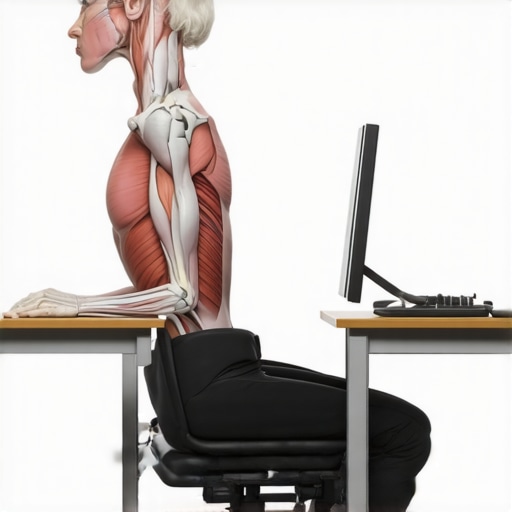
I remember catching my reflection in a storefront window on a Tuesday afternoon. I didn’t see a confident professional; I saw a question mark in a blazer. My head was jutting forward, my shoulders were curled inward like a defensive boxer, and my chest looked caved in. It hit me right then: ten years of staring at a 27-inch monitor had physically molded me into a version of myself I didn’t like. My back felt like a tight guitar string, and those headaches that started at the computer every afternoon weren’t just stress—they were a cry for help from my upper back. I was tired of the constant stiffness and the nagging feeling that my body was folding in on itself.
Why Your Desk Job is Secretly Reshaping Your Skeleton
The problem isn’t just that we sit; it’s how our muscles adapt to that sitting. When you spend eight hours a day in a C-shape, your chest muscles—the pecs—shorten and tighten, while the muscles between your shoulder blades become weak and overstretched. This creates a muscular tug-of-war that you are currently losing. I made the classic mistake of thinking I could just willpower my way out of it. I would pull my shoulders back, hold it for three minutes until my traps screamed, and then immediately slump the moment a Slack notification popped up. It was a losing battle because I was fighting my own anatomy. This struggle is often tied to that burning sensation between your shoulder blades, as the tension travels up the neck into the base of the skull. The weight of your head is another factor. For every inch your head moves forward, it adds about 10 pounds of pressure on your spine. A study published in the Journal of Physical Therapy Science highlights that this forward head posture can lead to significant respiratory dysfunction because your lungs literally do not have room to expand. You aren’t just looking slouchy; you’re actually sabotaging your energy levels and lung capacity.[IMAGE_PLACEHOLDER]
Is This Actually Fixable or Am I Stuck Like This Forever?
I get the skepticism. When you have spent years developing a forward shoulder slump from cell phone use and office work, it feels permanent, like your bones have fused into this position. You might think you need a fancy ergonomic chair or a three-thousand dollar standing desk to see results. But here is the truth: you can have the best chair in the world and still hunch. Real change comes from a two-pronged attack: opening up the tight front-side tissue and waking up the sleepy muscles in the back. It is about mobility, not just posture. Today, I am going to show you how to break that cycle once and for all. We will look at why you need the 60-second move to open up your tight chest muscles and how to retrain your nervous system to prefer a neutral spine. Have you ever caught your reflection and realized your posture had completely changed without you noticing? Tell me in the comments if you are currently fighting the desk slump—it is a lot more common than you think. Let’s get into the actual movements that saved my neck and back.
Stop Fighting Your Own Ribcage
To get out of the C-shape, you have to treat your body like a suspension bridge. If the cables at the front are too tight, the whole structure leans forward. Start by addressing those shortened pectorals. I used to think stretching was a passive hobby until I realized that the 60-second move to open up your tight chest muscles was the only way to let my lungs actually fill up again. When you open the chest, you stop the constant tug that pulls your shoulders toward your ears. I remember a specific Tuesday when I tried to force a straight spine by just squeezing my blades together during a meeting. I looked like a puffin and my lower back started to ache within minutes. It turns out I was flaring my ribs to compensate for a tight upper back. I had to apply the simple drill to stop your ribs from flaring during deadlifts just to stand normally without putting unnecessary pressure on my lumbar spine.
The Wall Is Your New Best Friend
Once the front is open, you need to wake up the muscles that have been snoozing since the start of your shift. The rhomboids and lower traps are your anchors. To do this correctly, learn how to use a wall slide to fix rounded shoulders. This movement forces your shoulder blades to move independently of your spine, teaching your nervous system that you don’t need to arch your lower back to stand up straight. I once spent a lunch break doing these in a hallway. A colleague walked in while I was pinned against the wall, arms in a ‘W’ shape, looking like I was trying to merge with the drywall. It was awkward, but the relief in my mid-back was so immediate that the social embarrassment was a fair trade. This type of consistency also translates to the gym; for instance, the same mechanics support the scapular reset that stops shoulder clicking during bench press, ensuring your workout builds you up instead of tearing you down.
Fix Your Head Position Without Looking Like a Robot
The ‘text neck’ is probably the hardest habit to break because our eyes dictate where our head goes. If your screen is too low, your spine will follow. It is non-negotiable: you must learn how to set up your laptop for better neck alignment. But even with a perfect setup, you need to retrain the deep neck flexors. I spent weeks doing chin tucks—one of the 3 exercises that fix a forward head posture—while sitting at red lights in my car. At first, it feels like you’re giving yourself a triple chin, but eventually, your head starts to sit over your shoulders like a golf ball on a tee rather than a bowling ball on a wet noodle.
Maintenance for People Who Actually Have a Life
You don’t need a two-hour mobility routine; you need micro-doses of movement. When I’m deep in a writing flow, I set a timer. Every hour, I perform the 10-second posture reset you can do at your desk. It is a quick system check for the brain to stop the slump before it sets in. If I feel a knot starting to form between my blades after a long day, I know exactly how to use a lacrosse ball to melt away mid-back knots before they turn into a full-blown headache. This isn’t about being perfect; it’s about having a toolkit that works when you’re busy.
We need to talk about the ‘stretch reflex’ trap. When your upper back feels tight, your first instinct is likely to pull your head down or twist your spine until it pops. But here is the contrarian truth: you are probably stretching muscles that are already chronically overstretched. In my years of dealing with desk-bound clients, I have seen that those upper traps and rhomboids aren’t ‘tight’ because they are short; they are ‘tight’ because they are screaming for stability while being pulled forward by your chest. This is why why stretching your hamstrings won’t fix your chronic tightness—the root cause is often a lack of support in the opposing muscle groups. If you keep pulling on these strained tissues, you are essentially trying to fix a frayed rope by tugging on it harder. It feels good for five minutes because of a temporary neurological dampening, but the pain always returns because the instability remains.
Why Do My Adjustments Only Last Forty-Eight Hours?
It is the most common frustration I hear: you leave the clinic feeling like a new person, but by Thursday morning, the old familiar ache is back. This happens because a professional adjustment is a neurological reset, not a mechanical ‘bolt tightening.’ A 2019 study in the Journal of Clinical Medicine found that patients who combined spinal manipulation with specific motor control exercises had significantly better long-term outcomes than those receiving passive care alone. If you do not reinforce the new range of motion with active movement, your brain defaults to the old, slumped patterns it has practiced for years. You have to revolutionize your rehab chiropractic techniques for faster recovery by teaching your nervous system how to own that new alignment. This is the truth about why your adjustments don’t seem to last; it is not a failure of the technique, but a failure to integrate that new movement into your daily life.
There is also the ‘oops’ factor that most people ignore: the dangerous habit of self-cracking. We have all been there—that quick, forceful twist of the neck at the desk to get a satisfying pop. While it provides a brief endorphin rush, you are almost never hitting the joint that is actually stuck. Instead, you are forcing the joints above and below the restriction—the ones that are already moving too much—to go even further. Over time, this creates localized hypermobility, making your neck feel more unstable and ‘guarded’ than before. This is the truth about cracking your own neck at your desk-2: you are chasing a symptom while fueling the underlying problem. To see real progress, you must learn how to identify if your back pain is muscular or nerve related so you can stop guessing and start targeting the actual source of the tension. Have you ever fallen into this trap? Let me know in the comments; I used to be a chronic self-cracker myself until I realized why my neck never actually felt ‘fixed.’
Once I stopped treating my chiropractor like a mechanic who ‘fixes’ me once a month and started viewing them as a coach for my nervous system, everything changed. The biggest shift was realizing that strategic chiropractic solutions for long-term back health involve what I do during the 167 hours a week I’m not in the office. I had to learn how to safely adjust your own posture throughout the day without relying on those aggressive, impulsive self-cracks that I used to do.
Stop Chasing the Pop and Start Building the Foundation
As Dr. Stuart McGill, a world-renowned expert in spine biomechanics, often notes in his technical publications, spinal stability isn’t about flexibility; it’s about creating ‘sufficient stiffness’ to protect the joints during movement. I used to think I needed to be as loose as a noodle, but I actually needed the core tension that comes from essential tips for managing back pain through healthy lifestyle choices. For me, that meant integrating ‘bracing’ into everything—from the way I pick up my groceries to how I sit through a grueling two-hour Zoom call.
How can I keep these results from slipping away?
Maintenance isn’t a chore; it’s a daily insurance policy for your mobility. I personally rely on a few ‘non-negotiable’ tools that have kept me out of the pain-flare-up cycle for years. First, I use a specific firm lumbar roll every time I’m in the car—learning how to optimize your car seat for lumbar support was a total game-changer for my commute and eliminated that dull ache that used to set in after twenty minutes. Second, when I’m training or know I’ll be on my feet for an event, I’ve mastered how to use kinesiology tape for lower back support. It isn’t just about the physical support; it provides a subtle, constant tactile reminder to my brain to keep my core engaged, preventing that late-afternoon postural collapse.
The Future of Spinal Health is Proactive
I truly believe we are moving toward a world where ‘smart’ clothing and wearable sensors will provide real-time haptic feedback the moment our spinal alignment shifts. We won’t have to guess if we are slouching; our shirts will literally buzz to tell us to reset. Until that tech becomes mainstream, we have to be our own sensors. Understanding how spinal alignment directly impacts your athletic performance gives you a reason to care that goes beyond just ‘not hurting.’ It’s about being faster on the field and more resilient in the gym. I also swear by a dedicated monitor arm for my workspace. Getting your screen to eye level prevents the ‘turtle neck’ effect that ruins your cervical curve over time. If you are serious about this, combine these tools with the lacrosse ball method for your mid-back, but pair it with a foam roller for your thoracic spine. This combination of ‘unstucking’ the joints and then ‘bracing’ them with strength is the only way to win the long game. My challenge to you: pick one ‘high-friction’ area of your day—maybe your car or your desk—and apply one ergonomic fix today. Try the kinesiology tape trick if you feel your lower back ‘giving out’ during long walks; the sensory input alone can reset your gait. We aren’t just managing pain; we are optimizing a machine.
The Hardest Lessons I Learned About Spinal Longevity
Looking back at my years of struggling with the desk-bound slump, I realized that true change didn’t come from a single ‘magic’ stretch, but from a shift in how I perceived my own body. One of the biggest revelations was discovering how your vision might be affecting your posture and neck pain; I was constantly leaning toward my screen just to see better, which sabotaged every exercise I did. I also learned that you cannot separate the way you move from the way you breathe. It turns out that how chiropractic adjustments can help your breathing is a major component of recovery because a restricted rib cage makes it impossible to maintain a neutral spine. Finally, I stopped ignoring the small aches, like why your tailbone hurts after long periods of sitting, and started addressing the root of the pressure rather than just hoping it would vanish on its own.
My Essential Resources for Sustainable Health
I didn’t reach this point alone. I relied on a curated set of tools and insights that I still use today. For those long office days, I swear by the SI joint exercise you can do while sitting at work to keep my lower back from seizing up. To truly understand the ‘why’ behind my progress, I spent hours reading about the science behind chiropractic adjustments for back pain relief, which helped me stay committed to the process. If you are an active person, I cannot recommend enhancing athletic performance with targeted chiropractic care enough; it bridges the gap between simply not hurting and actually thriving in your sport. These aren’t just links; they are the pillars of the routine that kept me from returning to that ‘question mark’ in a blazer.
Step Into a Life of Better Movement
Your journey out of chronic tension isn’t about achieving a perfect, rigid pose. It is about reclaiming the freedom to move without hesitation. Whether you are an athlete looking for the role of chiropractic care in effective sports injury recovery or a parent just trying to get through the day without a headache, your body is capable of incredible adaptation. You have the tools, the knowledge, and the roadmap. Now, you just have to give yourself the permission to prioritize your own physical well-being. Have you ever noticed that your posture improves when you focus on your breathing? Let me know in the comments below!