
I remember the absolute frustration of loading up a barbell for a heavy set of squats, only to feel my heels peel off the floor the second I tried to sink below parallel. I looked like a folding chair collapsing in slow motion. For years, I blamed my ‘short hamstrings’ or my ‘stiff back,’ but the truth was much lower down. Most of us are walking around with ankles that have the mobility of a brick, and it is quietly sabotaging our lifting, our running, and even our knee health. Today, I am going to share the exact 45-second drill that finally stopped that annoying ‘pinch’ in the front of my joint and let me squat deep with total confidence.
The Day I Realized My Ankles Were Ruining My Gains
I used to be the guy at the gym spending twenty minutes every single morning doing those long, boring static calf stretches against a wall. I thought if I just pushed hard enough, my muscles would eventually give in and let me move. It was a classic rookie mistake that many of us make early on. I was treating a joint capsule restriction as if it were just a tight muscle. This kind of ankle stiffness is often the real cause of knee pain, and no amount of stretching the back of your leg will fix a bone that is physically blocked from moving. My squat depth was limited by my joint mechanics, not my effort. I was working harder, not smarter, and my joints were paying the price with every rep.
Is This Quick Drill Actually Worth Your Time?
I know it sounds like another ‘bio-hack’ gimmick. How can 45 seconds accomplish what years of yoga and stretching couldn’t? The difference lies in targeting the talocrural joint—the actual hinge of your ankle. A study published in the Journal of Orthopaedic & Sports Physical Therapy found that restricted ankle dorsiflexion is a primary predictor of poor landing mechanics and chronic knee strain. When you use a specific mobilization drill, you are teaching the talus bone to glide backward as it should. It is like greasing a rusty hinge instead of just pulling on the door harder. For me, the results were almost instantaneous, and I finally stopped feeling like I was going to tip over backward every time I reached the bottom of a squat.
[image]
Why Traditional Calf Stretching Is Letting You Down
The biggest hurdle to better mobility is understanding that your calf muscles are only half the story. If you have ever felt a sharp, ‘bony’ pressure in the front of your ankle when you lean forward, that is a clear sign your joint is stuck. When that happens, your body compensates in ways that lead to trouble elsewhere. Maybe your feet ache after running because your stride is chopped short, or perhaps your lower back starts to ache because you are leaning too far forward to balance. I have been there, and I know how discouraging it feels to feel ‘stuck’ in your own body. Have you ever felt that sharp pinch in the front of your ankle during a workout? I would love to hear if you have tried to stretch it out only to have it feel exactly the same the next day. We also need to remember that big toe mobility plays a huge role in how the ankle functions. Before we get into the step-by-step movement, let us look at why this drill changes the game for your entire lower body chain.
Put the Band Where it Actually Matters
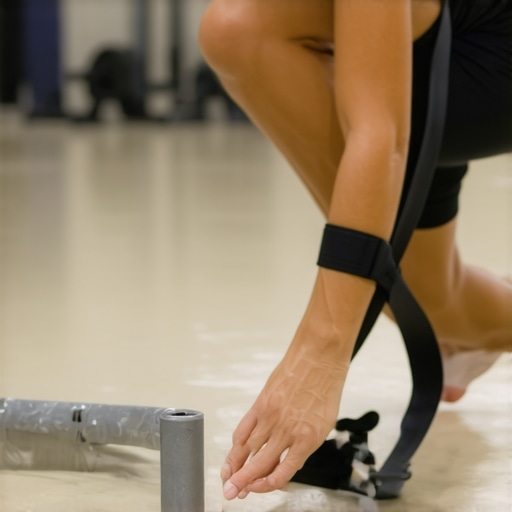
To clear that ‘stuck’ feeling in the front of your joint, you need a heavy-duty resistance band and a sturdy anchor point. Most people place the band way too high on their leg. If the band is touching your calf or your shin bone, you are just pulling on skin and muscle. To truly affect the joint capsule, the band must sit lower than those two bony bumps on the sides of your ankle—the malleoli. Think of it like a seatbelt for the talus bone; it needs to pin the bone down and pull it backward so the rest of your leg can hinge over it without getting jammed. This mechanical shift is why stretching your hamstrings won’t fix your chronic tightness; the problem is often a physical blockage in the joint, not a short muscle.
Create Enough Tension to Feel the Shift
Step away from the anchor point until the band is taut and pulling your foot backward. You want enough resistance that it feels like the joint is being slightly gapped. I remember a specific Tuesday before a heavy squat session where I didn’t use enough tension. I went through the motions, but the ‘pinch’ remained. It wasn’t until I stepped out another six inches—making the band pull aggressively—that I felt the talus finally slide back. That small adjustment was the difference between a painful set and a personal record. If you skip this, you are just doing a fancy-looking lunge. Using this tension correctly is similar to how strategic chiropractic solutions for long-term back health focus on joint alignment over temporary relief.
The Drive and Hold Technique
Once the band is pulling back, slowly drive your knee forward over your middle toes. Keep your heel glued to the floor. If the heel lifts even a millimeter, you have lost the mobilization effect. Push into that end-range until you feel a stretch or a slight pressure, then back off. Repeat this for 15 to 20 slow pulses. You aren’t trying to win a race; you are ‘flossing’ the joint. This movement patterns the brain and the joint to work together, much like how the 30-second drill to stabilize your ankles before a hike prepares your proprioception for uneven ground. I have found that doing this right before my warm-up sets stops that annoying ‘pop’ and is the best way to address why your knee clicks during lunges or squats.
Test Your New Range Immediately
Don’t just take my word for it. After 45 seconds of pulsing on one side, stand up and perform a bodyweight squat. You will likely feel like your ‘banded’ side is sinking into a deep hole while the other side feels like it is hitting a concrete wall. This immediate feedback proves that the joint was the bottleneck all along. When you combine this with the pelvic tilt fix that instantly boosts your squat depth, you create a powerhouse of lower-body mobility that allows for heavier loads with significantly less risk of injury. I used to think I was just ‘built’ to have bad ankles, but once I started treating the joint mechanics directly, my depth improved more in a week than it had in the previous three years of static stretching.
While the banded mobilization is a game-changer, I see many athletes make a fatal mistake: they assume every tight feeling requires more range of motion. In reality, your brain often creates a sensation of tightness to protect a joint that lacks stability. If you keep forcing a joint to move further without teaching it how to stay stable in that new range, your nervous system will just lock it back down. This is the core reason the truth about why your adjustments don’t seem to last often comes down to a lack of motor control, not a lack of flexibility. You aren’t actually tight in the muscular sense; you are unstable, and your brain is using your muscles as organic parking brakes to prevent injury.
Why do my mobility gains seem to vanish after forty-eight hours?
This is the most common frustration for high-level lifters and runners. You do the work, you feel great for a single session, and then you wake up Monday morning feeling like a rusted gate again. According to research published in the Journal of Athletic Training, the nervous system regulates muscle tone based on perceived threat levels. If your brain doesn’t trust your ankle in that new deep squat position, it will revert to the safest and stiffest setting possible as soon as you stop moving. This is where the science behind chiropractic adjustments for back pain relief and joint health becomes vital; it’s not just about the physical shift, but about resetting the communication between your mechanoreceptors and your brain to lower that protective threat response.
Don’t Fall for the Foam Roller Trap
One of the biggest oops factors I see in the gym is people trying to roll out their lower back or their IT band to fix ankle-related issues. Please, for the sake of your spine, why you should never roll your lower back on a foam roller is because you are essentially grinding your lumbar vertebrae into a hard surface without any rib cage protection. Instead of smashing sensitive tissue, we need to look at the global chain. Often, a tight ankle is actually a compensation for a hip that isn’t firing. When you revolutionize your rehab with chiropractic techniques for faster recovery, you start looking at how the foot affects the knee, which affects the hip, and eventually the spine. Have you ever fallen into this trap of focusing only on where it hurts rather than where the problem started? Let me know in the comments.
The Danger of Over-Mobilizing Without Loading
The nuance most people miss is that mobility without load is just a party trick. Once you create space in the joint with the banded drill, you must immediately perform a heavy isometric hold or a slow eccentric movement to save that progress in your brain’s hardware. If you just stretch and walk away, you have gained range but no control. This is why strategic chiropractic solutions for long-term back health emphasize functional movement alongside adjustments. You need to own the range you just earned. If you don’t, you are just temporarily stretching a rubber band that is destined to snap back. Have you ever felt like you are doing all the right drills but staying at the same baseline? It might be time to stop stretching and start stabilizing.
The Gear That Actually Lives in My Gym Bag
Maintaining mobility isn’t about doing the same 45-second drill forever; it’s about making your environment work for you. I personally swear by using a 5mm heel wedge for my initial warm-up sets. According to Dr. Kelly Starrett, physical therapist and author of ‘Becoming a Supple Leopard,’ maintaining the integrity of the foot-to-ankle relationship requires consistent tension and specific positioning that mirrors your sport. I use the Rogue Monster Bands because they provide the necessary ‘distraction’ force—the technical term for creating space in the joint—without snapping mid-pulse like the cheap ones from the local big-box store. If you are struggling with long-term results, it might be because you are relying on the truth about why your adjustments don’t seem to last without adding the necessary mechanical resistance. This is where enhancing athletic performance with targeted chiropractic care bridges the gap between a temporary fix and a permanent change in your movement patterns.
How do I maintain these ankle gains over the long haul?
The secret isn’t more stretching; it’s smarter integration. I’ve found that transitioning to a wide-toe-box shoe, like those from Vivobarefoot, for my daily walks has done more for my joint health than any single exercise. It allows the foot to splay naturally, which prevents the talus from getting jammed in the first place during everyday movements. You also need to look at essential tips for managing back pain through healthy lifestyle choices, as your overall systemic inflammation affects how ‘sticky’ your joints feel when you wake up. If I’m traveling and can’t use my band, I focus on the eccentric calf fix for chronic achilles tension to keep the muscles long and the joint moving smoothly through its full range.
Stop Guessing and Start Using Data
I predict we’ll soon see smart-socks with embedded pressure sensors to tell us exactly when our talus is jamming during a run or a heavy lift. We are moving away from ‘guessing’ where the tightness is and toward data-driven mobility. For now, we rely on strategic chiropractic solutions for long-term back health to ensure the nervous system is actually firing correctly and not just bracing for impact. If you still feel a pinch after doing the work, it might be time to discover how chiropractic adjustments can alleviate chronic back pain by checking the upstream chain in your hips and spine. Give the heavy-duty purple band a try tomorrow morning—don’t settle for the light ones—and feel the immediate difference in your first squat rep. You have to earn that range and then own it.
The Hardest Lessons I Learned While Chasing Real Joint Range
Looking back at my years of frustration, the biggest takeaway I have gathered is that symmetry is far more important than raw range. If your left ankle moves like a dream but your right feels like it is in a cast, your spine and hips will pay the price through compensation. I have realized that boosting your sports rehab journey with proven chiropractic strategies means addressing these side-to-side imbalances before they manifest as chronic injuries. It is not just about getting lower in the hole; it is about how the role of chiropractic care in effective sports injury recovery ensures your whole kinetic chain is communicating properly during every heavy lift.
My Personal Arsenal for Maintaining Supple Joints
I do not go anywhere without a heavy-duty resistance band and a simple lacrosse ball in my gym bag. While many lifters know how to use a lacrosse ball to melt away mid-back knots, using that same ball on the sole of your foot—the plantar fascia—is the perfect ‘pre-game’ for the banded ankle drill. Breaking up the soft tissue on the bottom of the foot allows the talus bone to move more freely once you add the band. I also made a permanent switch to shoes that actually let my feet function; you should definitely learn how to vet your running shoes for proper arch support to ensure you are not undoing all your hard-earned mobility gains every time you take a walk around the block.
#IMAGE_PLACEHOLDER_E#
Stop Letting Stiff Joints Hold Your Progress Hostage
You are not stuck with the mobility you have today, nor are you ‘just built’ to have bad knees. By spending just 45 seconds on this banded distraction, you are teaching your nervous system that it is safe to explore a deeper range of motion. This reclaimed ankle mobility will ripple upward, saving your knees from clicking and your lower back from the dreaded ‘butt wink’ at the bottom of a squat. If you have tried these drills and still feel a physical block that just won’t budge, do not hesitate to contact us to see if there is a deeper structural alignment issue at play. Your best, most powerful reps are still ahead of you once you clear the path for your joints to move. Have you ever felt that sharp ‘pinch’ in the front of your ankle during a workout, and did traditional calf stretching actually help, or did it make it feel worse? Let me know in the comments below.