
I was three hours into a cross-country move when my right leg simply gave up on me. One minute I was enjoying the scenery, and the next, a white-hot bolt of lightning shot from my hip down to my toes. I had to merge across three lanes of traffic while using my left foot to brake, which is about as fun as it sounds. If you’ve ever had to pull over on a gravel shoulder to do a frantic, awkward dance just to get your leg to ‘wake up,’ then you know exactly the kind of misery I’m talking about. Today, we’re going to figure out why your car seat is basically a trap for your nerves and how you can reclaim your road trips.
Your car seat is secretly a torture device
When you’re at a desk, you can shift around, but behind the wheel, you’re a captive audience. Your right leg is constantly hovering, tensing to hit the gas or brake, which keeps your hip flexors in a state of high alert. This constant tension pulls on your pelvis and puts your sciatic nerve directly in the line of fire. Early on, I made the rookie mistake of driving with a thick wallet in my back pocket. I was literally sitting on a wedge that shoved my spine out of alignment for hours. I also thought icing my back every time I stopped for gas was the answer, but I was just making my muscles tighter. The reality is that the real reason your sciatica flares up has more to do with the compression of the seat and the vibration of the road than just ‘sitting too long.’
Do those fancy ergonomic cushions actually work?
I get asked this at every neighborhood BBQ. Look, a $30 pillow isn’t a magic wand if your base setup is trash. You have to optimize your car seat for lumbar support properly before you start adding accessories. Research from the Journal of Physical Therapy Science indicates that the seated posture in a vehicle can increase intradiscal pressure by up to 1.5 times compared to standing. That’s like carrying a heavy backpack on your spine while you’re trying to navigate traffic. I’ve seen so many people make the stretching mistakes of trying to ‘pull’ the pain out, which only irritates the nerve further. Have you ever felt like your car was actually designed by someone who has never sat in a chair before?
Fix your seat geometry to save your spine
Think of your sciatic nerve like a garden hose. When you sit in a poorly adjusted car seat, you are essentially putting a heavy kink in that hose. The signal—the ‘water’—can’t flow, and the pressure builds until you feel that familiar, burning throb. To fix this, you have to look at your car as a cockpit that needs precision tuning. I remember a grueling eight-hour haul to Des Moines where I thought I could just ‘power through’ the stiffness. By hour four, my glutes felt like they were being poked with a hot skewer. I ended up pulling over and using a rolled-up gym towel from my trunk to prop up my hips because my seat was essentially a soft, spine-crushing bowl. It wasn’t pretty, but it taught me that seat geometry is non-negotiable.
Stop reaching for the pedals
The most common mistake is sitting too far back. If your leg is fully locked out or overextended when you press the gas, you are putting the sciatic nerve under maximum tension. This is one of the 3 stretching mistakes that make sciatica worse—you are essentially performing a forced hamstring stretch for hours on end. Instead, move your seat forward until your knee has a visible bend even when the pedal is floored. This slackens the nerve and takes the ‘pull’ off your lower back.
Level your pelvis to kill the pinch
Most modern car seats are designed with a ‘bucket’ shape where the back of the seat is lower than the front. This forces your pelvis to tilt backward, which rounds your lumbar spine and creates a massive disc bulge risk. You need to optimize your car seat for lumbar support by ensuring your hips are at least level with, or slightly higher than, your knees. If your seat doesn’t have a tilt adjustment, use a firm foam wedge. This keeps your pelvis in a neutral position, which is a cornerstone of strategic chiropractic solutions for long-term back health. When your pelvis is level, the weight of your torso is distributed through your sit-bones rather than your sensitive nerve endings.
Reset your nervous system at every red light
Static tension is the enemy. Even with a perfect seat, your muscles will eventually guard and tighten. You can combat this by using diaphragmatic breathing to calm your nervous system every time you hit a red light. Expand your belly as you inhale to create internal space and decompress the spine from the inside out. Furthermore, because the real reason your sciatica flares up is often related to restricted joint movement, it is vital to keep the joints mobile. This is why chiropractic adjustments can alleviate chronic back pain; they restore the motion that hours of driving take away. If you feel a flare coming on, try a subtle nerve glide: while stopped, gently tuck your chin to your chest and then look up at the ceiling while slowly pumping your right ankle. This helps the nerve ‘slide’ through the hip tissues rather than getting stuck and inflamed.
But here is where most people get it wrong. We are obsessed with ‘perfect’ posture, which usually means sitting as upright as a military cadet. I spent years trying to maintain a rigid 90-degree angle because that’s what the old ergonomics brochures suggested. The truth? That rigid verticality is a recipe for disaster. When you sit perfectly upright, you’re maximizing the vertical load on your L4 and L5 discs. Research published in the Journal of Biomechanics suggests that a slightly reclined position of 100 to 110 degrees actually minimizes spinal disc pressure compared to the ‘ideal’ 90-degree upright seat. By leaning back just a hair, you transfer some of that upper-body weight into the backrest rather than letting it crush your lumbar spine like a hydraulic press.
Sitting up straight is actually trashing your discs
The biggest trap I see drivers fall into is the use of rigid supports. Many people buy those stiff, plastic back braces thinking they are ‘forcing’ their body into health. However, you should be wary of the truth about posture braces and muscle atrophy. If a brace does all the work, your core muscles simply go on vacation. When you finally step out of the car, your spine has zero active support, making you incredibly vulnerable to a disc slip or a sudden spasm the moment you reach for your luggage. Instead of a brace, look for a dynamic support that allows for subtle micro-movements. The goal is to support the curve, not to mummify your torso. This is a crucial nuance often missed by those who only focus on the ‘crack’ and forget about the stabilizing muscles that hold everything in place.
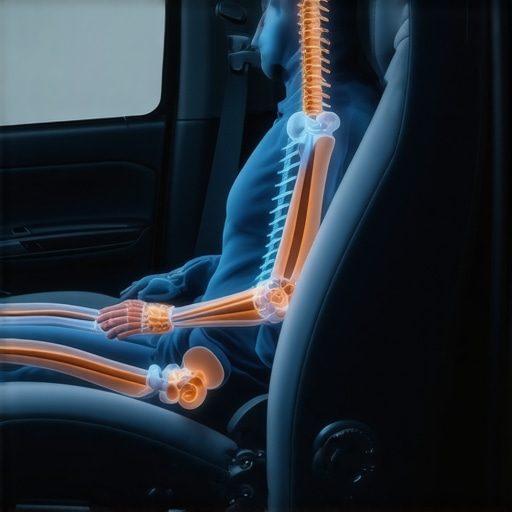
Are you stretching your way into a permanent flare-up?
Here is the ‘oops’ factor that ruins most recovery plans: treating nerve pain like muscle tightness. When your leg starts to burn, your instinct is to pull over and stretch your hamstrings or your glutes as hard as you can. If you have true sciatica, this is like taking a frayed electrical wire and pulling it from both ends. You aren’t ‘loosening’ the nerve; you’re irritating the protective sheath. I’ve seen patients turn a minor ache into a three-week bedrest sentence because they didn’t know how to safely stretch your psoas without hurting your back or when to stop. You have to learn how to identify if your back pain is muscular or nerve related before you start aggressive mobility work. If it’s the nerve, less is almost always more.
Why do some adjustments seem to vanish by the time you reach the parking lot?
This is the most common frustration in sports rehab. You get off the table feeling like a million bucks, but by the time you’ve driven home, the pain is back. It’s not that the adjustment ‘failed’; it’s that your car seat is immediately undoing the work. This is the core of the truth about why your adjustments don’t seem to last. If your pelvic geometry is crooked the moment you sit down, your nervous system will reflexively tighten those muscles back up to protect the spine. To get lasting results, you have to boost your sports rehab journey with proven chiropractic strategies that include ergonomic retraining. We have to change the environment (the car seat) so the body can actually hold the new alignment. Have you ever fallen into this trap where you feel great after a session but lose it all on the drive home? Let me know in the comments.
I have spent thousands of hours testing gadgets that claim to fix ‘driver’s back,’ and I have realized that most of them are glorified paperweights. However, a few specific tools have become non-negotiable for my long-haul survival kit. The one item I never leave home without is a high-density McKenzie Lumbar Roll. Unlike the soft, squishy pillows sold at truck stops, this firm cylinder maintains its shape under the pressure of your body weight, ensuring that your lumbar curve doesn’t collapse into a disc-straining ‘C’ shape. This is a foundational part of strategic chiropractic solutions for long-term back health because it provides the passive support your muscles can’t maintain during a three-hour commute. I also keep a roll of high-tension kinesiology tape in my glove box. Learning how to use kinesiology tape for lower back support provides a subtle tactile cue to your brain, reminding your core to stay engaged when you’re tempted to slouch. Dr. Stuart McGill, a renowned spine biomechanics expert at the University of Waterloo, emphasizes that the spine has a ‘capacity’—and once you exceed it through prolonged sitting, you are living on borrowed time. Using these tools helps you stay within your spine’s budget. 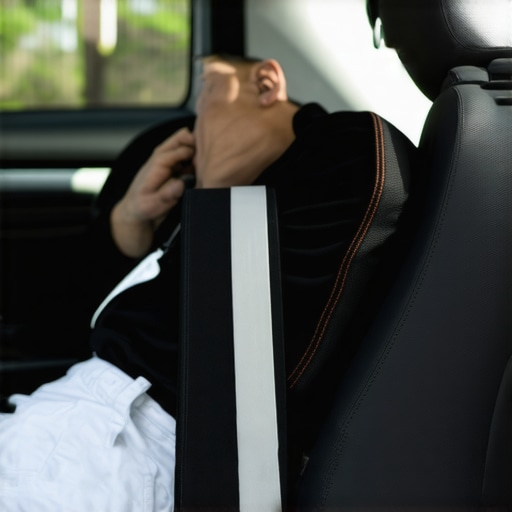
How do I maintain my spinal health over time?
Maintenance isn’t about a single fix; it is about building a robust system that can withstand the vibration and compression of the road. You need to boost your sports rehab journey with proven chiropractic strategies by incorporating active mobility drills into your pit stops. I don’t just stand up and walk; I perform three sets of ‘standing extensions’ where I place my hands on my hips and gently lean back to reverse the seated flexion. This simple habit, combined with essential tips for managing back pain through healthy lifestyle choices, like staying hydrated to keep your spinal discs plump, makes a massive difference over several hundred miles. We are also seeing a shift in automotive technology where ‘active’ seats are becoming the norm. In the very near future, AI-driven seat bladders will likely adjust your lumbar support in real-time based on pressure sensors, effectively giving you a micro-adjustment while you drive. Until that becomes standard in every sedan, you have to be your own ergonomic engineer. Even the most expert chiropractic adjustments can alleviate chronic back pain only if you stop re-injuring yourself every time you turn the ignition. I want you to try one thing on your drive tomorrow: set your phone timer for 20 minutes, and every time it goes off, perform a five-second glute squeeze to reset your pelvis. It sounds simple, but it is the most effective way to keep that sciatic nerve from getting pinned.
The Hardest Lesson I Learned About Driving Through Nerve Pain
Looking back at that panicked pull-over on the highway, I realize that my biggest mistake wasn’t the car seat—it was my mindset. I spent years thinking I could out-tough the biology of my nerves. The hardest lesson I learned is that your body doesn’t care about your ETA; it only cares about its internal pressure. I used to think I needed to push through, but I’ve realized that micro-breaks are much more effective than one long recovery session. If you’re finding that you need more professional help to decipher these signals, understanding the real difference between a chiropractor and a PT can help you choose the right partner for your recovery. Another epiphany was that my car-seat habits were bleeding into other areas of my life; for instance, I found that the best way to sit on a plane to avoid sciatica flares follows almost the exact same pelvic-tilting logic I used for my commute. Finally, I had to accept that ‘feeling the burn’ is for the gym, not for your sciatic nerve. In the world of recovery, remember the truth about no pain no gain in sports rehab: when it comes to nerves, pushing through the pain is just pushing closer to a permanent injury.
Road-Tested Tools for Your Spine’s Survival
I don’t believe in cluttering your car with every gadget on the market, but a few curated items are essential for long-term comfort. First, a firm lumbar roll is non-negotiable for anyone spending more than thirty minutes behind the wheel. It acts as a constant reminder for your spine to maintain its natural curve. Second, I highly recommend keeping a dedicated mobility guide or app handy. You can boost your sports rehab journey with proven chiropractic strategies by following a specific routine of nerve glides during your rest stops. Lastly, I always suggest integrating essential tips for managing back pain through healthy lifestyle choices, such as carrying a large water bottle to ensure you’re forced to stop, stretch, and hydrate every couple of hours. These tools aren’t just accessories; they are your frontline defense against the compression of the road.
#IMAGE_PLACEHOLDER_E#
Your Future Behind the Wheel Looks Brighter
Sciatica doesn’t have to be the passenger on every road trip you take. By reclaiming your seat geometry and respecting the delicate nature of your nervous system, you can turn a torturous commute back into a relaxing drive. You have the power to change the environment of your cockpit and, by extension, the health of your lower back. Remember that strategic chiropractic solutions for long-term back health are built on the small, daily adjustments you make yourself. Don’t wait for the next white-hot bolt of lightning to start caring for your alignment. Start tomorrow morning: tilt that seat back ten degrees, level your hips, and take a deep breath. Your spine will thank you for every mile. Have you ever noticed your leg pain getting worse during a specific part of your drive, like heavy traffic or long highway stretches? Let me know in the comments below.