
I vividly remember the morning my shoulder finally gave up on me. I reached for a jar of peanut butter on the top shelf and a sharp, white-hot pain shot through my rotator cuff, making me drop the jar. Like many of us who live for the gym, I thought I could out-tough the injury. I went straight to my gear bag, pulled out a heavy-duty ‘monster’ band, and started doing high-tension pull-aparts. I was dead wrong. I wasn’t rehabbing; I was just irritating an open wound. Today, we are going to fix how you approach those elastic loops so you can actually get back to the barbell without that nagging pinch that keeps you up at night.
Stop Treating Your Rotator Cuff Like a Heavy Bench Press
One of the biggest mistakes I made early on—and I see this all the time in the clinic—is choosing a band based on ego rather than mechanics. Your shoulder is a delicate ball-and-socket joint, not a forklift. If you pick a band that is too stiff, your larger muscles like the traps and pecs take over the movement, completely bypassing the tiny stabilizers that actually need the work. This is often why your shoulder pinches during overhead presses even when you think you are doing everything right. You need a band that allows for a full, fluid range of motion without forcing your body to cheat the movement by shrugging. Have you ever felt like your shoulder was working harder just to hold the band than to do the actual exercise?
Can a simple piece of latex really outperform a dumbbell?
It sounds a bit far-fetched, but the physics of resistance bands is what makes them superior for rehab. Unlike free weights, where gravity stays constant, the resistance of a band increases as it stretches. This actually matches the natural strength curve of your muscles. According to a study published in the Journal of Human Kinetics, elastic resistance training can produce muscle activation levels similar to free weights, but with significantly less joint shear force. However, here is the catch: if you start with too much tension, you lose that benefit entirely. You end up reinforcing the very compensations that caused the pain in the first place. Selecting the right color or weight is the difference between a wasted session and a functional recovery.
Pin Your Shoulder Blades Like a Precision Foundation
Think of your shoulder blade as the launchpad for a rocket. If the pad is shaky or tilted, the rocket—your arm—is never going to fly straight. Before you even think about stretching that band, you have to master the ‘set.’ This means drawing your scapula down and back toward your opposite back pocket. It is not a violent squeeze; it is a subtle engagement. When I first started my own recovery, I used to jam my blades together so hard I looked like a bird trying to take flight. This actually choked off my range of motion and made the pinching worse. You want to create a stable shelf, which is the scapular setting trick for pain-free pull-ups that most people ignore. Without this foundation, the rotator cuff is forced to work from a position of weakness, leading to that familiar sharp bite in the front of the joint.
Keep a Loose Grip to Wake Up the Stabilizers
It sounds counterintuitive, but white-knuckling the band actually shuts down the very muscles you are trying to activate. There is a neurological link between your hand and your shoulder; a death grip recruits the forearms and biceps, which creates a ‘shielding’ effect around the rotator cuff. I remember a specific session where I was struggling with lateral rotations. My hand was cramping from gripping the thin yellow band so hard. My coach made me loop the band over my open palm instead of gripping it. Suddenly, I felt a deep, dull ache in the back of my shoulder—the exact spot I had been trying to reach for weeks. This is a primary reason why your grip strength determines your rotator cuff health. By softening the hand, you force the rotator cuff to stabilize the humerus without help from the ‘big brothers’ of the arm.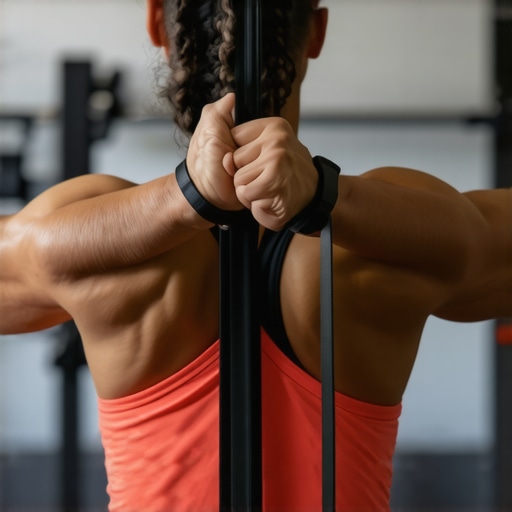
The 90-Degree Rule for True Rotation
Most people perform external rotations with their elbow flapping around like a broken wing. To truly isolate the infraspinatus and teres minor, you need to lock your elbow against your ribs. Imagine you are holding a rolled-up towel between your elbow and your side; if the towel drops, you’ve failed the rep. I used to cheat this by leaning my entire torso away from the anchor point, which felt like I was getting a ‘bigger’ stretch but was actually just stress on my spine. If you cannot maintain this 90-degree angle, you need to how to check your own shoulder mobility in 30 seconds to see if your thoracic spine is the real culprit. This isolation ensures the work stays on the cuff and doesn’t bleed into the lats or traps.
Check Your Spine Before You Blame the Cuff
If your mid-back is rounded like a question mark, your shoulder is physically blocked from moving correctly. You can do all the band work in the world, but if your spinal alignment is off, you are essentially driving a car with the parking brake on. This is where enhancing athletic performance with targeted chiropractic care becomes a game-changer. An adjustment can ‘unlock’ the rib cage and thoracic vertebrae, allowing the scapula to glide freely. I’ve seen athletes gain two inches of overhead reach just by fixing a stuck segment in their mid-back, rather than doing more rotator cuff exercises. It’s about clearing the path so the band work can actually take hold. For more advanced movements, you might even transition into the scapular drill for pain-free dips once the initial inflammation subsides.But once you move past those basic drills, you have to confront the myths that keep athletes stuck in a loop of ‘almost recovered.’
Static Stretching Might Be Your Shoulder’s Worst Enemy
Most people think that if a joint feels tight, the solution is to pull on it until it gives way. But here is the contrarian truth: many ‘tight’ shoulders are actually unstable. Your nervous system is locking the joint down to protect it because the stabilizers aren’t doing their job. If you keep stretching a rotator cuff that is already struggling for stability, you are essentially picking at a scab. This is a nuance I often explain when discussing the role of chiropractic care in effective sports injury recovery. Instead of lengthening the muscle, we need to reset the neurological ‘brakes’ so the joint can move without fear. This is how we revolutionize your rehab chiropractic techniques for faster recovery.
Look Past the Joint to Find the Real Culprit
One of the biggest ‘oops’ factors I see is people spending months on band work when the problem is actually a rib that isn’t sitting right. If your first or second rib is slightly out of place, it physically blocks the path of the nerves and tendons. You can do ten thousand rotations, but if you do not how to spot a rib subluxation fast, you are just spinning your wheels. 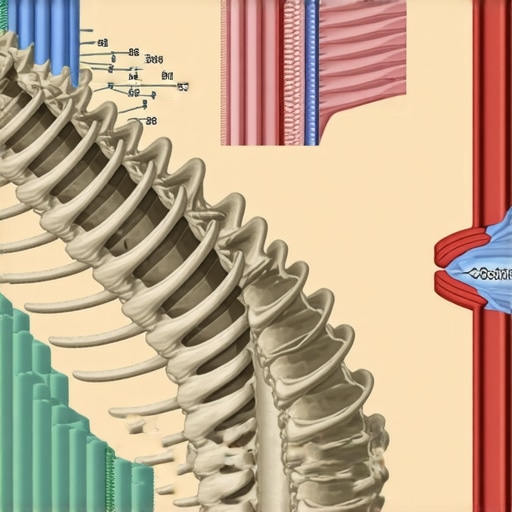
Why do the results of my adjustment disappear so quickly?
This is the most common question I get from high-level athletes. They feel incredible after a session, but 24 hours later, the ‘pinch’ returns. The answer lies in neuroplasticity. According to research in the Journal of Manipulative and Physiological Therapeutics, while an adjustment provides an immediate ‘reset’ to the nervous system, the brain will default to old, painful movement patterns if you do not follow up with specific loading. You have to ‘save’ the new range of motion with work. This is exactly the truth about why your adjustments dont seem to last. Without reinforcing the new alignment, your body treats the adjustment as a temporary glitch rather than a new standard. By integrating how spinal alignment directly impacts your athletic performance, we bridge the gap between ‘feeling better’ and ‘staying better.’ Have you ever fallen into the trap of thinking a single ‘crack’ would fix a year of damage? Let me know in the comments.
Stop the Cycle of Recurrent Pain
Once the initial fire of an injury is out, the real work begins. I used to think that as soon as the pinch was gone, I could go right back to my old 1RM bench press routine without a second thought. That ego-driven mindset is exactly why I ended up back on the treatment table three months later. The transition from acute rehab to long-term performance is where most people fail because they lack strategic chiropractic solutions for long-term back health and joint stability. You have to treat your shoulder maintenance like brushing your teeth; it is a non-negotiable daily habit.
My Favorite Gear for Shoulder Longevity
I have a very short list of tools that I actually use and recommend. First, throw away those massive, thick power bands for your rotator cuff work. They are too aggressive. I strictly use micro-bands—the thin, circular latex loops—because they provide just enough tension to wake up the stabilizers without over-recruiting the deltoids. Second, I am a firm believer in the lacrosse ball. If you are not using one, you are missing out on a cheap way to how to use a lacrosse ball to melt away mid-back knots. I use it against a wall to pin down the infraspinatus and move my arm through a full range of motion. This active release technique mimics what we do in the clinic and helps maintain the space created during an adjustment. 
How do I maintain these results for the long haul?
Maintenance is about neurological consistency. Dr. Stuart McGill, a world-renowned expert on spinal biomechanics, often discusses the concept of ‘proximal stiffness for distal mobility.’ This means your shoulder (the distal part) will only ever be as mobile and strong as your core and spine (the proximal part) are stable. If your trunk is weak, your brain will ‘clamp down’ on your shoulders to create artificial stability. This is why I always check if how your breathing mechanics are sabotaging your core strength. If you are a chest-breather, you are constantly up-regulating your trap muscles, which pulls your shoulders out of alignment. Switching to diaphragmatic breathing can actually be the missing piece of your rotator cuff rehab.
The Future of High-Performance Recovery
We are moving into an era where ‘feeling’ your way through a workout isn’t enough. I predict that in the next few years, we will see a massive surge in wearable electromyography (EMG) sensors that tell you in real-time if your rotator cuff is actually firing or if your traps are cheating for you. Until then, we have to rely on high-quality feedback. This is why boost your sports rehab journey with proven chiropractic strategies is so vital; it provides the external check and balance your body needs. I want you to try one specific thing tomorrow: before your next upper-body session, spend exactly 60 seconds on each shoulder blade with a lacrosse ball, then perform ten slow, controlled wall slides. This small investment will pay massive dividends in your lifting career. If you find your progress stalling, it might be time to revolutionize your rehab chiropractic techniques for faster recovery by looking at the nervous system, not just the muscle.
The Hardest Lesson I Learned While Chasing a Pain-Free Press
After years of trial and error, the biggest ‘lightbulb moment’ for me was realizing that the shoulder is merely a symptom-bearer for what’s happening in the rest of the body. I used to spend hours on specific band drills only to find the pain returning the moment I loaded the barbell. It wasn’t until I looked at how how spinal alignment directly impacts your athletic performance that I finally saw lasting change. Your nervous system won’t let your rotator cuff fire properly if it feels your spine is unstable. Another realization was that ‘more tension’ is usually the enemy of ‘better activation.’ If you feel your neck straining during an external rotation, you’ve already lost the rep and are likely reinforcing bad habits.
The Non-Negotiables for My Daily Recovery Routine
I’ve distilled my recovery down to three essential tools that stay in my gym bag at all times. First, Micro-Bands: These thin, circular loops are far superior to long flat bands because they force a constant, low-level engagement of the stabilizers without letting the deltoids take over. Second, a Lacrosse Ball: It is the ultimate tool to pin and stretch the infraspinatus between sets. Third, the knowledge of how a weak core actually causes chronic neck tension and shoulder instability. I also highly recommend looking into the work of Dr. Kelly Starrett for movement mechanics. Integrating these self-care tools with boost your sports rehab journey with proven chiropractic strategies ensures that my physical structure is actually ready for the load I’m putting on it.
Reclaim Your Training and Move Without Fear
You don’t have to live with a ‘bad shoulder’ forever. By shifting your focus from just stretching to intelligent stabilization and spinal health, you can get back to the movements you love. Whether it’s a heavy overhead press or just picking up your kids without a wince, the goal is long-term resilience and functional freedom. Finding strategic chiropractic solutions for long-term back health and joint stability is the bridge between temporary relief and a lifetime of performance. The path to recovery isn’t always a straight line, but it is always worth the effort to do it right. Have you ever felt like your shoulder pain was actually coming from your neck or mid-back instead of the joint itself? Let me know in the comments below.