
Stop Waking Up Feeling Like a Human Question Mark
I remember the morning I finally hit my breaking point. I was in my early thirties, but it took me a full three minutes just to roll out of bed and stand up straight. I looked like someone who had just finished a grueling marathon, not someone who’d just “rested” for eight hours. My mistake was simple but costly: I bought a mattress that felt like a plush hug in the showroom but turned into a sagging hammock for my lumbar spine by 3:00 AM. If you have ever felt that sharp pain during your first few steps out of bed, you know exactly the frustration I’m talking about. I spent thousands on the wrong gear before I realized that “comfort” is a marketing term, while “support” is a physiological one. Today, I’m going to show you how to look past the sales pitch and pick a mattress that actually respects your unique spine type, whether you are dealing with a flat back, a deep lumbar curve, or scoliosis.
Your Bed Should Respect Your Anatomy
For the longest time, I believed the myth that a “firm” mattress was the only way to save my back. I spent months sleeping on what felt like a carpeted sidewalk, thinking I was doing my body a favor. Instead, I just ended up with neck stiffness that never seemed to go away. The truth is, your spine has natural curves that need to be filled, not flattened. When you choose a bed based on your spine type, you are essentially providing a 3D mold for your body to recover in every night. We are going to solve the puzzle of material density and support levels so you can finally stop relying on chiropractic adjustments to fix what your bed is breaking every night.
Is a Luxury Price Tag Actually Worth the Investment?
There is a massive misconception that a $4,000 price tag is a shield against back pain. It isn’t. In fact, many high-end memory foams can actually trap you in a “sinkhole” if you have a certain pelvic tilt, making your lumbar spine’s position even worse than it would be on a cheap guest bed. A study published in The Lancet found that patients with non-specific low back pain actually reported better outcomes on medium-firm mattresses rather than very firm ones, which flies in the face of the “harder is better” advice we’ve heard for decades. Have you ever spent a fortune on a bed only to find yourself still tossing and turning at 2:00 AM? Let’s look at how to identify your specific spinal needs before you swipe your card again.
Map Your Spine Before You Map the Store
Before you even step foot into a mattress gallery, you need to understand that your back isn’t a flat board; it is a series of delicate arches. If you have a deep lumbar curve, a mattress that is too firm will leave a bridge of unsupported muscle hanging in mid-air all night. Conversely, if you have a flatter profile, a soft bed will allow your hips to sink like an anchor, creating a ‘banana’ shape that puts immense pressure on your discs. I learned this the hard way when I invested in a high-end memory foam ‘cloud.’ For the first twenty minutes, it felt like heaven. By 4:00 AM, my pelvis had tilted so far forward that my lower back was in a constant state of micro-spasm. It was a expensive lesson in how improper lumbar positioning ruins your recovery. I ended up needing a week of corrective work just to get my gait back to normal, which reminded me how the hidden link between your ankles and lower back health dictates how you move and sleep.
The Hand Gap Test Never Lies
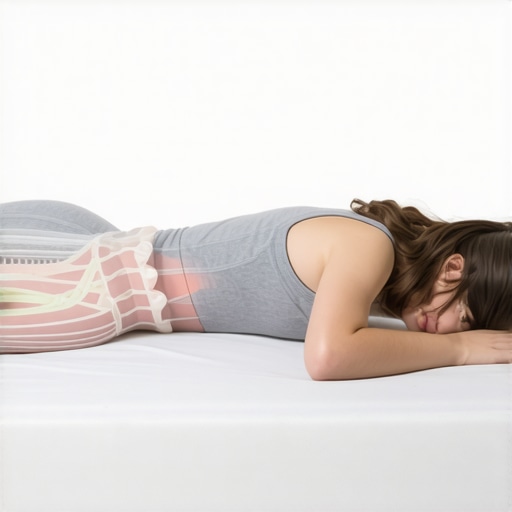
When you are testing a mattress, stop worrying about the thread count or the cooling gel and focus on the ‘Hand Gap.’ Lie down in your primary sleeping position—whether that is your back or your side—and try to slide your hand under the small of your back. In a perfect scenario, there should be just enough resistance that your hand barely fits. If your hand slides through with zero effort, the mattress is too firm and isn’t contouring to your spine. If you can’t get your hand under there at all because you’ve sunk deep into the material, the mattress is too soft and is swallowing your natural alignment. This lack of support is often why people experience sharp pain during those first few steps out of bed. You want a surface that acts like a custom orthotic for your entire body, filling the gaps without forcing the spine into an unnatural straight line.
Choose Materials That Push Back
Think of mattress materials like suspension on a car. You want enough ‘give’ to absorb the bumps (your shoulders and hips) but enough ‘push’ to keep the chassis (your spine) from scraping the ground. Traditional memory foam is a ‘dead’ material—it contours well but has very little push-back, which can be a nightmare for people who already struggle with scoliosis curves or hypermobility. Latex or high-density hybrids, on the other hand, offer an active response. They fill the lumbar gap while simultaneously supporting the heavier pelvic region. If you find yourself waking up with a ‘stuck’ feeling, it’s likely because your bed lacks this active tension. This is also why many people find that a specific morning routine is the only way to unstick the joints that the bed has essentially locked into place over eight hours. Don’t be afraid to spend thirty minutes laying on a floor model; your spine deserves more than a thirty-second ‘poke’ test.
Align Your Pelvis to Protect Your Discs
Your mattress choice should also account for how much force you typically put on your spine during the day. If you are an athlete or someone who lifts heavy, your discs are already dealing with significant spinal compression throughout your waking hours. Your bed is the only time those discs get to rehydrate and expand. If your mattress forces your pelvis into an anterior or posterior tilt, you are essentially continuing that compression all night long. I once worked with a patient who couldn’t figure out why his sciatica flared up every morning. We realized his mattress was so soft that his heavy hips were sinking four inches deeper than his torso, pulling on the sciatic nerve for hours. Once we swapped him to a medium-firm hybrid that stabilized his pelvic floor, his morning symptoms vanished within ten days.
The Myth of the ‘Bone Out of Place’
We need to have a serious talk about what actually happens during an adjustment. For years, the industry leaned on the ‘bone out of place’ theory—the idea that your vertebrae are sliding around like loose bricks and need to be hammered back into a slot. This is a massive oversimplification that leads many patients down a path of frustration. In reality, your spine is incredibly robust. If a bone were truly ‘out’ of its anatomical position, you wouldn’t be walking into a clinic; you would be in an emergency room. The truth is more nuanced: what we are treating is joint dysfunction or restricted mobility. When a joint stops moving through its full range, the surrounding muscles lock up, leading to the neurological feedback loop that we perceive as pain. Understanding this distinction is the first step toward moving from ‘fixing’ your back to ‘optimizing’ it.
Does the ‘Pop’ Actually Mean Your Spine is Straight?
One of the most common mistakes I see is patients chasing the sound rather than the function. That audible ‘pop’ is simply cavitation—the release of gas from the joint capsule. While the science behind that popping sound is satisfying, it isn’t a measurement of success. In fact, some of the most effective mobilizations I perform are completely silent. The trap here is that many people become addicted to the sound and start cracking their own neck for relief. When you do this, you are usually just moving the joints that are already hypermobile (too loose) while the actual ‘stuck’ segment remains frozen. This creates a cycle of temporary relief followed by even more instability.
Passive Care is a Trap That Stalls Your Recovery
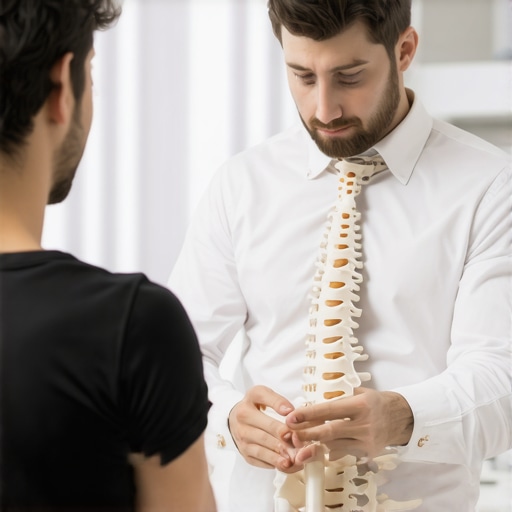
Here is my contrarian take: If you are seeing a practitioner for months and they are only adjusting you without giving you movement homework, you aren’t in rehab; you’re in a subscription service. Passive care (where things are done to you) is fantastic for opening a ‘neurological window’ of reduced pain, but it is active care (where you do the work) that actually rewires your movement patterns. A study published in the Journal of the American Medical Association (JAMA) found that for acute low back pain, spinal manipulation is most effective when paired with patient education and active exercise. If you don’t use that post-adjustment window to revolutionize your rehab through movement, you are just waiting for the old, dysfunctional patterns to pull you back into pain. This is precisely why most Omaha chiropractors miss the mark—they ignore the ‘active’ half of the equation.
Are You Ignoring the ‘No Pain, No Gain’ Fallacy?
In the world of sports rehab, there is a dangerous nuance people often miss: the difference between ‘good’ hurt and ‘bad’ hurt. I’ve seen athletes push through sharp, radiating pain because they believe the truth about no pain no gain applies to every injury. It doesn’t. If an exercise or an adjustment causes a sharp, electrical sensation, your nervous system is going to guard that area even harder, making your stiffness worse the next day. We want to challenge the tissue without triggering a protective spasm. Have you ever fallen into this trap of thinking you had to ‘tough it out’ only to find yourself back at square one? Let me know in the comments. We need to stop treating the spine like a mechanical object and start treating it like a living, breathing communication network. When you respect the nuances of your own physiology, you stop being a victim of your ‘bad back’ and start becoming the architect of your own recovery.
Stop Rolling Your Lower Back Like Dough. If there is one thing that drives me up the wall, it is seeing someone at the gym frantically foam rolling their lumbar spine. Your lower back consists of mobile segments that require stability, not more aggressive mashing. When you use the best way to use a foam roller for it band relief, you are targeting dense fascia that can handle the pressure. However, mashing your lumbar discs with a hard cylinder is a recipe for an inflammatory flare-up. Instead, I focus on the ‘hidden’ culprits that pull the spine out of alignment from the front. For me, that means addressing the psoas. I personally use a specialized psoas release tool because it is the only thing that can reach deep enough to unstick my hip flexors after a long flight. Learning how to safely stretch your psoas without hurting your back was a massive turning point in my personal recovery and stopped the constant tug-of-war in my pelvis.
The Three Tools I Refuse to Travel Without
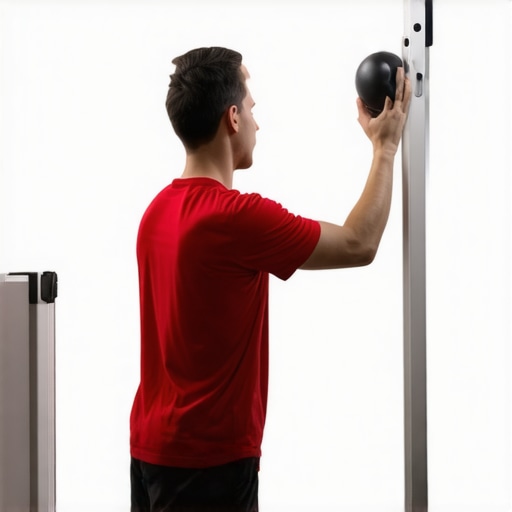
A lacrosse ball is my secret weapon for long-term maintenance. I use it against a hotel wall to pin and stretch the muscles between my shoulder blades every single night. Unlike a bulky foam roller, a lacrosse ball is precise. It allows for how to use a lacrosse ball for better thoracic mobility by targeting the specific costotransverse joints where your ribs meet your spine. I also keep a heavy-duty resistance band in my bag. It is not just for ‘toning’; I use it to reinforce the correct way to brace your core for heavy carries before I lift my luggage. If I cannot maintain internal pressure during a heavy lift, the best adjustment in the world will not stay ‘set’ for more than an hour. Finally, I never leave home without a firm lumbar roll for my car seat to prevent that ‘slumped’ posture that ruins my gait before I even arrive at my destination.
How can I maintain my spinal health for the next twenty years?
Maintenance is not about avoiding movement; it is about movement hygiene. Dr. Stuart McGill, the world-renowned spine biomechanist and author of Back Mechanic (2015), emphasizes that ‘spinal hygiene’—the way you brush your teeth, tie your shoes, and sit at your desk—dictates your long-term success more than any single 30-minute gym session. This is why essential tips for managing back pain through healthy lifestyle choices often focus on the small, repeated micro-movements we do when we think nobody is watching. I personally commit to the ‘McGill Big 3’ every single morning. These are the best core exercises for people who hate planks because they build endurance in the stabilizers without crushing the discs through repetitive flexion. If you want strategic chiropractic solutions for long-term back health, you have to stop viewing your back as something that needs ‘fixing’ and start viewing it as a living system that needs daily stewardship.
Biofeedback Sensors Are the Future of Posture
I predict that within the next decade, we will move away from static ergonomics and toward active, wearable biofeedback. We are already seeing the rise of IMU (Inertial Measurement Unit) sensors that can track spinal curvature in real-time with surgical precision. Imagine a world where your smartphone gives you a gentle haptic nudge the second your thoracic spine starts to round during a deep work session. This technology will take the guesswork out of sports rehab and turn every hour of your day into a subtle corrective session. Until those sensors are built into our clothing, the burden of awareness is on you. My challenge to you is to try the ‘Hand Gap Test’ from the previous section tonight, then swap your foam roller for a lacrosse ball on your mid-back tomorrow morning. Your spine will thank you by the time you finish your first cup of coffee.
The Hardest Truth About Chronic Stiffness
After years of working with patients and managing my own back health, I realized that the “perfect” solution doesn’t come in a box. Here are three things I wish I’d known sooner: Chasing the sound of a joint release is a distraction. That audible ‘pop’ is satisfying, but the science behind that popping sound proves it’s not a reset button for your skeletal alignment. Secondly, your bed isn’t a healer—it’s a recovery platform. If it doesn’t respect your specific lumbar arch, even the best role of chiropractic care in effective sports injury recovery will only feel like a temporary band-aid. Finally, movement is the only thing that actually sticks. Passive care opens the neurological window, but you have to walk through it with active habits to keep the pain from returning.
#IMAGE_PLACEHOLDER_E#
The Gear and Wisdom I Carry Everywhere
I am often asked what tools actually make a difference versus what is just expensive plastic marketed to desperate people. For me, it comes down to these three essentials: The Lacrosse Ball: Forget the bulky foam rollers; this allows for better thoracic mobility by hitting the tiny spots where your ribs meet your spine. Stuart McGill’s ‘Back Mechanic’: This book is the gold standard for understanding how to move without crushing your discs. Strategic Solutions: I rely on strategic chiropractic solutions for long-term back health rather than just quick fixes. These resources shift the power back to you, allowing you to manage your own spine without feeling like you need a daily adjustment.
Take Back the First Five Minutes of Your Day
You don’t need to overhaul your entire life to see results. It starts with small, consistent wins—like doing a proper morning warm-up or knowing how to manage a flare-up of chronic lower back pain before it ruins your weekend. Your spine is the pillar of your mobility and your athletic potential. By choosing a mattress that supports your unique anatomy and pairing it with smart movement, you’re not just avoiding pain; you’re investing in a more active, capable future. If you’re ready to stop the cycle of stiffness and start a plan that works for your unique body, feel free to contact us for a personalized assessment.
Have you ever noticed that your back pain feels significantly worse on certain hotel mattresses, or have you found a specific tool that changed the game for your recovery? Let me know in the comments below!