
I remember the exact Tuesday it happened. I was finishing up a project, reached for my lukewarm coffee, and a bolt of white-hot lightning shot from my lower back straight down to my right heel. I couldn’t move. I literally had to slide off my expensive mesh chair and crawl across my kitchen floor just to find a position that didn’t feel like an electric shock. I thought I was being smart by investing in a ‘pro’ setup, but I was actually setting a trap for my own nervous system. Today, I am going to show you exactly why your current seat is betraying you and how we can flip the script on that leg pain for good.
The Morning I Had to Crawl Across My Kitchen Floor
I made a massive mistake early in my journey with back health. I bought a high-end chair and assumed the price tag acted as a shield against poor habits. I sat for eight hours straight without a single break because the cushion felt fine, even while my nerves were screaming. This kind of static loading is exactly why your sciatica gets worse when you drive long distances or sit through endless meetings. My body wasn’t designed to be a statue. I learned the hard way that even the best furniture can’t fix a lack of movement or a poor pelvic tilt. If you are feeling that familiar throb right now, you might need to discover how chiropractic adjustments can alleviate chronic back pain by resetting the alignment your chair is slowly dismantling. Have you ever noticed your toes going numb after an hour of typing?
Your Desk Chair Acts Like a Nutcracker for Your Nerves
It is a simple matter of physics. When you sit, the pressure on your spinal discs can jump by nearly 40 percent compared to when you are standing. According to the Mayo Clinic, this increased pressure is a leading contributor to disc herniation, which is the primary bully behind sciatic nerve pain. Most office chairs, even the fancy ones, encourage a ‘C-shaped’ slump. This posture pushes your lumbar discs backward, right into the path of your sciatic nerve. It is like stepping on a garden hose. If you are struggling with a cramped environment, learning how to set up a home office in a small space without ruining your back is the first step toward survival. Small tweaks, like adjusting your armrest height to take the weight off your shoulders, can ripple down and change how your lower back handles the load.
Is a fancy ergonomic chair actually worth the money?
I get asked this all the time, and the answer is usually a frustrating ‘maybe.’ A thousand-dollar chair is a tool, not a cure. If you haven’t addressed the underlying structural issues, you’re just putting a silk pillow on a broken bed. Many people spend a fortune on gear only to realize that working from the sofa for ‘just an hour’ did more damage than the chair could ever fix. We need to look at the foundations of how you sit, not just what you sit on.
Reset the Foundation: Your Pelvis is a Bowl of Water
To fix the ‘nutcracker’ effect on your nerves, you have to stop thinking about your back and start thinking about your pelvis. Imagine your pelvis is a bowl filled to the brim with water. When you sit in a typical office chair, that bowl usually tips backward, spilling water over your tailbone. This is the ‘C-shape’ slump that crushes your discs. To fix this, you need to find a ‘neutral’ tilt. Sit on your sit-bones—those hard points in your glutes—and roll your pelvis slightly forward until the bowl is level. This simple shift creates an immediate natural arch in your lower back, taking the direct pressure off the sciatic nerve. If you find this impossible to maintain, it is often because why your desk chair is making your hip flexors tight; those muscles are literally pulling your pelvis out of alignment the moment you sit down.
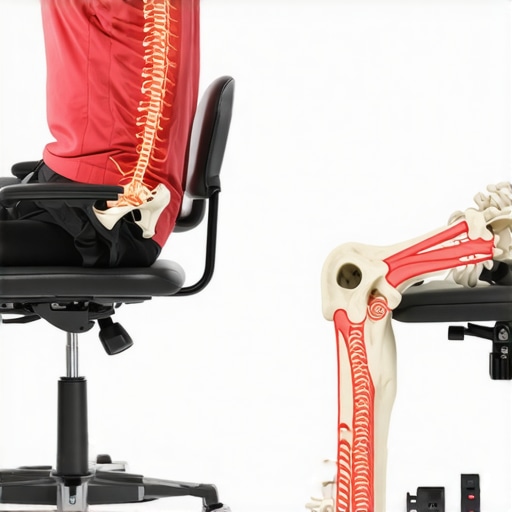
Kill the Static Load with the 20-Minute Rule
Movement is the only real currency your spine accepts. I used to pride myself on ‘grinding’ for three hours straight without standing up. I thought I was being productive, but I was actually suffocating my spinal discs. Discs don’t have a direct blood supply; they rely on movement to ‘pump’ nutrients in and waste out. I now live by the 20-minute rule: every twenty minutes, I stand up for exactly sixty seconds. You don’t need a full workout; just a quick reach for the ceiling or a few steps around the room. This tiny ‘reset’ prevents the static loading that leads to inflammation. Incorporating these essential tips for managing back pain through healthy lifestyle choices turned my workday from a physical endurance test into something actually sustainable.
Stop Being Your Own Chiropractor
I learned this lesson the hard way during a particularly bad week of leg pain. I tried a ‘self-adjustment’ by twisting violently over the back of my dining room chair. I heard a loud pop, felt a wave of instant nausea, and ended up stuck in a semi-fetal position for two days. Cracking your own joints is like scratching an itch—it feels good for a second because of a temporary endorphin release, but you aren’t actually moving the segment that is stuck. Usually, you are just over-stretching the joints above or below the problem area. This is exactly why you should stop cracking your own neck for relief or trying to ‘self-pop’ your lower back. You are creating hypermobility in the wrong places, which makes your spine even less stable. True relief comes from strategic chiropractic solutions for long-term back health that target the specific vertebrae causing the nerve interference, rather than just making noise.
Tactical Adjustments to Your Workspace
Your chair height is probably wrong. If your hips are lower than your knees, you are forcing your lower back to round. Raise your chair until your hips are slightly higher than your knee joints. This opens up the hip angle and makes that ‘neutral bowl’ position much easier to hold. For a quick win, try the 5-second fix for slouching at your laptop by pulling your chin back—not up—to align your ears over your shoulders. This ‘neck tuck’ reduces the weight your lower back has to stabilize. I used to think these tweaks were too small to matter, but when I finally combined them with professional care, the ‘electric shocks’ in my heel vanished. Consistency in these mechanics is the difference between a career of pain and a career of performance.
Stop Stretching Your Pain into Permanence
Most people assume that if their back hurts, they need to pull, twist, and elongate the muscle. In reality, you might be over-sensitizing an already irritated nerve. If you have been doing ‘child’s pose’ every morning and still feel that lightning bolt in your leg, you are likely experiencing the ‘stretching trap.’ This is why your morning stretches might be making your back more sensitive—your discs are most hydrated and pressurized right after you wake up, making them more prone to bulging under the strain of a deep forward fold. Pulling on a sciatic nerve that is already under tension is like trying to fix a frayed cable by yanking on it. You need stability, not more flexibility.
#IMAGE_PLACE_HOLDER_C#
The Pop is a Side Effect, Not the Goal
Let’s talk about the ‘pop.’ We have all seen the viral videos of massive cracks and instant relief. But here is the nuance: that sound is just a gas bubble releasing, a phenomenon known as cavitation. It feels great because of a temporary rush of endorphins, but the noise does not equal a correction. You can read more about the science behind that popping sound in your joints to understand why chasing the ‘crack’ is a dangerous game. Real progress happens when we change the mechanics of how the joint moves. This is why unlocking back pain relief with expert chiropractic adjustments requires a targeted approach rather than just making as much noise as possible.
Why does my back feel worse after a morning yoga session?
If you find yourself hobbling after a ‘gentle’ yoga class, you are probably over-rotating your lumbar spine. Your lower back is designed for stability, not high-velocity twisting. Another huge mistake is the ‘rest until it heals’ philosophy. According to a landmark study in The Lancet, prolonged bed rest is often the enemy of recovery for acute back pain. Movement is medicine, yet people still retreat to the sofa for days. I have seen patients lose weeks of progress because they thought they were protecting their back, when they were actually just letting the muscles atrophy. This is exactly why bed rest is the worst thing for acute back spasms.
The Transition to Active Recovery
If you want to truly win, you have to transition from passive care—where things are done to you—to active care, where you are an active participant. My most successful clients are those who boost your sports rehab journey with proven chiropractic strategies by layering specific stability work on top of their adjustments. The adjustment creates the window of opportunity, but your movement habits determine if that window stays open. Another nuance: people often ice their backs for far too long. While it numbs the pain, why icing your lower back might be slowing down recovery is because you are constricting the very blood flow needed to flush out the inflammatory markers. Have you ever fallen into this trap of resting too long or stretching too hard? Let me know in the comments.
The gear I actually use to keep my spine quiet
I stopped looking for ‘magic’ chairs and started looking for feedback tools. The most important piece of equipment in my office isn’t the desk itself, but a simple 12-centimeter cork ball. Most people use a lacrosse ball, and if you know how to use a lacrosse ball for better thoracic mobility, you can essentially perform a mini-maintenance session on your own mid-back every afternoon. I place it right between my shoulder blade and my spine—never on the bone—and lean into the wall. It breaks up the adhesions that form from hours of typing, which in turn prevents my lower back from having to overcompensate. I also swapped my standard mouse for a vertical one. It felt weird for three days, but it stopped the ‘pull’ on my neck muscles that was secretly contributing to my lumbar tension. When you align the small joints in your wrist, you stop the chain reaction of tightness that ends in your hips.
How do I keep my back from locking up again?
Maintenance is about frequency, not intensity. I treat my spine like a high-performance engine that needs a regular oil change rather than a complete overhaul once a year. This means sticking to strategic chiropractic solutions for long-term back health rather than waiting for a crisis to book an appointment. I personally use a ‘check-in’ model: I visit my chiropractor once a month even if I feel 100 percent. Why? Because they can often feel a segment that has lost its ‘play’ or normal motion before it becomes a full-blown spasm. This proactive approach is the core of enhancing athletic performance with targeted chiropractic care. If you wait until you can’t walk, you aren’t doing maintenance—you’re doing damage control.

Brace like a pro to stop the micro-tears
One technical detail people miss is ‘intra-abdominal pressure.’ According to a study published in the Journal of Electromyography and Kinesiology, improper activation of the deep core muscles during mundane tasks—like picking up a fallen pen—can lead to cumulative micro-trauma in the lumbar discs. I had to relearn the correct way to brace your core for heavy carries, even if I was just carrying a bag of groceries. You don’t suck your stomach in; you ‘expand’ your midsection 360 degrees, like a canister. This creates a cushion of air and muscle that protects the nerves I mentioned earlier. If you can master this ‘canister breath’ while sitting, you reduce the mechanical load on your L5-S1 disc by nearly 20 percent.
Why your shirt might soon tell you to stand up
I predict that in the next five years, we will see a massive shift toward wearable biomechanical feedback. We already have watches that track heart rate, but the next frontier is ‘smart fabrics’ that detect when your pelvis tilts into that dangerous ‘water bowl’ spill I described. We are moving away from passive furniture and toward active awareness. Until those shirts are affordable, I use a simple app that pings my desktop every 20 minutes. It is a digital leash, but it is the only way to combat the ‘flow state’ that makes us forget our bodies exist. If you want to see a real change, try the ‘lacrosse ball reset’ I mentioned tonight before bed. Just two minutes on each side of your upper back can change how your entire spine feels when you wake up. Don’t wait for the lightning bolt to strike again; build a fortress around your nerves today.
Hard Lessons from the Desk-Bound Trenches
Looking back at that Tuesday I spent crawling across the kitchen floor, I realize my biggest mistake wasn’t the chair I bought; it was the belief that my spine was a static object. Here is the insider truth: pain is often the very last signal your body sends, not the first. By the time you feel that lightning bolt, the mechanical failure has been brewing for months. I have learned that consistency always beats intensity. You cannot fix a week of slouching with one massive gym session or a single long stretch. It requires strategic chiropractic solutions for long-term back health that focus on micro-adjustments to your daily habits. Another epiphany? Your body is not fragile—it is just highly adaptable. If you train it to be a C-shape, it will excel at being a C-shape. We have to train it back into its natural, powerful curves.
The Gear That Actually Saved My Career
If you are looking to build your own toolkit, do not get distracted by flashy marketing. I swear by three specific things that changed my life. First, the Back Mechanic by Dr. Stuart McGill; it is the definitive manual for anyone who wants to understand their own spine. Second, a simple, firm lumbar roll is worth ten ergonomic mesh chairs because it forces that pelvic bowl into the right tilt. Third, I always keep a lacrosse ball nearby. Learning how to use a lacrosse ball for better thoracic mobility was a game-changer for my mid-back stiffness. These are not just gadgets; they are active participants in managing back pain through healthy lifestyle choices. I trust them because they put the control back into my hands rather than relying on a furniture designer.
#IMAGE_PLACEHOLDER_E#
Your Spine Deserves a Fresh Start
You do not have to accept that stiff back as a permanent part of your identity. Whether you are an office worker or an athlete, understanding how spinal alignment affects your balance and stability is the first step toward moving without fear. It is about more than just avoiding pain; it is about regaining the freedom to reach for a coffee, lift a child, or finish a workday without counting down the minutes until you can lie down. When you combine better movement with professional chiropractic adjustments, you are not just treating a symptom; you are restoring a foundation. The road to recovery is not always linear, but as you will find in the truth about no pain no gain in sports rehab, the most meaningful progress often happens quietly, one small alignment at a time. Have you ever bought a high-end ergonomic tool only to find out it made your pain even worse? Let me know in the comments below!