
I remember the morning my L5-S1 disc finally gave up on me; I reached for a simple coffee mug and a bolt of lightning shot from my lower back straight to my heel. I spent the next three weeks basically crawling to the bathroom, feeling every bit of my spine compressing like a rusty accordion. When you are that desperate, you start looking at late-night infomercials differently. I eventually bought an inversion table, thinking it was the ‘magic’ cure-all that would finally pull my vertebrae apart and let me breathe again. But here is the thing: I almost made everything worse because I didn’t understand the nuance of spinal decompression. Today, I want to peel back the curtain on whether these gravity-defying machines are a godsend or a gimmick for your specific injury. We are going to dive into the mechanics of relief and why your approach to the difference between a disc bulge and a disc herniation changes everything about how you should use one. Have you ever felt like your spine was just one inch too short for your body?
Gravity is the Constant Weight You Never Noticed
For years, I just assumed my back pain was a muscle thing. I spent a fortune on massage guns and heating pads, but the real culprit was the relentless downward pressure of living on Earth. Think of your spinal discs like jelly donuts; when you stand or sit all day, gravity squeezes them flat. If you are already dealing with a structural issue, that pressure is a recipe for a flare-up. I made the classic rookie mistake of hopping on my new table and flipping completely vertical for twenty minutes on day one. I woke up the next morning feeling like I’d been hit by a truck because my ligaments weren’t ready for that sudden shift. It is crucial to know how to manage a bulging disc without using opioids, and while inversion is a tool, it is not a toy.
Can flipping upside down really fix a herniated disc?
The skepticism is valid. Many people worry they’ll just end up dizzy or, worse, snap something. While inversion doesn’t ‘pop’ a disc back into place like a Lego piece, it creates a temporary state of negative pressure. According to research published in the Journal of Physical Therapy Science, mechanical traction can successfully reduce the size of a disc protrusion by creating space for rehydration. However, it’s a temporary window of relief, not a permanent structural fix. If you don’t use that window to strengthen your stability, you’re just a human yo-yo. In fact, jumping into heavy stretching right after inverting is often why most core exercises actually make lower back pain worse. You have to be strategic, or you’re just irritating an already angry nerve.
Stop Flipping Like a Pancake
The biggest mistake I ever made was thinking that more gravity meant more healing. I remember strapping my ankles into the foam rollers, taking a deep breath, and swinging all the way back until my hair was touching the floor. I stayed there for ten minutes, convinced I was ‘fixing’ my L5-S1. When I finally came back up, the pain wasn’t gone; it had localized into a sharp, hot poker sensation. My muscles had gone into a protective spasm because I shocked the system. Before you even touch the handles, you need to find your balance point. Your goal is to be a see-saw, not a pendulum. If you haven’t yet determined the source of your agony, learning how to identify if your back pain is muscular or nerve related is your first step before ever going upside down. Start at a measly 15-degree angle. It feels like nothing, but it is enough to begin the process of fluid exchange in the discs without triggering a ‘red alert’ from your nervous system.
The 3-Minute Pulse Method
Instead of staying inverted for a long stretch, I found success using what I call the ‘pulse.’ I would go down to a 20 or 30-degree angle for one minute, then pull myself back to level for thirty seconds. This oscillation acts like a pump for your spinal discs. Think of it like wringing out a wet sponge and then letting it soak back up fresh water. This is especially effective if you are already trying to how to sit without compressing your l5-s1 disc during your work hours. You are essentially reversing the daily damage in controlled bursts. 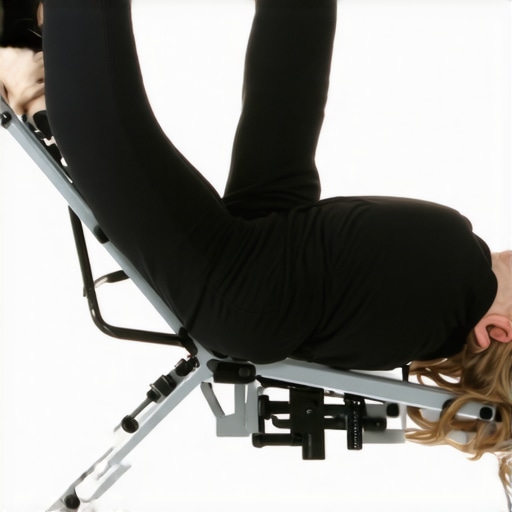
Why Your First Minute Must Be Boring
If you feel a massive stretch immediately, you’ve gone too far. The ‘meat’ of this process happens when the muscles relax enough to let the traction reach the actual joints. During one of my worst flare-ups, I spent three days doing nothing but 10-degree inversions. I felt like I was wasting my time until I realized I could finally put my socks on without gasping. The secret wasn’t the angle; it was the relaxation. This is why I always tell people that learning how to breathe through your belly for instant lower back relief is the engine that drives inversion. If you are holding your breath while upside down, your core is bracing, and that bracing prevents the spine from decompressing. You have to ‘trick’ your body into letting go.
The Horizontal Rest is Non-Negotiable
The most dangerous part of inversion is actually the moment you stand back up. Gravity returns with a vengeance, and if you go from upside-down to vertical in two seconds, your discs slam back together like a car door. After you finish your session, stay in the horizontal position for at least two full minutes. This allows the internal pressure to normalize. I learned this the hard way after a session where I jumped off the table to answer the door and ended up on the floor in a heap. If you find that your relief disappears the moment you hit the floor, it might be the truth about why your adjustments dont seem to last—you lack the immediate stability to hold that new space. Use those two minutes to gently engage your transverse abdominis before your feet ever touch the ground.
Stop Rolling Your Lower Back Like Bread Dough
We’ve all seen the person at the gym spending twenty minutes agonizing over a foam roller, trying to ‘mash’ their lower back into submission. I used to be that person until I realized I was actually shearing my lumbar vertebrae. Here is the contrarian truth: your lower back is designed for stability, not mobility. When you aggressively roll that area, you’re often irritating the very nerves you’re trying to soothe. This is a classic ‘oops’ factor in home rehab. Instead of helping, you are likely creating micro-instability that forces your muscles to guard even harder. If you’ve been doing this, it’s exactly why you should never roll your lower back on a foam roller. The ‘tightness’ you feel is often a protective tension, not a short muscle that needs mashing.

Why do my adjustments vanish after 48 hours?
This is the question that separates the casual patient from the expert. You get adjusted, you feel like a new human, and then by Tuesday afternoon, the old ache returns. Most people blame the chiropractor or their mattress, but the reality is often neurological. Your brain has spent years ‘mapping’ your body in a dysfunctional state. An adjustment provides a new input, but your nervous system is a creature of habit. Research published in the Journal of Manipulative and Physiological Therapeutics suggests that spinal manipulation actually changes the way the prefrontal cortex processes information, essentially ‘rebooting’ the system. However, if you don’t reinforce that reboot with movement, the brain defaults to its old, painful software. Understanding the truth about why your adjustments dont seem to last is about realizing that the table time is just the catalyst; the real work happens in how you move between visits.
The Brain-Spine Connection No One Talks About
I see it all the time in sports rehab: athletes who think they just need a ‘pop’ to get back in the game. But how spinal alignment directly impacts your athletic performance goes far beyond mechanical clicks. It’s about proprioception—your brain’s ability to know where your limbs are in space. When your spine is locked up, that signal is ‘noisy.’ You might think you’re tight and need to stretch, but often why stretching your hamstrings wont fix your chronic tightness is because the brain is keeping them tight to protect a vulnerable spine. You cannot stretch your way out of a neurological defense mechanism. To get lasting results, you need strategic chiropractic solutions for long-term back health that address the pattern, not just the pain. Have you ever fallen into the trap of over-stretching or over-rolling only to feel worse? Let me know in the comments—I’ve been there, and the path out is often the opposite of what we’re told.
I used to think that my weekly adjustment was a hall pass to treat my body like trash for the other six days. I would walk out of the clinic feeling like a million bucks, then spend four hours slumped in my car seat, effectively undoing every millimeter of progress. The real shift happened when I realized that maintenance isn’t a chore; it is an environmental audit. If you are a road warrior like I was, you need to look at how to optimize your car seat for lumbar support because your car is often the ‘crime scene’ where your back pain begins. I started carrying a simple D-shaped lumbar roll everywhere—the cinema, my office, even long flights—and it did more for my L5-S1 than any $5,000 massage chair ever could.
How do I maintain my spinal health over time?
The secret isn’t more stretching; it is smarter bracing. Dr. Stuart McGill, a leading expert in spine biomechanics and author of Back Mechanic, emphasizes that the goal of the spine is to be a rigid beam that transfers force, not a flexible noodle. I started implementing his ‘Big 3’ exercises daily. This focus on stability is exactly what leads to strategic chiropractic solutions for long-term back health. Instead of chasing the next ‘pop,’ focus on building a muscular corset. If you are struggling with those stubborn spots between your shoulder blades, stop trying to stretch them out. I personally use a lacrosse ball for two minutes every evening to pin and move the tissue. Learning how to use a lacrosse ball to melt away mid-back knots was a game-changer for my thoracic mobility without compromising my lumbar stability.  Beyond the tools, we have to look at the ‘why’ behind our movement. If you are an athlete, you need to understand the role of chiropractic care in effective sports injury recovery as a way to recalibrate your nervous system, not just fix a bone. If you find your progress stalling, look at your feet. Often, how to vet your running shoes for proper arch support can be the missing link for chronic SI joint issues. I predict that the next frontier of back health will be wearable biofeedback sensors that alert you when your pelvic tilt starts to shear your discs during a squat or a long walk. We are moving toward a world of ‘pre-habilitative’ data where your phone tells you you’re about to have a flare-up before it even starts. For now, your best tool is consistency. Don’t wait for the lightning bolt to strike again. Use essential tips for managing back pain through healthy lifestyle choices like walking in 15-minute intervals rather than one long hour-long slog. When you combine the right gear with chiropractic techniques for faster recovery, you stop being a victim of your biology. I challenge you to try this today: set a timer for every 30 minutes of sitting and perform a 10-second ‘bracing’ check where you stiffen your core as if someone is about to poke you. It sounds too simple to work, but it is the difference between a spine that thrives and one that merely survives.
The Hardest Lessons My L5-S1 Ever Taught Me
Reflecting on my journey, I realized that relief isn’t a destination—it’s a maintenance schedule. I spent years waiting for a ‘silver bullet’ like an inversion table to fix me, but the real breakthrough came when I understood that the science behind chiropractic adjustments for back pain relief is about neurological recalibration, not just bone-cracking. I learned that pain is a signal to change how I move, not just a nuisance to be stretched away. Most importantly, I discovered that consistency in small habits—like proper bracing—is far more powerful than a sporadic 20-minute inversion session. It’s about being the CEO of your own recovery rather than a passive passenger on a treatment table.
A Short List of Gear That Actually Works
If you’re tired of wasting money on gimmicks, here is what is actually in my daily kit. First, a firm D-shaped lumbar roll is essential; I never leave home without knowing the best way to support your lumbar spine while driving long distances. Second, I keep a lacrosse ball in my gym bag to manage upper back tension; learning how to use a lacrosse ball to melt away mid-back knots saved my shoulders during my desk-bound years. Finally, find a copy of Dr. Stuart McGill’s Back Mechanic. It provides the structural foundation you need to understand why your spine behaves the way it does and how essential tips for managing back pain through healthy lifestyle choices can prevent the next ‘bolt of lightning’ from ever striking.
The First Step Toward a Life Without Constant Back Pain
You don’t have to live in fear of your next sneeze or sudden movement. By combining tools like controlled decompression with unlocking back pain relief expert chiropractic adjustments that work, you can build a resilient body that handles the demands of daily life. The road to recovery isn’t always linear, but every small adjustment you make to your posture and bracing counts. Start today by simply noticing how you sit. You have the power to change your spinal trajectory. Have you ever tried an inversion table or a specific chiropractic method that completely changed your perspective on back pain? Let me know in the comments below!