
I’ll never forget the rainy Tuesday when my three-year-old decided her legs simply stopped working right in the middle of a crowded grocery store. I did what any tired parent would do: I scooped her up with a quick, jerky twist to get us out of the way. Big mistake. That familiar, hot needle of pain shot straight through my lumbar spine, and I realized I’d just fallen for the same trap I warn my patients about every single day. Even as someone who deeply understands the science behind chiropractic adjustments, I let my guard down. We think because they are our kids, our bodies will somehow magically compensate for the awkward, shifting weight. They don’t. In that moment, I wasn’t an expert; I was just another dad with a seized-up lower back and a very confused toddler.
Your Hip Isn’t a Shelf
In my early days of parenting, I was the king of the ‘hip-hitch.’ I’d kick my right hip out, let my daughter rest there like a sack of flour, and go about my business. I thought I was being efficient. In reality, I was practically begging for an SI joint imbalance and a miserable case of tight hip flexors. When you shift your center of gravity that far off-axis, your spine has to pull overtime just to keep you upright. Today, we’re going to look at the lifting technique for parents that keeps your spine stacked and your core engaged, rather than just hanging on your ligaments and hoping for the best.
Is it even possible to stay pain-free with a thirty-pound baby?
The short answer is yes, but it requires a total mental shift. You have to treat your toddler like a heavy kettlebell, not a fashion accessory. Research published in the Journal of Biomechanics suggests that lifting an object even a few inches away from your center of mass increases the compressive load on your lower back exponentially. That means your 25-pound toddler can feel like a 200-pound deadlift if your form is sloppy. Have you ever noticed that your back feels ‘fragile’ after a long weekend of park trips and piggyback rides? That’s your body screaming for a better mechanical approach. I want to help you avoid the cycle of temporary relief and constant flare-ups. If you’ve been wondering why your adjustments don’t seem to last, the culprit is almost certainly how you’re moving during the sixteen hours a day you aren’t in a clinic. Let’s look at how to rebuild your carry from the ground up.
Move With Your Hips and Not Your Spine
The first rule of toddler-lifting is to stop treating your back like a crane. When you bend at the waist with straight legs, you’re essentially using your lower vertebrae as a literal hinge for a heavy lever. Instead, you need to master the hip hinge secret for people with chronic lumbar issues. Think of your hips as a powerful, hydraulic piston. By pushing your glutes back and keeping your shins vertical, you transfer the weight to your strongest muscles rather than your smallest discs. I remember a particularly chaotic morning trying to get my daughter into her car seat while holding a coffee and a diaper bag. I tried to do the ‘reach and twist’—the ultimate back-killer—and felt that sickening pop. Since then, I’ve learned to square my shoulders to the seat and step into the car, keeping the ‘kettlebell’ (my kid) tight to my chest. It felt slower at first, but it saved me three days of bed rest.
Brace Your Core Before the Struggle
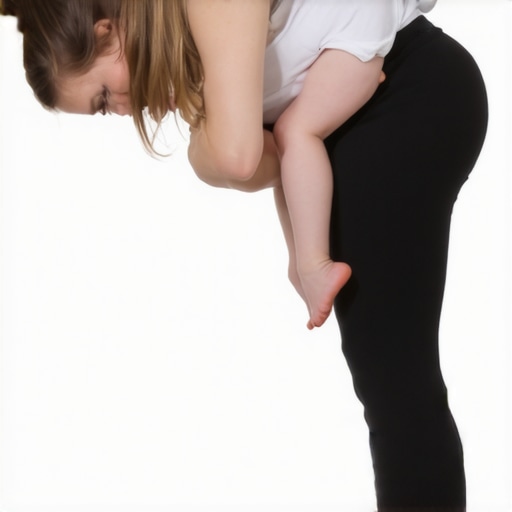
Most parents wait until they feel a strain to tighten their muscles. By then, it’s too late. To protect yourself, you need to learn how to breathe through your belly for instant lower back relief and stability. Imagine you’re about to be punched in the stomach; that 360-degree expansion is what creates intra-abdominal pressure, acting like a built-in weightlifting belt. If you find yourself constantly ‘sucking in’ your stomach to look thinner, stop. You’re actually turning off your primary stabilizers, which is why most core exercises actually make lower back pain worse when performed without proper bracing. Before you reach for the toddler, take a deep belly breath and hold that tension until the lift is complete.
Keep the Load Against Your Chest
Remember that physics lesson about leverage? The further an object is from your center of gravity, the heavier it ‘becomes’ for your tissues. When your child is squirming or reaching for a toy, the temptation is to hold them out at arm’s length. Don’t. You need to hug them close, nearly touching your sternum. This reduces the shearing force on your lumbar spine significantly. If you’re struggling to figure out how to identify if your back pain is muscular or nerve related, pay attention to when the pain spikes. If a close-to-chest carry is fine but an extended reach causes a shooting tingle, you’re likely dealing with disc compression that needs immediate mechanical correction.
Stop the One-Sided Hip Carry
We all do it—the ‘lazy’ carry where the kid sits on one hip while we stir a pot or talk on the phone. This creates a massive lateral shift in the pelvis. Over time, this repetitive strain is the reason you might feel like your pelvis is ‘out,’ and it’s why your chiropractor checks your leg length every visit. If you must carry them on a hip, you have to switch sides every few minutes. Better yet, use a structured carrier or encourage them to walk. Your spine isn’t designed to be a permanent kickstand for thirty pounds of wiggly toddler.
Most of my patients come in complaining that their back ‘feels tight’ and they’ve spent the morning doing long, static hamstring stretches to ‘loosen it up.’ Here’s the contrarian truth: that tightness isn’t a muscle length problem; it’s a neurological protection mechanism. Your brain is essentially pulling the emergency brake to prevent further injury. When you force a stretch on a guarded muscle, you aren’t helping; you’re actually tugging on sensitized nerves, which is why your morning stretches might be making your back more sensitive. In my experience, the more you fight the tension with aggressive mobility work, the more the body recruits other muscles to lock down the area, leading to a cycle of chronic stiffness that feels impossible to break.
Your Brain is Pulling the Emergency Brake
We often fall into the trap of thinking our bodies are just mechanical pulleys and levers. They aren’t. They are controlled by a nervous system that prioritizes safety over range of motion. If your lumbar spine feels unstable because of a minor disc irritation, your hamstrings will tighten up to act as secondary stabilizers. If you successfully ‘stretch’ them out, you’ve just removed the only thing holding your pelvis steady. This is a classic nuance in boost your sports rehab journey with proven chiropractic strategies. Instead of attacking the tightness, we need to address the underlying instability. A study published in Clinical Biomechanics by Dr. Stuart McGill highlights that repetitive end-range flexion—the very thing you do during a toe-touch stretch—can actually delaminate disc fibers over time. It’s a common mistake that turns a minor ache into a long-term issue.

Why does my MRI show a bulge if I only feel pain occasionally?
This is the question that keeps parents up at night after they finally get imaging. Here’s the secret: your MRI is a snapshot, not a sentence. Many people with zero back pain have significant disc bulges or degenerative changes. If you’ve been trying to figure out how to read your mri report without panicking, remember that the clinical picture—how you move and where you hurt—matters more than the picture on the film. Understanding the difference between a disc bulge and a disc herniation is important, but neither is a guarantee of permanent pain. The ‘trap’ is assuming the bulge is the only cause of your symptoms, leading you to avoid movement altogether. In reality, why bed rest is the worst thing for acute back spasms is because it allows the surrounding tissues to become even more deconditioned and sensitive.
The Trap of the Passive Recovery Mindset
Another nuance people miss is the ‘no pain, no gain’ fallacy in rehabilitation. While you need to push yourself, there is a massive difference between therapeutic discomfort and ‘threat’ pain. If a movement causes a sharp, lightning-bolt sensation, your nervous system registers that as a threat and resets your progress. I always tell my patients that the truth about no pain no gain in sports rehab is that we want to work right at the edge of your tolerance without crossing it. Have you ever fallen into the trap of ‘powering through’ a stretch only to feel worse the next day? Let me know in the comments. We need to stop treating the symptoms and start respecting the neurological signals our bodies are sending us. True recovery isn’t about how far you can reach; it’s about how well you can stabilize the reach you already have.
Maintenance isn’t about being perfect; it’s about having a fail-safe system when life gets chaotic. Once you’ve moved past the acute phase of pain, the goal shifts from recovery to resilience. I personally rely on a simple McKenzie Lumbar Roll every time I sit at my desk or drive for more than twenty minutes. It’s not a fancy gadget, but it provides the mechanical tactile feedback required to maintain a neutral spine when my postural muscles inevitably fatigue. If you’ve been searching for essential tips for managing back pain through healthy lifestyle choices, start with the environment you spend the most time in. By the time you feel the ache, you’ve likely been slumped for hours. Using a tool like this forces the lordotic curve to stay intact, preventing the passive tissues from overstretching.
Stop guessing and start tracking your movement
I often tell my patients that awareness is 90% of the cure. You can get the best expert chiropractic adjustments that work, but if you go right back to the same movement patterns, you’re just pouring water into a leaky bucket. I use a simple habit-tracking method where I perform the 10-second posture reset you can do at your desk every time I finish an email. This tiny ‘micro-break’ signals the nervous system to let go of unnecessary tension. It’s much more effective than trying to remember to ‘sit straight’ for eight hours straight. We are seeing a massive shift toward this type of neurological training in clinical practice. According to Robin McKenzie, founder of the McKenzie Method of Mechanical Diagnosis and Therapy, most back pain is ‘mechanical’ in nature, meaning it is caused by positions and movements, which also means it can be reversed by the same logic.
The two tools that live in my gym bag
Beyond the lumbar roll, I swear by a standard lacrosse ball for targeted soft tissue work. I don’t use it to just roll around aimlessly; I use it specifically for the gluteus medius and the lateral hip. When these muscles get ‘gunked up’ from sitting or improper lifting, they pull on the pelvis and cause that nagging lower back stiffness. If you want to boost your sports rehab journey with proven chiropractic strategies, you have to be active in your own care. I also recommend checking how to optimize your car seat for lumbar support, especially if you have a long commute. These small adjustments are the difference between a flare-up and a productive day. I predict that in the next few years, we will see AI-integrated ‘smart clothing’ that provides haptic feedback—a gentle vibration—the moment your spine moves out of a safe range, effectively automating the coaching I provide in my office.
How do I keep my back healthy for the long haul?
Long-term health is built on the foundation of ‘scaling’ your movements. Once you can hinge without pain, you need to start adding load. This is where strategic chiropractic solutions for long-term back health become vital. We don’t just want you ‘not hurting’; we want you strong. If you’re a parent, that means your ‘gym’ is the living room floor. Practicing your squat mechanics while picking up toys is the ultimate functional training. If you notice your knees caving or your back rounding, go back to the basics and learn how to fix the butt wink in your deep squat to protect your discs. Transitioning into enhancing athletic performance with targeted chiropractic care is the final step in the journey. My advanced tip for you today: next time you pick up your toddler, try to ‘anti-shrug’ your shoulders down and back first. This simple cue locks your latissimus dorsi into your thoracolumbar fascia, creating a natural back brace that is more powerful than any belt you can buy.
The Most Costly Mistakes I Made as a Dad with Back Pain
Reflecting on my own journey, the biggest ‘aha’ moment wasn’t a specific exercise, but the realization that my spine doesn’t care if I’m ‘busy.’ It only cares about load and position. I used to think I could ignore my form just for a ‘quick lift’ to get a crying child into a car seat, but those are the exact moments that set me back weeks. Here are the core lessons that finally stuck after years of clinical practice and personal trial and error:
- The 10% Rule: You don’t have to be perfect; you just have to be mindful. If your form is 10% more intentional today than it was yesterday, you are winning. Small improvements in essential tips for managing back pain through healthy lifestyle choices compound over time to create massive results.
- Anticipate the Wiggle: A toddler is a dynamic, unpredictable load. If you don’t brace your core before they move, your discs take the brunt of the impact. I learned to ‘lock in’ my breath before I even reached out.
- Passive Rest is a Trap: I used to think lying on the couch for three days was the cure for a flare-up. It’s actually the opposite. Controlled, intentional movement is what signals the nervous system that it’s safe to let go of the pain response.
#IMAGE_PLACEHOLDER_E#
What I Pack in My Spinal Protection Kit
You don’t need a gym full of expensive equipment to keep your back safe while raising kids. I’ve narrowed my personal essentials down to three things that actually make a difference in my daily life. First, a simple lacrosse ball for targeted glute release—this is my go-to for melting away the tension that builds up after a long day of carrying kids. Second, I highly recommend exploring the Omaha parents guide to finding a gentle pediatric chiropractor; often, ensuring your child is moving comfortably makes the lifting and carrying parts of parenting significantly smoother for everyone involved. Finally, I keep a McKenzie lumbar roll in my vehicle to maintain my spinal curve during those long commutes to school and sports practices.
Your Path to Pain-Free Playtime Starts with One Choice
You aren’t a broken machine destined for a life of ‘managing’ aches; you are a biological system that is remarkably good at adapting if you give it the right inputs. Parenting is an endurance sport, and like any athlete, you deserve a recovery plan that actually addresses the root cause. By shifting your focus from just stopping the pain to building a more resilient, stable body, you can stop fearing the floor and start enjoying the moments that matter most. If you’re ready to break the cycle of constant stiffness, seeking out unlocking back pain relief expert chiropractic adjustments that work can provide the mechanical reset your nervous system needs to feel safe again. You’ve got this, and your back will thank you for the extra care. What’s the one lift or carry that always seems to trigger your back pain? Let’s swap stories and solutions in the comments below.