
I sat on my living room floor, grimacing. My fingers were barely past my knees, and the back of my legs felt like they were made of rusted rebar. “I just need to stretch more,” I told myself, a mantra I had repeated since high school track. I spent twenty minutes every night in a deep pike stretch, sweating, shaking, and making zero progress. In fact, the more I stretched, the tighter I felt the next morning. It was a vicious cycle that eventually led to a nagging lower back ache that just would not quit. I was stuck in a loop of self-inflicted tension, convinced that if I just pulled hard enough, my muscles would eventually give in. They didn’t. Instead, they fought back harder.
Why Your Brain is Putting the Brakes on Your Legs
Most of us treat our hamstrings like pieces of leather that just need a good tug to lengthen. But here is the hard truth I learned after years of sports rehab and a few too many chiropractic adjustments: your hamstrings probably are not short. They are likely in “protective tension.” When your pelvis is tilted or your core is not firing properly, your brain hitches those hamstrings up tight to keep you from falling apart. It is a safety mechanism, not a flexibility issue. I made the massive mistake of trying to “power through” this tension for years, which is exactly why your morning stretches might be making your back more sensitive rather than helping you move better. If you have ever felt like your first few steps out of bed hurt, you know that sensation of being physically stuck. I spent a fortune on fancy rollers and yoga classes before I realized that my hip flexors were still tight after a year of stretching because I was ignoring the stability part of the equation. We are going to stop the tug-of-war with your nervous system today. We need to stop thinking about muscles as isolated ropes and start thinking about them as wires connected to a very sensitive computer—your brain.
Does stretching even do anything for chronically tight legs?
It is a fair question. If you have been reaching for your toes for a decade and still cannot touch them, you are right to be skeptical. According to research from the National Academy of Sports Medicine (NASM), static stretching often fails to address the underlying “neural drive” or the overactive nervous system that causes the sensation of tightness. We need to shift the focus from length to control. Have you ever felt like you were doing everything right, following every YouTube tutorial, but your body just refused to relax? I would love to hear if you are currently stuck in that “stretcher’s trap.” It is frustrating as hell, but it is also a signal that we are looking at the wrong problem. Before we dive into the specific neurological fixes, we need to understand that a 3-minute warm-up that prevents hamstring strains is worth more than an hour of aggressive static pulling. It is time to stop punishing your muscles for doing their job of protecting you and start giving them the stability they actually crave.
Stop Pulling and Start Positioning Your Pelvis
Imagine your pelvis is a bucket of water. When you have an anterior tilt—where your tailbone points up and your belt line dips down—you are essentially pouring water out the front. This position pulls the hamstrings into a pre-stretched state before you even start moving. Your brain feels this tension and, fearing a tear, locks the muscle down even tighter. To fix this, we have to look at the ribcage. Use the simple test for rib flare and why it matters for your core to see if your ‘air’ is pushing your spine into that arched, high-tension position. If your ribs are flared, your hamstrings will never relax because they are busy acting as secondary stabilizers for your spine. This isn’t a length issue; it is a structural management issue. I learned this the hard way during a heavy lifting phase where I ignored my pelvic position and ended up with a ‘pop’ that sidelined me for weeks. I had to master the deadlift cue that stops your lower back from rounding before my body would finally let the hamstrings lengthen naturally.
Exhale Fully to Unlock Your Hips
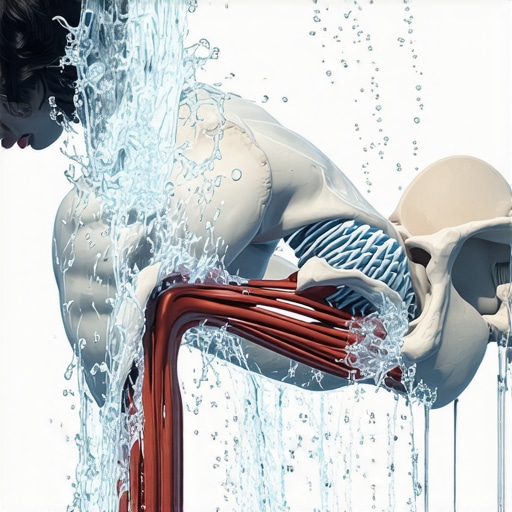
The fastest way to signal safety to your nervous system is through your breath. When you exhale fully—I mean really empty your lungs—your ribs drop and your pelvis naturally tucks back into a neutral position. I remember working with a runner who swore her hamstrings were ‘made of stone.’ We spent ten minutes doing nothing but deep exhales in a 90/90 position with her feet on a wall. By the end of the session, she could touch her toes for the first time in years without a single traditional stretch. No pulling, just breathing. This is a core part of the role of chiropractic care in effective sports injury recovery because it resets the neurological baseline. When you stop fighting your own reflexive tension, the muscles have no reason to stay tight.
Wake Up Your Glutes to Shut Down the Tension
If your glutes are not doing their job, your hamstrings have to do double work. They are pulling the weight of the leg and trying to stabilize the hip. This is often why your glute bridge isnt fixing your lower back pain—you are likely using your lower back and hamstrings to lift your hips instead of your actual glutes. When I was coming back from a hip injury, I had to be incredibly disciplined about this. I used to just power through the reps, but until I learned to ‘tuck’ my pelvis and feel the glute burn without the hamstring cramp, my mobility stayed stuck. You have to convince the hamstrings they are off-duty so they can finally let go. This shift in mindset is vital because the truth about no pain no gain in sports rehab is that sometimes the most effective work feels like you aren’t doing ‘enough’ intensity-wise, yet it yields the biggest mobility gains.
The Myth of the Bone Out of Place
I used to think my spine was like a stack of Jenga blocks where one piece was slightly ‘out’ and just needed to be shoved back in. That is perhaps the biggest misconception in modern sports rehab. Your vertebrae do not just slide out like drawers in a cabinet. Instead, what we are dealing with is joint fixation—a loss of proper segmental motion. When a joint stops moving correctly, the brain loses its high-definition ‘GPS signal’ for that area, leading to muscle guarding and that nagging tightness. This is where the science behind chiropractic adjustments for back pain relief really shines. It is not about ‘putting it back’; it is about restoring the neurological input so your brain feels safe enough to let your muscles relax. I learned this the hard way after trying to ‘stretch’ a joint that was actually stuck; it is like trying to pull a knot tighter in a rope.
The Trap of Self-Cracking for Quick Relief
A huge mistake I see athletes and office workers make is the ‘self-adjustment’ trap. You know the one—twisting your torso or yanking your neck until it pops. It feels like an instant release, but it is actually a dangerous ‘oops’ factor. Most of the time, you are only popping the joints that are already moving too much (hypermobile) to compensate for the one that is truly frozen. This is exactly why you should stop cracking your own neck for relief. You are creating a cycle of instability where you get a temporary endorphin hit but never actually fix the restricted segment. I have seen patients who have self-cracked for years only to end up with chronic ligament laxity and more pain than they started with. Have you ever fallen into this trap of chasing the ‘pop’ for temporary relief? Let me know in the comments.
Why does the tightness return 48 hours after a session?
This is the question that separates the beginners from the pros. If you get adjusted and feel like a superhero, but the stiffness creeps back in by Wednesday, you are likely missing the ‘neuromuscular re-education’ phase. According to research in the Journal of Manipulative and Physiological Therapeutics, spinal manipulation has a profound neurophysiological effect, but without immediate follow-up movement, the brain eventually reverts to its old, guarded protective patterns. You have to ‘save’ the new range of motion with specific stability work. This is why we focus on revolutionize your rehab chiropractic techniques for faster recovery—it is about the marriage of the adjustment and the exercise. The adjustment opens the door, but your movement habits determine if that door stays open. Understanding the real difference between a chiropractor and a PT is crucial here because the best results happen when the two philosophies overlap. We are not just moving bones; we are reprogramming the way your nervous system interprets tension and load.
Keep the Gains You Worked So Hard For
Once you finally get out of that acute pain cycle, the biggest mistake you can make is assuming you are ‘cured’ and going back to your old habits. I have fallen into this trap more times than I care to admit. You feel great after a session, you skip your exercises for a week, and suddenly that familiar twinge returns. Building strategic chiropractic solutions for long-term back health isn’t about being in the doctor’s office every week; it is about what you do in the 167 hours between appointments. It is about integrating essential tips for managing back pain through healthy lifestyle choices into your daily flow so that your body never has a reason to go back into lockdown mode.
The Only Two Tools You Actually Need
You don’t need a thousand-dollar recovery setup. In my bag, I carry two things: a standard lacrosse ball and a slightly deflated kids’ playground ball. The lacrosse ball is my precision tool. I use it to tackle specific trigger points in the glutes and upper back, but you have to be careful not to overdo it. Knowing how to use a lacrosse ball for better thoracic mobility is a game-changer for desk workers. If the lacrosse ball feels too aggressive, I’ll switch to the correct way to use a tennis ball for muscle knots to provide a gentler stimulus. The goal isn’t to bruise the tissue; it is to give the nervous system a ‘sensory input’ that tells the muscle it is okay to relax. According to a study published in the Journal of Bodywork and Movement Therapies, self-myofascial release is most effective when combined with active movement immediately afterward, rather than just lying on the ball like a lump.
How do I keep my back from locking up again?
Maintenance is less about ‘stretching’ and more about ‘checking in.’ I swear by a 4-step morning routine for chronic lower back stiffness that takes exactly six minutes. It’s about moving every joint through its available range before you sit at a desk for eight hours. Avoid the temptation of ‘support’ gadgets that do the work for you. I often warn people about the truth about posture braces and muscle atrophy—if a brace is holding you up, your muscles are getting weaker. Long-term results come from active stability, not passive restriction. I predict that in the next five years, we are going to see a massive shift toward wearable biofeedback sensors that alert you when your pelvic tilt shifts or your core goes ‘dark’ during a lift, allowing us to correct these patterns in real-time before they ever become painful.
My advanced tip for you this week: try the ’90/90 breathing’ for just two minutes before you go to bed tonight. Lie on your back with your feet on the wall and focus on that full exhale we talked about. It is the single best way to ‘save’ your spinal alignment before you head into eight hours of sleep. Try it once tonight and see if you don’t wake up feeling 20% less stiff tomorrow morning.
Lessons from 500 Failed Toe Touches
I spent years thinking I had ‘bad genetics’ for flexibility. I didn’t. I had a nervous system that was constantly on high alert. The first ‘lightbulb moment’ was realizing that how to tell the difference between muscle soreness and a real injury is less about the pain level and more about the quality of movement. The second was accepting that my hamstrings were actually ‘long’ enough; they were just guarding against a pelvic position they didn’t trust. Finally, I realized that expert chiropractic adjustments that work aren’t just about ‘cracking’—they are about resetting the neural tone so your brain feels safe enough to stop the lockdown. If you’ve been pulling on your legs for years with no change, you aren’t broken, you’re just using the wrong map.
The No-Fluff Rehab Toolkit
You don’t need a gym full of machines to see progress. My toolkit is minimal for a reason. First, grab a lacrosse ball; it is the best way to boost your sports rehab journey with proven chiropractic strategies by providing specific sensory input to hyper-active tissue. Second, use a wall for 90/90 breathing—think of this as the ‘software update’ your hips need before they can accept a ‘hardware’ change. Third, stop guessing and start learning how the pros do it. I highly recommend investigating enhancing athletic performance with targeted chiropractic care to see why stability always beats raw flexibility in the long run. These tools are simple, but when used together, they solve the problem from the brain down to the bone.
Your Body is Waiting for Permission to Let Go
Moving without fear is a skill you have to relearn. It is not about being the most flexible person in the room; it is about having a body that trusts you to move into different positions without hitting the emergency brake. Whether you are dealing with years of desk-bound stiffness or a lingering athletic injury, the path to relief starts with one full exhale and a shift in perspective. You have all the tools you need to stop the tug-of-war and start moving with ease again. Have you ever felt like your muscles were ‘fighting back’ against your stretches? Let me know your experience in the comments below!